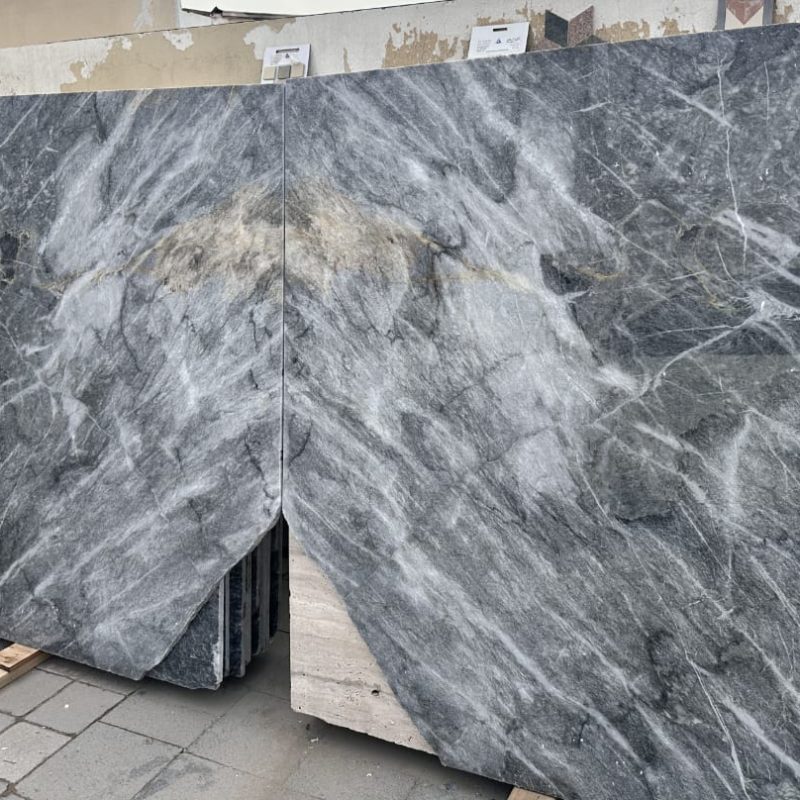
Grey ocean marble
pRICE :
AED 2,400 to AED 6,000 per m²
Grey Ocean Marble is a dark grey marble quarried and selected for high-end interiors that need durability, longevity, beauty, and elegance—especially when you want a bold grey base with soft movement/veining. Material Type: Natural stone (Marble). Origin: This name is used in the market for similar-looking grey marbles, and the quarry source can differ by batch; you’ll commonly see “Ocean Gray Marble” listed as quarried in Mexico and “Ocean Grey Marble” listed with Turkey references, so the exact origin should be confirmed on the specific slab lot you choose. Priamry Color(s): Dark grey/charcoal with lighter veins, and some suppliers describe grey with blue undertones. Additional Names: Depending on the supplier catalog, it may appear under names such as Oceanic Grey Marble / Gray Ocean Marble, and sometimes as Ocean Grey Breccia, Grey Emperador, or related trade-name variants. Finished Surface: Most commonly supplied in polished or honed, with other textured options sometimes available by request. Average slab size: Availability varies because every block yields differently, but many catalogs show slabs around 2400×1200 mm and up, and you’ll also see ranges like 80”×40” up to 120”×70” depending on stock. Price: Quote-based in the UAE—final cost depends on grade/vein movement, thickness, finish, slab yield, fabrication (cutting/edges), and delivery location.
Recommended Usage: Grey Ocean Marble is widely used for interior wall and floor applications, statement cladding, hotel/reception areas, bathrooms, stairs, and decorative features; it can also be used in kitchens (countertops/backsplashes) when properly sealed and cared for, because marble is a premium natural stone that rewards good maintenance with long-term visual impact. In UAE projects, designers choose it because the dark grey tone stays modern while the natural veining keeps it warm and upscale—so you get a surface that looks refined today and still feels timeless years later. At Arifeen Marble, we supply Grey Ocean Marble across all states/emirates of the UAE (Dubai, Abu Dhabi, Sharjah, Ajman, Ras Al Khaimah, Fujairah, Umm Al Quwain), and we help you match slabs for a consistent look (especially important for large floors and feature walls) while guiding you toward the right Finished Surface: polished for maximum shine and depth, or honed for a softer, contemporary, low-glare finish.
What is Grey Ocean Marble?
Grey Ocean Marble (often listed interchangeably as Ocean Gray Marble / Ocean Grey Marble / Grey Ocean Marble) is a natural marble known for a dark grey to charcoal base with flowing lighter veining that creates an “ocean-like” movement across the surface. Because it’s a natural stone, no two slabs look exactly the same—some lots read more uniform and calm, while others show bolder swirls and contrast, which is why it’s usually selected slab-by-slab for premium interiors.
The name is also used across multiple supplier catalogs, so origin can vary depending on the exact lot: many references describe Ocean Gray as quarried in Mexico, while other catalogs list Ocean Grey as quarried in Turkey. For UAE projects, the most reliable way to lock the origin is to verify the shipment details for the exact slabs you approve for your job. In terms of availability and processing, Grey Ocean Marble is commonly offered in polished and honed finishes, and it can be supplied as full slabs or cut-to-size pieces for floors, walls, stairs, and countertop fabrication. Typical slab supply in the market often falls within “big slab” ranges such as roughly 1600–2800 mm length and 1200–2400 mm width, with common thickness bands like 18–30 mm depending on the selection and intended use.
Why Grey Ocean Marble is trending in UAE interiors
Grey Ocean Marble is trending in UAE interiors because it fits the region’s current preference for high-impact, luxury surfaces—especially statement walls and large, continuous stone features that look seamless and architectural. In Dubai and Abu Dhabi projects, designers increasingly use large slabs with natural veining (including book-matched layouts) to create bold focal points in living rooms, entrances, reception areas, and offices—exactly the type of application where Grey Ocean’s movement and depth shine.
Another reason is the broader shift toward dramatic dark stone as a “rich contrast” material: darker marbles are being used for feature walls, flooring zones, and countertop statements to bring a sophisticated, hotel-like feel into residential and commercial spaces. Grey Ocean Marble specifically works well with popular UAE palettes—white or cream walls, warm wood, brushed metal accents, and layered lighting—because the dark grey base delivers a modern look without feeling flat, while the veining adds natural character that stays timeless over the long term. This balance of modern minimalism and natural luxury is exactly why homeowners, designers, and contractors keep specifying grey marbles in high-visibility areas where first impressions matter most.
Arifeen Marble supply coverage across UAE (all emirates)
Arifeen Marble provides Grey Ocean Marble supply and delivery across the entire UAE, supporting both residential (villas, apartments) and commercial projects (offices, retail, hotels, lobbies, restaurants). We handle orders as full slabs, cut-to-size tiles, and fabrication-ready pieces (for flooring, wall cladding, stairs, vanity tops, and countertops), with delivery arranged to your site location, warehouse, or contractor workshop—depending on what’s best for your installation timeline.
Our UAE-wide coverage includes all seven emirates, with deliveries commonly arranged to major neighborhoods and development zones such as:
Dubai: Downtown Dubai, Business Bay, Dubai Marina, Jumeirah (Jumeirah 1/2/3), Palm Jumeirah, Jumeirah Village Circle (JVC), Jumeirah Lake Towers (JLT), Al Barsha, Al Quoz (many fit-out workshops), Deira, Dubai Silicon Oasis
Abu Dhabi: Al Reem Island, Saadiyat Island, Yas Island, Khalifa City, Al Raha Beach, Al Mushrif, Al Maryah Island
Sharjah: Al Majaz, Al Khan, Al Nahda, Al Taawun, Muwaileh
Ajman: Al Nuaimiya, Al Rashidiya, Al Zahra, Ajman Industrial Area
Ras Al Khaimah: Al Hamra Village, Mina Al Arab, Al Nakheel, RAK Industrial Area
Fujairah: Al Faseel, Madhab, Fujairah City Center areas
Umm Al Quwain: Al Salamah, Al Raas, UAQ Industrial Area
To keep the process smooth for UAE projects, we support practical on-ground needs too—like secure packaging, careful handling for polished surfaces, coordination with building security/loading schedules, and delivery planning for high-rise locations where service lifts, cranes, or offloading timing can matter. If your project needs a consistent look across large areas, we also help you select matching slabs (tone and veining) so Grey Ocean Marble reads uniform and premium from one space to the next.
Grey Ocean Marble Overview
Color, pattern, and visual characteristics
Grey Ocean Marble is best described as a deep grey to charcoal marble with soft-to-dramatic movement running across the slab. The look typically sits between “calm modern grey” and “expressive natural stone,” depending on how bold the veining is in the specific lot you select. In UAE interiors, this tone works especially well because it reads luxury and modern under warm lighting, and it pairs easily with popular materials like wood, brass, black hardware, and light neutral paint.
What you’ll usually see visually:
Base tone: dark grey / graphite / charcoal (some slabs lean cooler, some warmer)
Veining: lighter grey to white linear waves or cloud-like sweeps (often “ocean” movement)
Depth: polished finish gives a richer, more reflective look; honed gives a softer, contemporary feel
Mood: premium, bold, architectural—great for feature walls and large surfaces
Where the look shines most (visual impact):
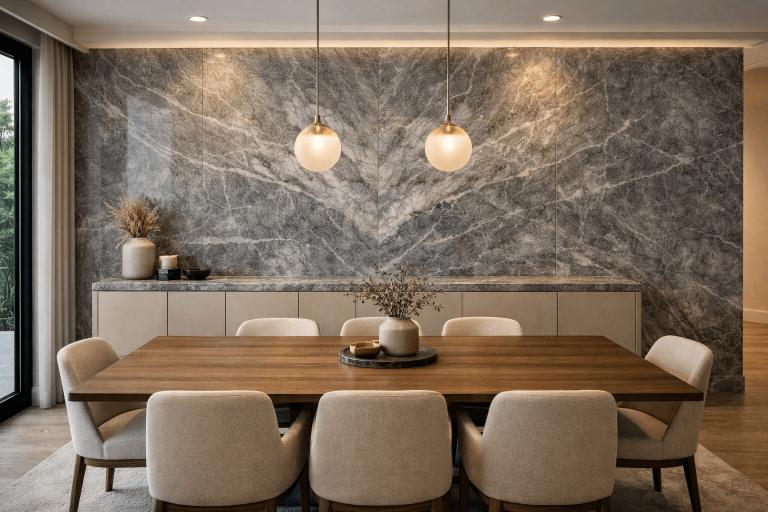
Large wall cladding / TV walls / lobby walls where the veining can “flow”
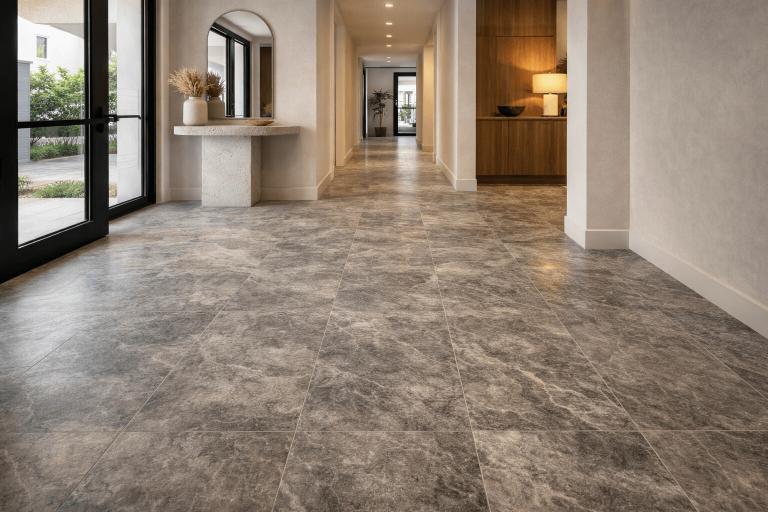
Flooring in open areas when you want a high-end hotel vibe
Stairs and vanity areas for a strong, clean grey statement
Tip for a premium result: if you’re doing a feature wall, choose slabs with a consistent vein direction and plan the layout (vein-matching or bookmatching) before cutting.
Natural variation and uniqueness: what to expect
Because Grey Ocean Marble is natural stone, variation is part of its value—and also something you should plan for. Even within the same “Grey Ocean” label, the veining intensity, background shade, and contrast can change from one batch to another. That’s why serious projects in the UAE typically finalize by slab selection (viewing slab photos or approving in person) rather than relying only on a small sample.
Normal (expected) variation you may see:
Some slabs appear more uniform (clean charcoal with light lines)
Others have stronger movement (bolder waves, higher contrast)
Occasional natural features like hairline fissures (often filled during finishing) that do not necessarily affect performance when handled and installed correctly
How to control the final look (recommended approach):
Approve slab photos in the same lighting style as your space (warm vs cool lights change how grey reads).
If the area is large, request slab-to-slab matching so the tone stays consistent.
For feature walls, plan a layout drawing (vein direction + joint positions) before fabrication.
Decide finish with intent:
Polished: maximum elegance, depth, and “luxury shine”
Honed: softer, modern, lower glare (often preferred for contemporary interiors)
Buyer checklist before cutting (quick and practical):
Confirm how “busy” you want the veining to be (calm vs dramatic)
Confirm thickness and finish consistency across all slabs
Confirm if any slabs are resin-backed (common for stability in some marbles)
Confirm final usage area (bathroom, floor, wall, kitchen) so sealing and care expectations match the space
Grey Ocean Marble vs similar grey marbles (quick comparison)
Below is a quick, practical comparison against popular grey stones often considered in UAE projects. This is meant to help you choose by look + feel + use-case, because “grey marble” can vary widely in movement, maintenance feel, and overall vibe.
| Stone Option | Overall Look | Veining / Pattern | Best Use-Case | Style Vibe | Price Position (Typical) |
|---|---|---|---|---|---|
| Grey Ocean Marble | Dark grey/charcoal | Ocean-like flowing movement | Feature walls, flooring, stairs, vanities | Modern luxury, statement | Mid to premium (varies by grade) |
| Bardiglio (Grey Marble family) | Medium to dark grey | Cloudy / linear veins (often softer) | Floors, bathrooms, classic interiors | Elegant, timeless | Mid to premium |
| Grigio Carnico | Dark, dramatic grey | Strong white veining, higher contrast | Feature walls, bold floors, luxury accents | High-drama luxury | Premium |
| Tundra Grey | Light to medium grey | More “fossil / breccia” look (busy texture) | Flooring, bathrooms, large areas needing warmth | Warm contemporary | Mid-range |
| Grey Emperador | Brownish-grey to deep grey | Spiderweb / fractured veining | Floors, walls, classic-luxe spaces | Rich, traditional | Mid to premium |
| Pietra Grey (commonly used as grey “marble” option) | Deep uniform grey | Minimal veining (clean lines) | Minimalist floors, bathrooms, countertops | Sleek, minimal | Mid to premium |
How to choose fast (rule of thumb):
Want movement and a statement → Grey Ocean or Grigio Carnico
Want minimal, clean, modern → Pietra Grey
Want warmer grey with texture → Tundra Grey
Want classic richness → Grey Emperador
Key Features and Benefits
Premium aesthetics for modern and classic spaces
Grey Ocean Marble is chosen first for its high-end visual impact: a deep grey/charcoal base with natural movement that instantly makes a space feel more “designed,” more architectural, and more premium. It works beautifully in both contemporary and classic interiors because grey is neutral, but the veining keeps it from looking flat or industrial.
What makes it look premium (and why designers like it):
Depth and richness: Dark grey tones create an expensive, grounded look—especially in large slab applications.
Natural “movement”: The flowing pattern brings softness and character, so the stone looks alive rather than uniform.
Finish flexibility:
Polished: glossy, reflective, dramatic (best for luxury lobbies, feature walls, formal spaces)
Honed: matte, smooth, modern (best for contemporary homes and low-glare interiors)
Pairs especially well with popular UAE interior combinations:
Warm wood (walnut/oak tones) + soft lighting
White/cream walls + black accents (frames, handles, trims)
Metallic accents (brass, champagne gold, brushed steel)
Where the aesthetic benefit is strongest:
Feature walls (TV wall, lobby wall, reception wall)
Flooring in open-plan living areas
Stairs and landings
Vanity walls and bathroom focal zones
Durability and longevity
Grey Ocean Marble is a natural stone surface built for long-term use when it’s specified correctly and maintained properly. In real-world UAE projects, marble performs best when you match the finish and application to the space (for example, honed finishes in high-traffic areas and careful sealing in wet zones).
Durability highlights (what you can expect in normal use):
Strong, stable stone for interiors: Suitable for floors, walls, stairs, and bathrooms when installed on a proper substrate.
Long service life: Marble is commonly used in heritage buildings and premium hospitality projects because it can last for decades with proper care.
Refinishable surface: Unlike many manufactured surfaces, marble can often be re-polished or re-honed over time if it dulls or shows wear—useful for hotels, lobbies, and high-use homes.
Important realism (so you get the best long-term result):
Marble can etch from acidic liquids (lemon, vinegar, harsh cleaners), especially in kitchens and dining areas.
It can scratch under abrasive grit (sand/dust tracked in), which is why good entrance mats and routine cleaning matter.
A quality sealer helps with stain resistance, but it doesn’t make marble “maintenance-free.”
Longevity best practices (simple and effective):
Seal appropriately for the area (kitchens/bathrooms typically need more attention than walls)
Use pH-neutral cleaners
Avoid acidic/bleach-based cleaners
Use felt pads and protect high-contact corners/edges
Heat resistance (suitability for UAE conditions)
Marble is generally comfortable in warm climates and is commonly used across the region, but “heat resistance” should be understood the right way depending on where the stone is installed.
How Grey Ocean Marble behaves with heat (practical view):
Indoor UAE environments: In air-conditioned interiors, marble performs reliably as flooring and wall cladding. It stays dimensionally stable in typical indoor temperature ranges.
Kitchen countertops: Marble can handle normal kitchen warmth, but direct high heat (like placing a hot pan straight from the stove) can risk thermal shock, discoloration, or finish damage—so trivets are recommended.
Outdoor/exterior use: If you plan exterior cladding or outdoor flooring, heat plus sun exposure and weathering can change how marble ages over time. For exteriors, the best solution is confirming the stone’s suitability for the exact location and selecting the right finish (textured finishes often make more sense outdoors).
UAE-friendly specification tips:
Prefer honed or textured finishes for areas with higher foot traffic (more forgiving day-to-day)
Plan movement/expansion joints during installation (especially in large-format flooring)
Use correct adhesives and installation methods suitable for local site conditions
Value addition for residential and commercial projects
Grey Ocean Marble doesn’t just “finish” a space—it upgrades the perceived quality of the property or business. That’s why it’s frequently specified in premium villas, penthouses, and commercial spaces where first impressions are everything.
Residential value benefits:
Luxury perception: Dark grey marble reads upscale and timeless.
Stronger resale appeal: Premium stone finishes often help a home stand out in photos and in-person viewings.
Design longevity: Grey remains a safe, modern neutral—so it tends to age better than trendy colors.
Commercial value benefits:
Brand impact: A marble reception wall or lobby floor signals quality immediately.
High-end customer experience: Ideal for hotels, clinics, salons, offices, and retail where ambience matters.
Maintainable over time: With proper maintenance, surfaces can be refreshed (re-honed/re-polished), helping spaces keep their premium look longer.
Quick “best-fit” guide
Choose Grey Ocean Marble if you want: premium aesthetics + long lifespan + architectural presence
Consider alternatives if you want: ultra-low maintenance (engineered stone/porcelain may be better for heavy-use kitchen counters)
Available Finishes
Polished finish (look, pros, best use-cases)
A polished finish on Grey Ocean Marble delivers the most “luxury marble” appearance—high shine, stronger color depth, and a mirror-like reflection that makes the veining look more dramatic. In UAE interiors, polished Grey Ocean is often chosen for spaces where you want a premium, hotel-style feel and where lighting (spotlights, chandeliers, cove lighting) can bounce beautifully off the surface.
Look
High-gloss, reflective surface
Dark grey appears deeper and richer
Veins look sharper and more defined
Makes spaces feel brighter because it reflects light
Pros
Maximum elegance: Gives the strongest luxury effect and highlights the natural beauty of the stone.
Easy everyday wipe-down: Smooth surface makes dust and light surface dirt easier to clean.
Great for visual impact: Ideal when the stone is meant to be a focal element.
Best use-cases in UAE
Feature walls (TV walls, reception walls, lobby walls)
Low-to-medium traffic flooring (formal living rooms, hallways with controlled use)
Luxury bathrooms (vanity walls, vanity tops, dry-zone walls)
Commercial interiors where aesthetics matter (hotel lobbies, office reception areas, high-end retail)
Considerations
Polished marble can show water spots and smudges more easily (especially in bathrooms).
It can feel more slippery if used on floors in wet areas; for showers or wet floors, honed is usually preferred.
Like all marble, it can etch from acids—so in kitchen tops, it needs careful daily habits.
Honed finish (look, pros, best use-cases)
A honed finish is smooth but matte (low sheen). It gives Grey Ocean Marble a more modern, architectural look—less glare, more softness, and a calm “designer” feel. In UAE homes and commercial projects, honed Grey Ocean is popular because it looks premium while being more forgiving for daily living, especially in spaces with heavy foot traffic or bright lighting.
Look
Matte to low-sheen surface
Softer, more contemporary appearance
Veins look slightly more subtle than polished
Reduces reflections from downlights and large windows
Pros
More forgiving day-to-day: Minor scratches, smudges, and etch marks tend to be less noticeable than on high-gloss surfaces.
Better traction: A safer choice for floors, and especially for bathrooms compared to polished.
Modern aesthetic: Ideal for minimal, contemporary interiors where you want stone richness without shine.
Best use-cases in UAE
High-traffic flooring (family living areas, corridors, commercial walkways)
Bathrooms (floors, shower walls, vanity areas—especially if you prefer low glare)
Stairs (steps and landings for a balanced mix of elegance and practicality)
Kitchen countertops (often chosen by homeowners who prefer a quieter look and want a surface that hides daily marks better)
Considerations
Honed marble may appear slightly lighter than polished because it reflects less light.
It can absorb stains more readily than polished if not sealed properly—so sealing matters, especially in kitchens and bathrooms.
Regular cleaning should still be gentle and pH-neutral to protect the stone.
Leather / brushed finish (look, pros, best use-cases)
A leather (sometimes called brushed or “antiqued”) finish gives Grey Ocean Marble a textured, touchable surface that sits between honed and heavily textured stone. Instead of a shine, you get a soft, natural feel with gentle highs and lows that bring out the stone’s character in a more subtle, premium way. This finish is popular when you want Grey Ocean Marble to feel warm, modern, and sophisticated—without glare.
Look
Low sheen with a soft texture
Veins feel more natural and layered
Dark grey often appears richer and “stone-like” rather than glossy
Hides fingerprints and everyday marks better than polished
Pros
Better grip and practicality: More slip-resistant than polished, making it a smart option for floors and stairs.
Hides daily wear: Minor scratches, smudges, and water spotting tend to be less noticeable.
Premium “designer” feel: Looks high-end and contemporary, especially under warm lighting.
Great for feature surfaces: The texture adds depth without needing heavy veining.
Best use-cases in UAE
Stairs and landings (elegant + safer underfoot)
Flooring in busy homes (family areas, corridors) and select commercial interiors
Feature walls where you want a luxury look but not a mirror finish
Kitchen islands / countertop statement pieces when the goal is a softer, more forgiving surface
Considerations
The texture can hold dust or residue a bit more than polished; regular gentle cleaning keeps it looking sharp.
Sealing still matters—especially in kitchens and wet areas—because marble is naturally porous.
Matte / satin finish (when to choose)
“Matte” and “satin” are often used to describe the same family of finishes as honed—smooth with little to no reflection—though “satin” may imply a slightly softer glow compared to a very flat matte. For Grey Ocean Marble, this choice is ideal when you want the stone to feel modern, calm, and architectural, and you want to reduce reflections from bright UAE interiors (spotlights, large windows, glass partitions, and glossy décor).
Choose matte/satin when:
You prefer a subtle, modern look over high shine
The area has strong lighting and you want less glare
The space is used daily and you want a surface that’s more forgiving
You’re designing a minimalist interior (clean lines, neutral palette, less visual noise)
Where it works best:
Floors in living areas, corridors, bedrooms
Bathrooms (walls and floors) where glare can feel harsh
Large wall cladding where a glossy reflection might distract from the overall design
Commercial spaces aiming for a sophisticated “quiet luxury” aesthetic
Important note
Matte/satin surfaces can show oil or dark moisture patches temporarily if the stone isn’t sealed well (especially around sinks and vanities). A proper sealer and correct cleaning routine make the finish perform beautifully.
Finish selection guide (based on area and traffic)
Use this guide to select the right finish for Grey Ocean Marble based on where it will be installed and how heavily it will be used. This approach helps you get the best balance of beauty + practicality in UAE homes and commercial projects.
| Area / Application | Recommended Finish | Traffic Level | Why it’s the best fit |
|---|---|---|---|
| Feature wall (TV wall, reception wall, lobby wall) | Polished or Honed/Matte | Low | Polished gives maximum drama; honed keeps it modern and glare-free. |
| Living room flooring (residential) | Honed/Matte or Leather/Brushed | Medium | More forgiving than polished; hides daily wear and reduces slipperiness. |
| Corridors & high-traffic flooring | Honed/Matte or Leather/Brushed | High | Better traction and easier long-term appearance maintenance. |
| Bathroom walls | Polished or Honed/Matte | Low–Medium | Polished looks luxurious; honed reduces water-spot visibility and glare. |
| Bathroom floors (outside shower) | Honed/Matte or Leather/Brushed | Medium | Safer underfoot; less slippery than polished. |
| Shower floors | Not ideal in large polished marble pieces; prefer textured options | High (wet use) | Wet traction matters most; smaller formats/textures are safer. |
| Stairs / Steps | Leather/Brushed or Honed/Matte | High | Better grip and a premium, practical finish for daily use. |
| Kitchen countertops | Honed/Matte or Leather/Brushed | High | More forgiving for etching/smudges; still luxurious when sealed and maintained. |
| Office reception / retail interiors | Polished (statement) or Honed (practical) | Medium | Choose polished for wow-factor; honed for daily commercial wear. |
Quick decision rules (easy to remember):
Want the most luxury shine → Polished
Want the most practical everyday look → Honed/Matte
Want texture + premium feel + better grip → Leather/Brushed
Sizes, Thickness & Custom Cutting
Standard slab sizes
Grey Ocean Marble is typically supplied in slabs, and slab dimensions can vary depending on the block yield, the quarry lot, and the supplier’s current stock. In the UAE market, you’ll most commonly see Grey Ocean Marble available in these practical slab ranges:
Common slab size ranges (typical in stone trade):
Length: ~ 2400 mm to 3200+ mm
Width: ~ 1200 mm to 2000+ mm
What this means for your project
For feature walls and large open floors, larger slabs help reduce joints and elevate the luxury look.
For kitchens and vanities, slab width matters because it impacts whether you can get long, seamless countertop runs (and whether a waterfall side can be cut from the same slab for vein flow).
Best practice for a premium outcome
Approve slabs by photos/video under neutral lighting (or in-person selection if possible), then plan cutting so the most attractive sections land in the most visible areas (island front, vanity face, feature-wall center).
Tile sizes (common options)
If your project needs easier handling, faster installation, or budget-friendly coverage, Grey Ocean Marble can be processed into tiles and cut-to-size panels.
Common tile sizes used in UAE interiors:
300 × 300 mm (classic bathrooms, smaller spaces)
300 × 600 mm (walls, bathrooms, practical layouts)
600 × 600 mm (most common for residential floors)
600 × 1200 mm (modern, fewer joints, premium look)
800 × 800 mm / 900 × 900 mm (larger-format luxury feel)
1200 × 1200 mm (high-end projects, requires excellent substrate prep)
Where tiles make the most sense
Bathrooms (especially floors and wet zones)
Apartments where lift access and handling are constraints
Commercial corridors where replacement flexibility matters
Thickness options (e.g., 16mm / 18mm / 20mm / 30mm)
Thickness affects strength, feel, edge detailing, and long-term stability—especially on countertops and stair treads.
| Thickness | Best For | Why People Choose It |
|---|---|---|
| 16mm | Wall cladding, light-duty interior applications, some flooring | Lighter weight, cost-efficient, easier handling |
| 18mm | Flooring, wall cladding, general interior stonework | A common “standard” thickness for many interior jobs |
| 20mm | Countertops, vanities, stairs (depending on design) | More solid feel; better for fabrication and edge work |
| 30mm | Premium countertops, island tops, heavy-duty stair treads, luxury statement edges | Strong visual presence, best for bold edge profiles and high-end finishing |
Quick selection tips
Floors: 16–20mm is common depending on format and substrate quality.
Countertops/vanities: 20mm is widely used; 30mm looks more premium and allows stronger edge shaping.
Stairs: often 20mm or 30mm depending on tread span and design.
Custom cutting and edge profiles
Arifeen Marble can supply Grey Ocean Marble as full slabs or custom cut-to-size pieces based on your drawings, measurements, or site templates. Custom cutting is especially important for:
Kitchen countertops (sink/hob cutouts, drainer grooves if required)
Islands and waterfall sides (mitred edges, vein continuity)
Vanity tops (basin cutouts, backsplash returns)
Stair treads/risers (nosings, consistent height + safe edges)
Feature walls (panel sizing, matching vein direction)
Common custom fabrication options
Cut-to-size panels (floors/walls)
Countertop shaping + sink/hob cutouts
Drip grooves / under-mount sink reveals (where required)
Edge profiling (below)
Straight edge
Look: Clean, modern, minimal
Pros:
Most cost-effective
Sharp, contemporary lines
Best use-cases:Modern kitchens, vanity tops, wall cladding edges
Notes:Corners can be sharper—often paired with slight easing (micro-bevel) for comfort and chip resistance.
Beveled edge
Look: A small angled cut on the top edge that catches light nicely
Pros:
Adds definition without looking heavy
Helps reduce chipping at the top edge
Best use-cases:Countertops and vanities in modern/classic interiors
Notes:Great when you want a refined detail but still a clean profile.
Bullnose edge
Look: Fully rounded edge (soft and classic)
Pros:
Comfortable to touch
Safer for family homes (fewer sharp edges)
Best use-cases:Bathroom vanities, stair nosings, family kitchens
Notes:The rounded profile can slightly reduce the “sharp modern” feel, but it’s very practical.
Ogee edge
Look: Decorative “S-curve” profile (more traditional luxury)
Pros:
High-end, classic detailing
Adds a premium furniture-like finish
Best use-cases:Luxury villas, classic kitchens, formal powder rooms
Notes:Requires skilled fabrication; usually looks best on thicker stone (often 30mm) or laminated build-ups.
Mitred edge (waterfall look)
Look: Thick, seamless edge effect—often used for waterfall islands
Pros:
Creates a “solid block” appearance without using a full 60mm-thick slab
Best option for continuous vein flow down the side
Best use-cases:Kitchen islands (waterfall sides), premium vanity designs, statement counters
Notes:Fabrication quality is everything: clean joints, strong bonding, and careful vein alignment are key for a luxury finish.
Applications of Grey Ocean Marble
Grey Ocean Marble is a premium natural stone that fits beautifully into UAE homes and commercial spaces when it’s specified with the right finish, thickness, and layout. Its dark grey base and flowing movement make it ideal for high-visibility surfaces where you want a refined, architectural look. Below are the most popular and practical ways to use it, along with tips to get the best results.
Flooring
Living rooms and corridors
Grey Ocean Marble flooring creates an instantly upscale mood—especially in open-plan living areas where large surfaces allow the pattern to flow naturally. In villas and apartments, it’s commonly used for living rooms, majlis areas, corridors, and entrance zones where you want a luxury finish that still feels timeless.
Why it works
Dark grey floors look rich and modern, and they pair easily with neutral walls and warm décor.
The natural movement makes the floor feel “designed,” not flat.
With good installation, marble floors can look premium for years and can be refreshed later if needed.
Best finish choices
Honed / matte: Best for daily living—less glare, more forgiving for minor wear.
Leather / brushed: Great for a textured, practical luxury feel (and often better traction).
Polished: Best when you want maximum shine and a formal look, but it shows marks more easily.
Practical UAE notes (for long-term performance)
In dusty environments, fine sand can act like an abrasive—good entrance mats and regular sweeping help protect the finish.
For a clean, high-end look, plan for fewer joints using larger formats (tiles or slabs), and align the vein direction through corridors.
Hotel lobbies and commercial floors
In commercial settings, Grey Ocean Marble is used to create that “premium first impression” the moment someone walks in—especially in hotel lobbies, office entrances, retail showrooms, and reception floors. The deep grey tone communicates quality, while the natural veining gives uniqueness that engineered materials struggle to match.
Why commercial designers select it
Strong visual impact under lobby lighting
Luxurious brand feel (ideal for hospitality and corporate spaces)
Natural stone carries a high perceived value
Recommended approach for commercial durability
Choose honed or leather/brushed finishes for higher foot traffic (they hide wear better).
Use quality installation practices: proper substrate leveling, correct adhesives, and movement joints for large areas.
Consider periodic professional maintenance (light re-honing or polishing) for long-term presentation.
Wall cladding & feature walls
Grey Ocean Marble is especially powerful on walls because walls stay cleaner than floors, and the stone’s pattern can be presented like artwork. UAE interiors often use grey marble walls to create statement zones—bold, modern, and unmistakably premium.
TV wall and statement panels
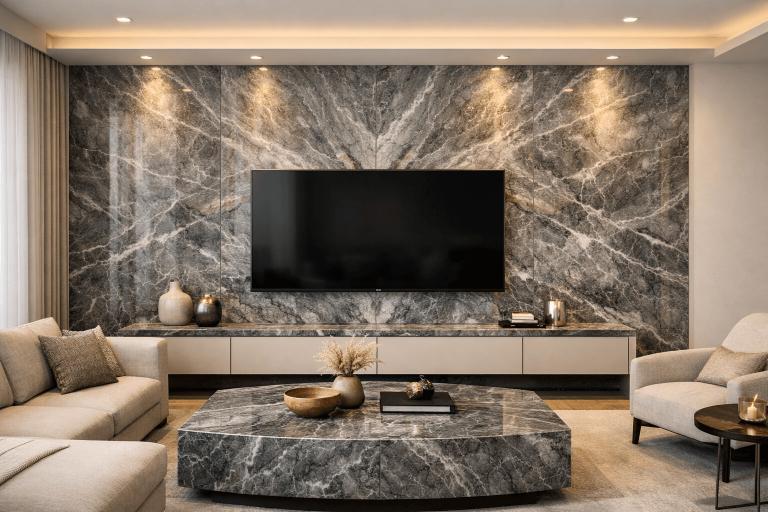
A Grey Ocean Marble TV wall is one of the most popular choices because it creates a strong focal point without needing heavy décor. When installed as large panels, the “ocean movement” becomes the design itself.
Best ways to make it look premium
Use large panels to reduce joints and make the wall feel seamless.
Plan the layout for vein flow—vertical or horizontal direction should be decided early.
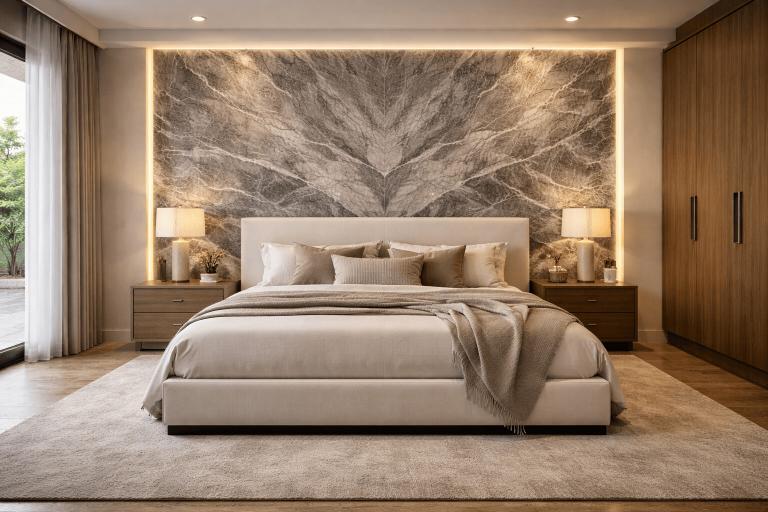
Consider bookmatching if you want a luxury symmetrical look (two slabs mirrored like butterfly wings).
Finish recommendation
Polished for maximum drama and depth (high-end look).
Honed/matte if you want a calmer, modern look with less reflection from lighting.
Lift lobby and reception walls
For commercial buildings, lift lobbies and reception walls are high-visibility areas where material selection directly affects brand perception. Grey Ocean Marble suits these spaces because it looks premium, photographs well, and immediately signals quality.
Why it’s ideal for receptions
Creates a clean, confident “luxury corporate” identity
Works well with signage, metallic logos, and indirect lighting
Holds its visual value over time because grey is timeless
Layout tip
Keep joints aligned and minimal, and choose slabs that match in tone so the wall looks intentional and continuous. For big lobby walls, selecting slabs from the same lot helps keep a consistent grey.
Kitchen countertops
Grey Ocean Marble countertops deliver a high-end look, especially in modern UAE kitchens where grey stone is used with white cabinetry, wood finishes, and warm lighting. However, marble kitchens should be chosen with the right expectations: marble is premium, but it rewards good habits.
Island tops and working counters
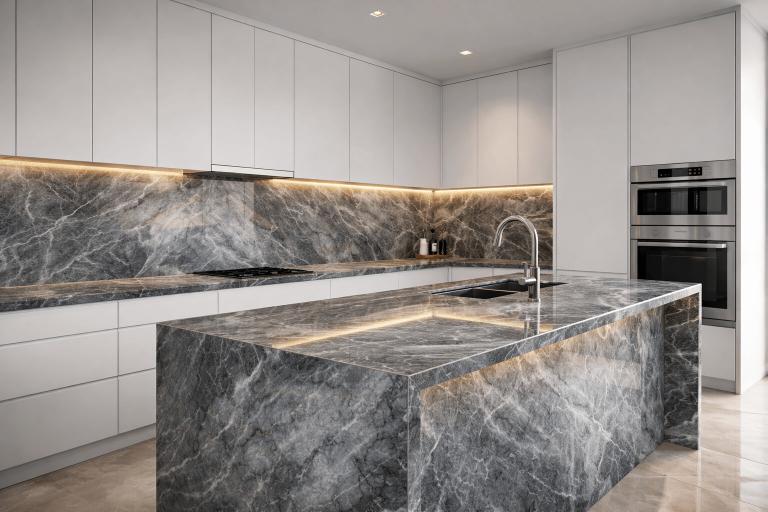
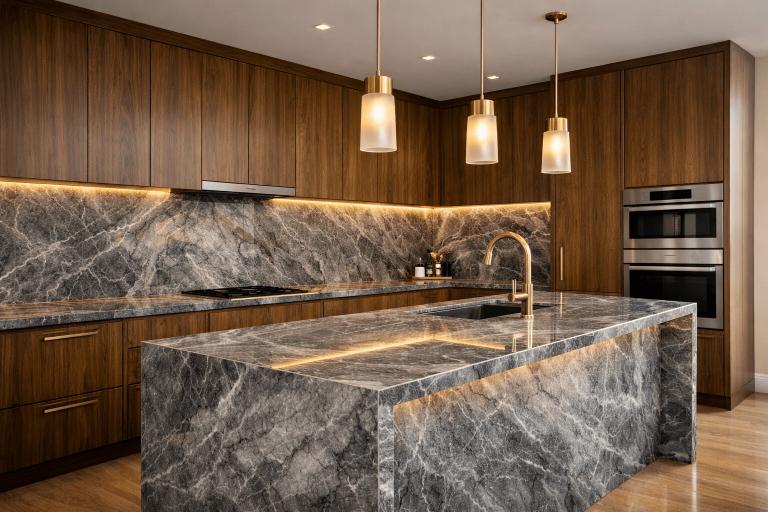
Island tops are one of the best places for Grey Ocean Marble because the island is usually the “showpiece” of the kitchen. It looks stunning as a large, uninterrupted slab—especially with a waterfall edge.
Why it’s popular
Dark grey islands look bold and luxurious
Veining creates a natural centerpiece
Excellent for waterfall designs and statement edges
Best practices for daily use
Use a quality sealer and re-seal as needed
Wipe spills quickly (especially acidic liquids like lemon, vinegar, sauces)
Use chopping boards and trivets (avoid direct pan heat)
Finish recommendation
Honed or leather/brushed for working counters: more forgiving and hides daily marks better.
Polished if the countertop is mainly decorative or if you want maximum shine—just expect a bit more visible maintenance.
Backsplashes
Grey Ocean Marble backsplashes are a smart way to get the luxury marble look with lower risk than heavy-use countertop areas. Since backsplashes don’t face cutting and direct impact as much, the stone keeps its beauty longer and is easier to maintain.
Why it’s a great application
Adds high-end detail with relatively simple maintenance
Looks exceptional behind cooktops and sinks (especially in a full-height slab backsplash)
Enhances the entire kitchen design without needing extra décor
Recommended backsplash styles
Full-height slab backsplash: minimal joints, maximum impact
Cut-to-size panels: practical and clean
Tile backsplash: more budget-friendly, but more joints to clean
Finish recommendation
Polished for a bright, luxurious look and easy wipe-down
Honed/matte if you prefer a softer, modern appearance with less glare
Bathroom use
Grey Ocean Marble is an excellent choice for bathrooms because it delivers a spa-like, high-end feel—especially when used as large panels or coordinated slab sets for vanity areas and feature walls. Bathrooms also allow you to enjoy the stone’s beauty with fewer harsh risks than kitchens, as long as sealing and cleaning are handled correctly.
Vanity tops
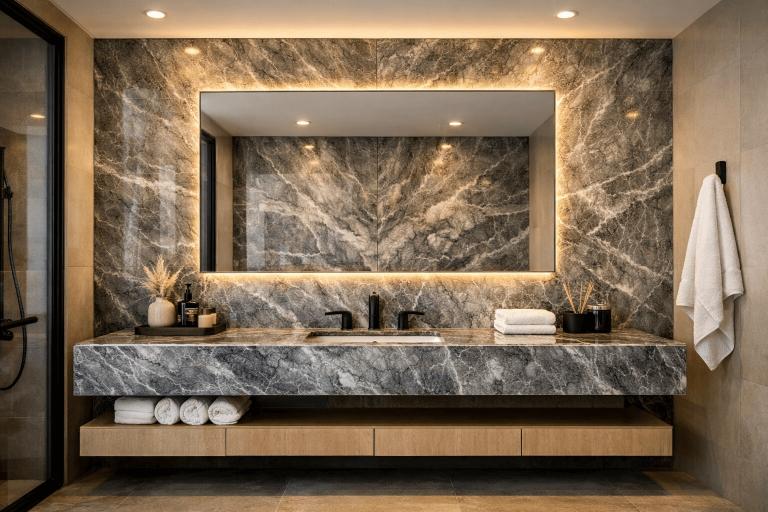
Grey Ocean Marble vanity tops instantly elevate a bathroom, giving it a luxury hotel finish—particularly when paired with warm lighting, metallic fixtures, and clean cabinetry lines.
Why it works well on vanities
Vanities are visually prominent, so the marble becomes a design centerpiece.
Daily contact is usually lighter than kitchen counters, so the stone stays cleaner.
Works beautifully with both under-mount and vessel basins.
Recommended finish
Polished: Best for a rich, high-end look and easy wipe-down.
Honed / matte: Best if you prefer a softer, modern look and want fewer visible water marks.
Practical care tips
Seal the vanity top and keep the sealer maintained, especially around the faucet and sink area.
Wipe standing water to avoid water spots on polished surfaces.
Use pH-neutral cleaner (avoid bleach, strong bathroom acids, and harsh descalers).
Design upgrade ideas
Add a matching short backsplash (or full-height stone wall) behind the vanity.
Use the same slab for vanity + wall panel to keep the veining continuous for a premium finish.
Shower walls (best finish and care)
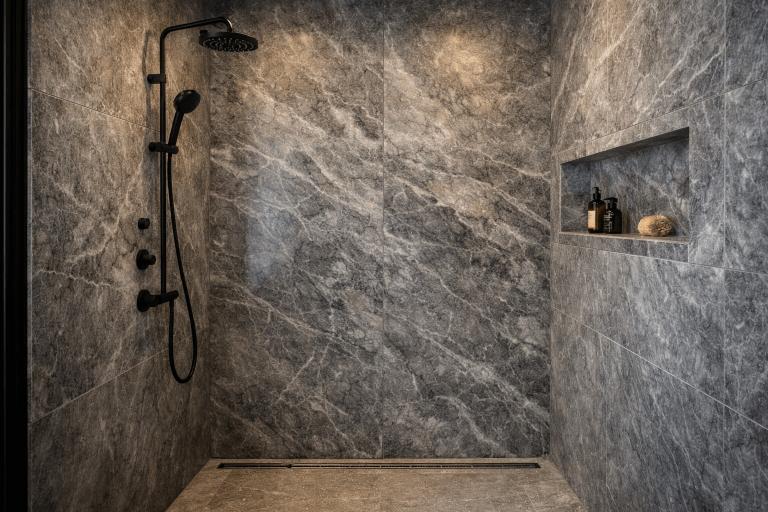
Grey Ocean Marble shower walls can look spectacular—dark, dramatic, and extremely premium—especially with niche details and hidden lighting. For showers, the focus should be on finish choice, sealing, and gentle maintenance, because this is a high-moisture environment.
Best finish for shower walls
Honed / matte: Often the best overall choice for shower walls because it reduces glare and tends to show fewer water spots than high-gloss.
Polished: Looks ultra-luxury, but it can show water marks and soap residue more clearly—so it’s best when the client is comfortable with regular wiping and maintenance.
Care essentials for shower walls
Use a quality sealer suitable for wet areas and maintain it as needed.
After showers, a quick wipe-down (squeegee or microfiber cloth) helps prevent soap film buildup.
Avoid acidic cleaners and strong descalers—these can dull marble and damage the finish.
Ensure good ventilation (exhaust fan) to reduce moisture staying on the surface for long periods.
Practical note for shower floors
For safety and traction, marble on shower floors requires extra caution. Many projects prefer smaller-format tiles or more textured solutions for better grip; Grey Ocean Marble is usually safer and more practical on shower walls than on the shower floor.
Staircases and steps
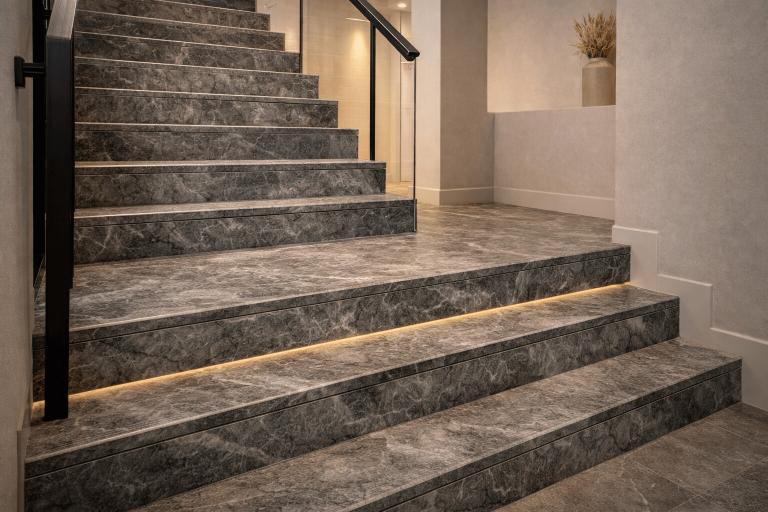
Grey Ocean Marble staircases deliver a strong architectural statement—clean, bold, and premium. In villas and duplex apartments, it’s commonly used for treads, risers, and stair landings, sometimes paired with glass railings or dark metal for a modern UAE look.
Why it’s a great stair material
Adds instant luxury and “grand” feel to an entry or central staircase.
Strong visual continuity when matched with adjacent flooring.
Can be fabricated with refined edge details for safety and comfort.
Best finish choices
Leather/brushed or honed/matte: Preferred for better grip and less visible wear.
Polished: Looks premium but can be slippery and show marks more easily—better for low-use staircases or decorative steps with careful maintenance.
Recommended fabrication details
Rounded or eased edges (like bullnose or soft bevel) for comfort and chip resistance.
Consistent tread sizing and careful alignment for a seamless luxury look.
Optional anti-slip solutions depending on the project (especially in commercial stairs).
Fireplace surrounds
Grey Ocean Marble fireplace surrounds create a sophisticated focal point that works especially well in modern villas and luxury apartments where the fireplace is a design feature. Dark grey marble frames the fire beautifully, giving a clean and expensive “gallery” feel.
Why it works
Grey Ocean Marble provides contrast and depth, making the fireplace visually stronger.
Complements modern interiors (minimal) and classic interiors (luxury) alike.
Works well with metal trims, wood mantels, and large-format panel designs.
Best finish
Polished for maximum luxury and reflection.
Honed/matte if you want a calmer, modern look.
Heat note
A fireplace surround is usually safe for stone when the design keeps the marble away from direct flame and extreme heat concentration. The right installation and heat shielding design matter—especially for built-in modern fireplace units.
Outdoor use (when it works, when to avoid)
Outdoor use of Grey Ocean Marble can be done, but it requires careful planning because exterior conditions in the UAE—sun exposure, temperature changes, dust, and weathering—can affect how natural marble ages over time.
When outdoor use can work well
Covered outdoor areas with less direct sun exposure (covered patios, shaded courtyards, protected walkways)
Vertical cladding in areas protected from constant water exposure and harsh cleaning chemicals
Decorative exterior features where the stone is not under heavy wear
When to avoid (or use alternatives)
High-traffic outdoor flooring exposed to intense sun + dust + frequent washing
Pool surrounds and constantly wet zones where slip resistance and chemical exposure are major factors
Open exterior façades where long-term weathering and maintenance demands may be high
Outdoor finish guidance
Prefer honed/matte or textured finishes outdoors for better traction and a more forgiving appearance.
Polished finishes outdoors are generally less practical due to slipperiness and visible dust/water spotting.
Outdoor care expectations
Outdoor stone requires more routine cleaning due to dust and environmental residue, and it may need periodic sealing and professional maintenance to keep it looking premium.
Bookmatching & Vein Matching Options
Grey Ocean Marble becomes truly “high-end” when the slab layout is planned with intent. Because the stone has natural movement and flowing veins, the way you arrange slabs (or cut panels) can turn an ordinary installation into a signature feature. Two of the most premium approaches are bookmatching and vein matching—both widely used in UAE luxury villas, penthouses, hotel lobbies, and reception areas.
What is bookmatching in Grey Ocean Marble?
Bookmatching is a layout technique where two adjacent stone panels are placed side-by-side as mirror images—like opening a book. This creates a symmetrical pattern that feels intentional, dramatic, and very luxurious. With Grey Ocean Marble, bookmatching can make the “ocean” movement look like a flowing wave or butterfly-shaped design, especially when the slab has strong directional veining.
How bookmatching is achieved (simple explanation)
A block is cut into consecutive slabs.
Two slabs are selected that were cut one after the other.
One slab is flipped so the veining mirrors the other slab.
Why clients choose bookmatching
Luxury visual impact: It looks custom and architectural.
Perfect for feature moments: Turns the marble into artwork.
Creates symmetry: Especially powerful in modern interior design where balance matters.
Important note
Bookmatching depends heavily on the slab’s natural pattern. Not every Grey Ocean slab will produce a clean mirror effect—so slab selection is the key step.
Vein matching for large walls and floors
Vein matching means aligning the natural lines of the marble across joints so the pattern looks continuous from one piece to the next. This can be done in more than one way, depending on the style you want:
Common vein-matching styles
Continuous match (flow match): Veins run in the same direction, continuing naturally across panels.
Slip match: Panels repeat in the same direction, creating a rhythm and clean, modern flow.
Random match: Used when the goal is a natural look without strict alignment (more relaxed, often used in flooring).
Why vein matching matters in UAE projects
Large-scale spaces (open living rooms, lobbies, reception areas) can look disjointed if the veins don’t flow.
Proper matching reduces the “patchwork” appearance and makes the installation look premium.
It helps maintain consistency under strong lighting (spotlights can highlight misalignment).
Where vein matching delivers the biggest upgrade
Large wall cladding where joints are visible
Long corridors where lines naturally guide the eye
Wide open floors where you want the stone to feel calm and continuous
Practical approach for best results
Start with slab selection (tone consistency first, then vein direction).
Plan a layout drawing before cutting (panel sizes + joint locations).
Keep joint lines straight and consistent.
Avoid placing highly dramatic vein pieces in random positions—use them intentionally as center highlights or focal areas.
Best areas for feature layouts
Bookmatching and vein-matching are not necessary everywhere—using them in the right places is what makes a project feel curated (and keeps budgets controlled). Below are the most effective areas to use feature layouts with Grey Ocean Marble:
Top choices for bookmatching (maximum wow-factor)
TV walls and statement walls in living rooms
Master bathroom feature wall behind the vanity or bathtub
Reception walls in offices, hotels, clinics, and high-end retail
Lift lobby feature panels where people pause and look
Top choices for vein matching (clean, premium continuity)
Large wall cladding in living rooms, dining rooms, and corridors
Hotel lobbies and commercial entrance halls
Open-plan flooring in villas and penthouses
Stair landings and double-height spaces where the design is visible from multiple angles
Where a simpler layout is often enough
Utility corridors, back-of-house areas, and less visible zones
Small bathrooms where a busy match might feel overwhelming
Areas with many cabinets/fixtures that break the surface visually
A good design rule
Use bookmatching for focal “hero” walls, and use vein matching for large continuous surfaces that need calm flow. This combination gives the project a luxury identity without over-designing every single surface.
Design & Styling Ideas
Grey Ocean Marble is versatile because its dark grey base can be styled in multiple directions—minimal modern, warm contemporary, or classic luxury. The key is to treat it like a “hero material” and build the palette around it with the right contrasts, metals, and lighting so the veining looks intentional and the grey reads rich (not dull).
Color combinations that work best
White cabinets + grey marble
This is one of the cleanest, most popular pairings in UAE kitchens and bathrooms because it creates a crisp contrast and keeps spaces feeling bright while still looking premium.
Why it works
White cabinetry lifts the room and balances the darker stone.
Grey Ocean becomes the visual centerpiece without overpowering the space.
Works in both glossy-modern kitchens and classic shaker-style cabinetry.
Best pairing ideas
Cabinet shades: pure white, off-white, ivory
Hardware/fixtures: chrome for a clean modern look, or brushed nickel for softness
Walls: warm white paint helps keep grey from looking too cold
Countertop styling: a waterfall island in Grey Ocean looks especially premium with white cabinets.
Design tip
Keep the backsplash either:
Full-height Grey Ocean slab for a luxury “stone wrap” look, or
A quiet light backsplash (soft white / light grey) to let the marble stay the hero.
Black accents + grey marble
Grey Ocean Marble and black accents create a confident, modern, high-contrast design—very popular in contemporary villas, penthouses, and commercial reception areas.
Why it works
Black outlines and frames the marble, making it look sharper and more architectural.
Dark grey + black reads premium when the lighting is done right.
Looks exceptional with minimal furniture and clean lines.
Best pairing ideas
Black elements: black taps, black cabinet handles, black window frames, black trims
Metals: black + brushed steel for modern; black + champagne gold for luxury
Texture balance: add wood or fabric softness so the space doesn’t feel too “hard”
Design tip
If you’re using Grey Ocean on a wall, consider thin black profiles or trims to frame panels and hide joints cleanly.
Beige/wood tones + warm lighting
This is the “warm luxury” formula—perfect for UAE interiors where homeowners want modern finishes but also want the space to feel welcoming, not cold.
Why it works
Warm beige and wood tones soften the grey and make it feel richer.
Warm lighting brings out the marble’s depth and movement.
This combination looks expensive even with simple furniture.
Best pairing ideas
Wood tones: walnut, oak, warm teak-style laminates
Beige neutrals: sand, cream, greige, soft taupe
Metals: brushed brass, champagne gold, bronze tones
Soft furnishings: textured fabrics, warm rugs, layered curtains
Design tip
If the marble looks “too dark” on paper, don’t panic—warm lighting and wood tones usually make Grey Ocean feel balanced and luxurious in real spaces.
Suggested lighting styles to enhance the stone
Lighting is what makes Grey Ocean Marble look either “flat grey” or “deep luxury stone.” The right lighting adds dimension, highlights veining, and improves the overall mood.
Best lighting approaches
Wall washers / grazing lights:
Installed near the top or side of a feature wall to create a soft gradient that reveals texture and veining.Cove lighting:
Warm cove lighting above marble walls adds a premium hotel-like ambience.Spotlights (controlled, not too harsh):
Use a thoughtful spotlight layout to avoid glare and hot spots—especially on polished marble.Pendant lights over islands:
Great for kitchen islands; warm pendants create beautiful highlights on Grey Ocean surfaces.Backlit mirror lighting in bathrooms:
Works perfectly with Grey Ocean vanity backsplashes or feature panels, creating a clean luxury look.
Finish + lighting pairing (practical)
Polished marble: use softer, well-placed lighting to avoid strong glare.
Honed/leather finishes: more forgiving; you can use brighter lights without harsh reflections.
Recommended grout / joint color guidance (for tile applications)
When Grey Ocean Marble is installed as tiles or cut-to-size panels, grout/joint color can either make the installation look seamless and premium—or make it look busy and broken up. The best grout choice depends on whether you want a continuous slab-like effect or a more “tiled” rhythm.
Most premium look (seamless effect)
Choose a grout color close to the base grey of the marble.
This makes joints visually disappear and keeps the floor/wall calm.
Recommended grout directions
For dark grey Grey Ocean tiles: use dark grey / charcoal grout matched to the stone base.
For lighter veining emphasis: a mid-grey grout can work, but avoid very light grout unless you want the joints to stand out.
What to avoid (in most luxury installations)
Bright white grout with dark grey marble: it creates a grid effect and can make the surface look fragmented.
Very contrasting grout colors (unless it’s a deliberate design choice).
Joint width guidance (general)
Large-format tiles typically look most premium with minimal, consistent joints—but the exact joint width depends on tile calibration and substrate flatness.
For walls and feature panels, thinner joints usually look cleaner and more slab-like.
Extra practical note
In wet areas (bathrooms), grout selection should also consider stain resistance and long-term appearance. Darker grout generally hides discoloration better than very light grout.
Maintenance, Cleaning & Care
Grey Ocean Marble is a premium natural stone, and the best way to keep its durability, longevity, beauty, and elegance is simple: clean gently, seal correctly, and avoid harsh chemicals. With the right routine, it stays rich and refined for years—whether it’s on floors, walls, vanities, or kitchen surfaces.
Daily cleaning (do’s and don’ts)
Do (safe daily habits)
Use a soft microfiber cloth or mop for dust and everyday wiping.
Clean with a pH-neutral stone cleaner or mild soap diluted in water.
Wipe spills quickly—especially in kitchens and bathrooms.
For floors, sweep/vacuum regularly to remove dust/sand (important in UAE conditions).
Don’t (what causes most damage)
Don’t use acidic cleaners (anything that smells like strong lemon/vinegar or bathroom “descaler” types).
Don’t use abrasive powders, scouring pads, or rough brushes—they can dull the finish.
Don’t let water pool for long periods on polished surfaces; it can leave spots and film.
Don’t drag heavy furniture across marble floors—use felt pads and lifters.
Quick daily routine by area
Floors: sweep → damp mop (pH-neutral cleaner) → dry if needed
Vanity tops: wipe water → wipe soap residue → dry with microfiber
Kitchen tops: wipe spills immediately → mild cleaner → dry (especially around the sink)
Sealing requirements (how often and why)
Marble is naturally porous. Sealing doesn’t make it “stain-proof,” but it reduces absorption so spills stay on the surface longer and are easier to wipe before they penetrate. For Grey Ocean Marble, sealing is one of the best investments you can make—especially in kitchens, bathrooms, and high-traffic flooring.
Why sealing matters
Helps reduce staining from oils, cosmetics, soaps, and food liquids
Makes everyday cleaning easier
Improves long-term appearance (less patchiness around wet zones)
How often to seal (practical guidance)
There isn’t one perfect schedule because it depends on:
Finish type (honed/leather can absorb faster than polished)
Usage intensity (kitchens get more exposure than feature walls)
Cleaning habits (harsh products can strip sealers faster)
Typical UAE-friendly sealing rhythm
Kitchens: more frequent checks; re-seal when water stops beading
Bathrooms/vanities: moderate frequency depending on exposure
Walls/feature panels: less frequent, because they see less wear
Floors: depends on traffic; entryways and corridors need more attention than bedrooms
Simple “water test” to know when to re-seal
Place a few drops of water on the surface:
If it beads for several minutes, sealer is still working well.
If it darkens the stone quickly, it’s time to re-seal.
Stain prevention tips for kitchens and bathrooms
Grey Ocean Marble stays looking premium when you prevent stains before they happen—mostly through sealing + quick wipe habits.
Kitchen stain prevention
Wipe oil and sauce spills quickly (oils can penetrate if left too long).
Use coasters under glasses and bottles (especially near the sink).
Avoid leaving citrus, vinegar, or tomato-based items sitting on the surface.
Use chopping boards (cutting directly can scratch and also leaves marks).
Keep a trivet ready—avoid placing hot pots directly on the marble.
Bathroom stain prevention
Wipe water around taps and basins to prevent mineral deposits and soap film.
Keep perfumes, hair dyes, and cosmetics from sitting directly on the stone.
Use trays for toiletries to reduce ring marks and buildup.
Ventilate well after showers to reduce moisture film lingering on walls.
What to do if something spills
Blot first (don’t rub), then clean with pH-neutral cleaner, then dry.
For stubborn stains, use stone-safe methods; aggressive chemicals often make things worse.
Scratch and etch resistance (what it means for marble)
Two terms matter most with marble: scratches and etching—and they’re different.
Scratch resistance (physical marks)
Scratches happen from abrasive grit (sand, dust, dragging objects, rough cleaners).
Dark marbles can show fine scratches more under certain lighting, especially on polished finishes.
How to reduce scratches
Use entrance mats, especially near main doors.
Vacuum/sweep frequently.
Add felt pads under furniture.
Avoid abrasive sponges and scouring pads.
Etch resistance (chemical marks)
Etching is a dull mark caused by acids reacting with marble (lemon, vinegar, some bathroom cleaners, cola, certain detergents).
Etching is not “a stain”—it’s a change in the surface finish.
Polished marble can show etches more clearly because the shine breaks; honed/leather finishes hide them better.
Practical takeaway
If the surface is high-use (kitchens, busy vanities), many homeowners prefer honed or leather/brushed Grey Ocean because it’s more forgiving day-to-day.
If the surface is mainly visual (feature walls, reception panels), polished looks incredible and stays looking great with simple care.
What products to avoid on marble
Avoiding the wrong products is the fastest way to protect Grey Ocean Marble. Many common household cleaners are too harsh for natural stone.
Avoid these on marble
Vinegar, lemon-based cleaners, acidic detergents
Bathroom descalers, heavy-duty lime removers
Bleach, ammonia, and strong disinfectants used repeatedly on the surface
Abrasive powders and cream cleaners that “scrub”
Rough scouring pads (green pads) and wire scrubbers
Generic “multi-surface” cleaners if you’re not sure they’re stone-safe
Use these instead
pH-neutral stone cleaner
Mild soap diluted in water (for routine wipe-down)
Microfiber cloths and soft mops
If you want, I can write the next section (Quality Standards – What Arifeen Marble Delivers) and make it very buyer-focused: slab grading, thickness consistency, finish inspection, matching support, and delivery protection across all emirates.
Quality Standards (What Arifeen Marble Delivers)
When you invest in Grey Ocean Marble, the final result depends on more than just the stone name—it depends on selection, consistency, finishing quality, and how safely it reaches your site. At Arifeen Marble, our quality standards are built to protect the look you’re paying for: durability, longevity, beauty, and elegance—from slab selection to delivery across all UAE emirates.
Stone selection and grading
Grey Ocean Marble can look very different from one batch to another. Our process focuses on selecting stone that matches the project goal (calm modern vs bold dramatic) while keeping a consistent tone across the order.
What we check during selection
Overall tone consistency: keeping the background grey aligned (avoiding random light/dark jumps)
Vein style and movement: selecting slabs that match your preferred look (subtle flow or dramatic motion)
Structural integrity: checking for excessive natural fissures, weak zones, or edge vulnerabilities
Project suitability: choosing slabs/tiles appropriate for your intended application (flooring, walls, vanities, counters)
Grading approach (practical categories used in the trade)
Premium/Select: more consistent tone, cleaner look, better visual balance—ideal for feature walls and large floors
Standard/Commercial: natural variation is higher; still beautiful, but better for smaller areas, secondary spaces, or where pattern consistency is less critical
Matching support for premium projects
For high-visibility installations (TV walls, lobbies, open-plan flooring), we prioritize:
Same-lot selection when possible
Slab-to-slab visual matching
Layout-friendly slab choices for bookmatching or continuous flow patterns
Thickness consistency and calibration
Thickness is not just a number—it impacts how the stone installs, how joints align, and how premium the final finish looks. Uneven thickness can create lippage on floors, weak edges on counters, and poor alignment on wall panels.
What we deliver
Thickness selected to fit the application (commonly 16/18/20/30mm depending on use)
Consistent calibration so pieces sit evenly during installation
Edges prepared to reduce chipping risk during handling and site movement
Why this matters in real projects
Flooring: consistent thickness helps achieve a flatter, cleaner floor with smoother joints
Wall cladding: calibrated panels align better and reduce installation adjustments
Countertops: consistent thickness improves edge profile accuracy and overall finish quality
Finish consistency and inspection
The finish is what you see and touch every day. Even premium stone can look inconsistent if the finish varies from slab to slab or piece to piece. Arifeen Marble focuses on delivering a consistent final appearance—especially important for large floors, feature walls, and matched sets.
Finishes we support with quality control
Polished: uniform gloss level and clarity
Honed/matte: consistent smoothness and low sheen
Leather/brushed: even texture without patchy “high/low” zones
Our inspection focus
Uniform surface appearance: avoiding uneven shine or dull spots
Edge finishing quality: clean edges, correct profile, consistent polishing on edges
Defect checks: chips, cracks, excessive filler visibility, or surface inconsistencies
Batch consistency: ensuring the stone reads as one coordinated selection when installed
For feature layouts
If the project requires bookmatching or vein matching, we help ensure the selected slabs are suitable for that layout so the final wall or floor looks intentional, not random.
Packaging and safe delivery practices
Natural stone is heavy, fragile at edges, and expensive—so safe delivery is not optional. We protect Grey Ocean Marble to ensure it arrives in the same condition it was selected.
How we package and protect
Secure crating for slabs and cut-to-size pieces
Corner and edge protection to reduce chipping risk
Surface protection (especially for polished faces) to prevent scratches during transport
Proper labeling and handling direction to reduce site confusion
Safe delivery across all UAE emirates
We coordinate delivery logistics based on your project type:
Villa sites: planned offloading location and safe movement path
High-rise projects: coordination with loading bays, service lifts, and timing windows
Commercial sites: scheduled delivery to match contractor readiness and reduce on-site damage risk
On-site success support
We aim to deliver in a way that supports smooth installation—proper stacking guidance, correct handling instructions, and delivery planning that reduces last-minute site risks.
Grey Ocean Marble Pricing in UAE
Grey Ocean Marble pricing in the UAE is usually quote-based, because natural stone cost depends heavily on the exact slab selection, thickness, finish, fabrication complexity, and delivery requirements. Two projects can use “Grey Ocean Marble” and still have very different totals—one might use standard tiles for a bathroom floor, while another uses premium slabs with bookmatching for a double-height feature wall.
What affects the price?
Slab grade and veining
The biggest price driver is what the slabs look like and how consistent the batch is.
Premium/select grade slabs (more balanced tone, cleaner look, consistent veining) generally cost more.
Slabs with dramatic, designer-style movement can also be priced higher—especially if they’re suited for bookmatching or large feature layouts.
Consistency across multiple slabs matters: if you need the same tone and vein direction for a large floor or wall, the selection requirement is higher, and that can affect pricing.
Simple rule: the more “hero-piece” the slab looks, the higher the value.
Thickness and finish
Both thickness and finish directly impact material cost and processing.
Thickness: 30mm typically costs more than 20mm, and 20mm more than 16/18mm because it uses more stone and often targets premium applications (islands, statement counters, luxury edges).
Finish type:
Polished is common and often competitively priced due to high demand.
Honed/matte can be similar or slightly different depending on processing.
Leather/brushed may cost more due to additional finishing steps and lower availability.
What buyers should know: the same marble can have different pricing simply because the finish and thickness change the processing and yield.
Cutting, edging, and fabrication
Many clients compare only the stone price, but fabrication is where project totals can change significantly—especially for kitchens, vanities, and stairs.
Fabrication elements that affect cost
Cut-to-size processing (tiles/panels/custom shapes)
Edge profiles (straight vs ogee vs bullnose—more detailed edges cost more)
Mitred edges (waterfall look) which require precision cutting, joining, and reinforcement
Sink/hob cutouts (especially under-mount cutouts and polished inner edges)
Backsplashes and upstands (extra pieces and finishing)
Stair work (tread/riser sizing, nosing, consistent finishing)
Practical note: a simple straight-edge countertop costs less than a waterfall island with mitred edges and matched veining.
Delivery location and project scale
UAE logistics can influence price depending on where and how the stone needs to arrive.
Delivery factors
Emirate + site access (villa vs high-rise vs restricted commercial loading)
Offloading requirements (crane/hoist coordination, timing windows, long carry distances)
Packaging needs for fragile cut-to-size orders
Project scale
Larger projects can sometimes benefit from better per-unit efficiency (more consistent production runs).
However, very large projects that require strict matching across many slabs may increase selection complexity.
Price formats (per sq. ft / per sq. m / per slab)
Grey Ocean Marble is typically quoted in one of these formats depending on how you’re buying it:
Per slab: common for slab selection (feature walls, countertops, islands)
Per sq. ft: commonly used in UAE fit-out discussions and contractor pricing
Per sq. m: common for flooring and wall cladding calculations, especially in design drawings and BOQs
Which format is best?
Choose per slab when you care about slab aesthetics and matching (feature walls, islands).
Choose per sq. ft / sq. m when the job is area-based (floors, wall coverage, bathroom cladding).
To avoid confusion, a proper quote should clearly state:
Thickness
Finish
Grade/selection level
Quantity (area or slab count)
Fabrication scope (if any)
Delivery emirate and site type
How to get an accurate quote (measurements checklist)
The fastest way to get a correct Grey Ocean Marble quote is to share measurements and usage details clearly. Below is a practical checklist used for UAE projects.
1) Application type
Flooring / wall cladding / vanity top / kitchen countertop / stairs / feature wall
2) Total area
In sq. ft or sq. m (and mention if it’s net area or includes wastage)
For floors/walls: length × width of each area
3) Preferred stone format
Full slabs / large tiles / standard tiles / cut-to-size panels
4) Thickness and finish
16mm / 18mm / 20mm / 30mm
Polished / honed / leather-brushed / matte-satin
5) Layout preference (important for premium jobs)
Normal layout / vein matching / bookmatching
Desired vein direction (horizontal/vertical) for feature walls
6) Fabrication details (if countertops/vanities/stairs)
Countertop length and depth (each side)
Island size (top + waterfall sides if needed)
Sink type (top-mount / under-mount) + cutout sizes
Hob cutout size (if applicable)
Edge profile choice (straight/bevel/bullnose/ogee/mitred)
Backsplash height and length (if required)
7) Site details for delivery
Emirate + area (e.g., Business Bay, Al Reem Island, Al Majaz)
Site type (villa, high-rise, commercial)
Floor level and access (service lift/loading bay timing)
8) Timeline
Required delivery date window
Whether installation is already scheduled
If you want, I can write the next section (Supply & Delivery Across All UAE Emirates) in a more structured style with a short service workflow (selection → cutting → packaging → delivery) and a list of delivery areas in each emirate.
Supply & Delivery Across All UAE Emirates
At Arifeen Marble, we supply Grey Ocean Marble across all seven emirates of the UAE, supporting homeowners, contractors, interior designers, fit-out companies, and commercial projects. Whether you need full slabs, cut-to-size panels, or tile formats, our delivery approach is planned to protect the stone, keep slab selection consistent, and match your site schedule.
Delivery and supply availability in
Abu Dhabi
We deliver Grey Ocean Marble across Abu Dhabi for villas, apartments, and commercial developments—especially where premium stone is used for reception walls, bathrooms, and lobby floors.
Common delivery areas in Abu Dhabi:
Al Reem Island, Al Maryah Island, Saadiyat Island, Yas Island
Khalifa City, Al Raha Beach, Al Mushrif, Al Bateen
Industrial and contractor zones where workshops operate (as required by project logistics)
Dubai
Dubai is one of the highest-demand markets for Grey Ocean Marble because of the preference for statement walls, modern kitchens, and luxury flooring. We deliver to both residential and commercial sites, including high-rises with controlled loading schedules.
Common delivery areas in Dubai:
Downtown Dubai, Business Bay, Dubai Marina, JLT
Palm Jumeirah, Jumeirah, Al Barsha
JVC, Dubai Hills, Meydan zones
Al Quoz (fit-out workshops and fabrication-related areas), Deira, Dubai Silicon Oasis
Sharjah
We supply and deliver Grey Ocean Marble in Sharjah for apartments, villas, and commercial projects where dark grey stone is used to upgrade entrances, corridors, and bathrooms.
Common delivery areas in Sharjah:
Al Majaz, Al Khan, Al Nahda
Al Taawun, Muwaileh, Al Qasimia
Sharjah industrial areas (when deliveries are routed to contractor storage/workshops)
Ajman
Ajman projects often use Grey Ocean Marble for practical luxury—floors, stairs, vanity tops, and feature walls—especially in villa and mid-rise developments.
Common delivery areas in Ajman:
Al Nuaimiya, Al Rashidiya, Al Zahra
Ajman Industrial Area (workshops, contractor pickup points)
New residential zones and villa clusters (as per project location)
Ras Al Khaimah
In Ras Al Khaimah, Grey Ocean Marble is frequently selected for villas, resort-style interiors, and premium reception spaces—especially where modern grey palettes are preferred.
Common delivery areas in RAK:
Al Hamra Village, Mina Al Arab
Al Nakheel, central RAK areas
Industrial zones and site storage points for larger projects
Fujairah
Fujairah deliveries are arranged for residential projects, commercial spaces, and renovations where marble is specified for bathrooms, wall cladding, and statement flooring.
Common delivery areas in Fujairah:
Fujairah City areas, Al Faseel, Madhab
Contractor pickup points and project sites based on access requirements
Umm Al Quwain
We deliver Grey Ocean Marble for villas, small commercial projects, and development sites in Umm Al Quwain, with logistics planned according to site access and offloading space.
Common delivery areas in UAQ:
Al Salamah, Al Raas
UAQ Industrial Area (for workshop/contractor routing when needed)
Typical delivery timelines and logistics process
Delivery depends on whether the order is in-stock slabs or custom cut-to-size fabrication. Arifeen Marble follows a clear process so the stone arrives safely and matches your design intent.
Typical logistics workflow
Requirement confirmation
Application (floor/wall/counter), finish, thickness, quantity, and location.Slab/lot selection
Matching tone and veining, especially for feature walls, large floors, islands, and bookmatching.Cutting & fabrication (if required)
Panels/tiles, edge profiles, sink/hob cutouts, mitred edges for waterfall counters, staircase sizing.Quality check
Surface finish consistency, thickness check, edge inspection, defect review.Packaging & dispatch
Crating, corner protection, surface protection (especially for polished), labeling.Delivery coordination
Confirm access: villa entry, high-rise loading bay, service lift timing, offloading equipment needs.
Important practical factors that influence delivery planning
High-rise projects may require scheduled loading windows
Some sites require advance gate passes or specific delivery hours
Offloading space and floor protection may be needed for premium slabs
Site delivery vs warehouse pickup
Both options are available depending on how your project is organized.
Site delivery (best for most clients)
Delivered directly to villa, apartment tower loading bay, hotel, office, or retail site
Ideal when the installer is ready and you want fewer handling steps
Recommended for large slabs and delicate polished finishes to reduce risk
Warehouse pickup (best for some contractors/workshops)
Useful when the contractor wants to stage materials or coordinate with their fabrication workflow
Often used when deliveries are routed to fit-out workshops (for example, in industrial zones)
Can be practical for phased projects where materials are stored before installation
Which should you choose?
Choose site delivery if you want the safest, simplest route with fewer transfers.
Choose warehouse pickup if your contractor needs staging, fabrication sequencing, or controlled storage before installation.
Installation Guidance (For Best Results)
Grey Ocean Marble looks most luxurious when the installation is planned with the same care as slab selection. The right substrate, adhesive system, joint planning, and finishing steps directly impact long-term performance—especially in UAE projects where large-format floors, feature walls, and high-rise logistics are common.
Substrate preparation and leveling
A premium marble finish starts under the stone. Uneven substrates cause lippage, cracking risk, hollow spots, and misaligned joints—problems that are expensive to fix after installation.
Best-practice preparation
Ensure the substrate is structurally sound, clean, and dry (no dust, oil, loose screed, or weak plaster).
Level the surface properly—large-format marble needs a flatter base than small tiles.
For floors, confirm:
No hollow screed areas
Proper curing time for new screed
Correct slope planning in wet areas (bathrooms) before marble is installed
For walls, confirm:
Strong, stable backing suitable for stone weight
Correct alignment and plumb (especially for large panels and bookmatching layouts)
Why leveling matters more with Grey Ocean
Dark marbles can visually highlight uneven reflections and joint shadows. A flat, well-leveled surface keeps the look clean and truly premium.
Adhesives and materials recommendations (general)
Material selection should match the application (floor, wall, wet area, large panels). The goal is strong bonding, minimal staining risk, and long-term stability.
General recommendations (safe and widely used in stone work)
Use high-quality cementitious tile adhesive designed for natural stone and the intended area.
For many marbles, installers often prefer white adhesive to reduce the chance of shadowing/discoloration (important for some light stones; for dark grey it can still help keep the system clean and consistent).
In wet areas (bathrooms/shower walls), ensure the full system includes:
Proper waterproofing membrane (where required)
Compatible adhesive and grout
For large-format panels, use the correct trowel size and technique to ensure full coverage.
Installation technique that protects the stone
Aim for full adhesive coverage (no voids).
Voids can cause weak spots, hollow sound, and cracking under load—especially on floors and stairs.Back-buttering (applying adhesive to the back of the stone) is commonly used to improve bonding for large pieces.
Note: exact adhesive brand/type should be chosen by the installer based on substrate, panel size, and site conditions, but the principle is consistent: use a stone-appropriate, high-quality system and ensure full coverage.
Marble joint spacing and expansion gaps
Joints are not just “lines”—they are a safety system for movement, alignment, and long-term stability.
Joint spacing (general guidance)
Use consistent joints that suit the tile/panel size and calibration.
Large-format marble generally looks best with minimal but consistent joints, provided the substrate is flat and the stone is well-calibrated.
Avoid forcing extremely tight joints if the stone batch has slight size variation—this can cause misalignment and chipping.
Expansion gaps (critical for performance)
Plan movement/expansion gaps:
Around room perimeters (edges against walls)
At transitions (doorways, different flooring materials)
Across large continuous areas (to reduce stress build-up)
Use appropriate flexible sealants where movement is expected (instead of rigid grout).
Why it matters
Without proper expansion planning, stress can build up and lead to cracking, tenting, or edge damage—especially in larger UAE interiors with wide open-plan floors.
Post-installation sealing and finishing
After installation, the stone still needs the final “protection step” to perform well long-term. Many issues blamed on “marble quality” are actually caused by skipping or rushing this stage.
Recommended post-installation steps
Final cleaning: Remove grout haze and adhesive residue with stone-safe methods.
Drying time: Allow proper drying before sealing (important so moisture isn’t trapped).
Apply a suitable sealer: Especially important for:
Kitchen tops
Bathroom vanities
Shower walls
Floors in high-use zones
Final polishing/finishing (if required): Some projects choose a final finishing step after installation for a perfectly uniform surface look, especially on premium floors.
Ongoing protection
Re-sealing is based on usage and exposure. The best approach is to monitor performance (water-beading test) and re-seal when needed rather than following a rigid calendar.
Common installation mistakes to avoid
Avoiding these mistakes is the difference between “it looks good today” and “it still looks premium years later.”
Mistakes that affect appearance
Installing without a layout plan for feature walls (random vein direction, awkward cuts)
Poor slab matching (tone shifts across a wall/floor)
Uneven joints or misaligned grout lines
Skipping dry-lay or mock layout for large patterns
Mistakes that affect durability
Poor substrate leveling (creates lippage and stress points)
Incomplete adhesive coverage (hollow spots, cracking risk)
Using the wrong adhesive/grout for wet areas
No expansion gaps (leads to cracking or tenting)
Sealing too early (traps moisture) or not sealing at all in high-risk areas
Mistakes that affect long-term maintenance
Using harsh cleaners during “handover cleaning” (can etch or dull marble immediately)
Leaving cement/grout residue too long (hardens and becomes difficult to remove safely)
Installing polished marble on wet floors without considering slip risk
Grey Ocean Marble vs Alternatives
Choosing Grey Ocean Marble is usually a design-led decision: you’re selecting a natural stone surface for its depth, movement, and luxury feel. But for UAE projects—especially kitchens, commercial floors, and high-traffic areas—it’s smart to compare it against granite, porcelain slabs, and quartz so you pick the right material for the right space.
Grey Ocean Marble vs Granite (pros/cons)
Grey Ocean Marble and granite can both look premium, but they behave differently in daily use—especially in kitchens and heavy-traffic projects.
Grey Ocean Marble — Pros
More “luxury movement” and natural elegance: marble veining often feels more artistic and high-end.
Timeless interior appeal: ideal for feature walls, vanities, floors, and statement surfaces.
Refinishable: can often be re-honed/re-polished over time to refresh the surface.
Grey Ocean Marble — Cons
More sensitive to acids: can etch from lemon/vinegar and strong cleaners.
Needs sealing + care habits for best long-term appearance (especially in kitchens).
Can show wear more easily in heavy-use zones if polished.
Granite — Pros
Generally stronger for kitchens: better resistance to scratching and etching than marble in many cases.
Heat-tolerant in day-to-day use: typically more forgiving for hot cookware (still recommended to use trivets).
Lower maintenance feel compared to marble for busy kitchens.
Granite — Cons
Different aesthetic: granite often has a “granular” pattern rather than marble’s flowing veining.
Some granites can still stain without proper sealing, and seams can be visible depending on pattern.
If you love the dark, dramatic look but want granite performance, explore Black Cosmic Granite as a premium, bold alternative.
Grey Ocean Marble vs Porcelain slabs (pros/cons)
Porcelain slabs have become popular in modern UAE interiors because they offer a consistent look with strong performance—especially for kitchens and commercial spaces.
Grey Ocean Marble — Pros
Natural depth and authenticity: no printed pattern can fully replicate natural stone movement.
Unique slabs: each piece is one-of-a-kind, which elevates luxury projects.
Grey Ocean Marble — Cons
More maintenance-sensitive: sealing and careful cleaning habits matter.
Etching risk in kitchens and dining zones.
Porcelain Slabs — Pros
Highly practical: excellent resistance to staining, etching, and many household chemicals.
UV stable: great for bright areas and some outdoor applications.
Consistent pattern: easier for large coverage and repeatable design.
Porcelain Slabs — Cons
Less natural depth: can look flatter up close compared to real marble.
Edge detailing limits: mitred waterfall edges are possible, but the “stone body” feel differs.
Chipping risk at edges if mishandled during fabrication/installation (quality fabrication is essential).
Best UAE use-case comparison
Want maximum practicality for a busy kitchen or commercial counter → porcelain slab often wins.
Want luxury authenticity for feature walls, reception areas, and statement interiors → Grey Ocean Marble shines.
Grey Ocean Marble vs Quartz (pros/cons)
Quartz (engineered stone) is very popular for kitchens because it’s consistent and low maintenance—but it has different strengths than marble.
Grey Ocean Marble — Pros
Natural elegance: premium movement and timeless luxury.
Better for statement walls and luxury detailing where natural stone presence matters.
Grey Ocean Marble — Cons
Needs sealing and careful habits in high-use kitchens (etching risk from acids).
Quartz — Pros
Low maintenance: strong stain resistance and easy daily cleaning.
Consistent color and pattern: easier to plan and match across a large kitchen.
Great for family kitchens where practicality is priority.
Quartz — Cons
Heat sensitivity: direct hot cookware can damage or discolor some quartz surfaces—trivets are essential.
Less natural uniqueness: patterns can repeat and feel less “one-of-one” than marble.
Some designs can look artificial next to real stone.
Best UAE use-case comparison
For heavy daily cooking kitchens → quartz is often a practical choice.
For luxury interiors and feature surfaces → Grey Ocean Marble looks more premium and authentic.
When Grey Ocean Marble is the best choice
Grey Ocean Marble is the best choice when your priority is design impact and premium natural stone character, and you’re willing to maintain it correctly.
Choose Grey Ocean Marble when:
You want a statement feature wall (TV wall, reception wall, lift lobby wall).
You’re designing a high-end bathroom (vanity tops, wall cladding, spa-style finishes).
You want luxury flooring in controlled-use areas (living rooms, formal spaces, boutique commercial zones).
You want a premium island top where the marble becomes the centerpiece (especially with a mitred waterfall edge).
You value natural uniqueness more than “maintenance-free” performance.
If you want a different luxury direction (still premium):
For iconic white luxury marbles: Arabescato Marble or Bianco Carrara Marble
For warm, dramatic sophistication: Armani Bronze Marble
For bold black luxury statements: Black Marble, Nero Marquina, Belgium Black Marble, or Portoro Marble
For styling Grey Ocean in furniture form: Marble Coffee Table
And if you’re sourcing regionally, you can also explore our service coverage here: Marble Suppliers in Fujairah
FAQs
Yes—Grey Ocean Marble can be used in kitchens, especially for island tops, backsplashes, and statement counters where the goal is luxury aesthetics. The key is choosing the right finish and using proper care habits. For most UAE homes, honed/matte or leather/brushed finishes are more forgiving for daily cooking because they hide etching and smudges better than high-gloss polished surfaces. If you cook heavily every day and want a “set and forget” surface, granite, quartz, or porcelain may feel easier—but if you want authentic natural stone elegance, Grey Ocean Marble is an excellent choice when sealed and maintained properly.
Grey Ocean Marble is a natural stone, so it can stain if spills are left too long—especially oils, colored liquids, and cosmetics. However, it does not have to be “high maintenance” if you take the right steps:
Apply a quality sealer and maintain it.
Wipe spills quickly, especially oils, coffee/tea, sauces, and bathroom products.
Use pH-neutral cleaning products.
With these habits, staining risk becomes manageable and the stone stays elegant.
There isn’t one fixed schedule because sealing depends on:
Area of use (kitchen vs wall)
Finish type (honed/leather often needs more attention than polished)
How heavily the surface is used and cleaned
A practical UAE approach is to check the sealer performance regularly using a simple water-drop test:
If water beads on the surface for several minutes, protection is still strong.
If the stone darkens quickly where water sits, it’s time to re-seal.
High-use areas like kitchen tops and busy vanities usually need more frequent attention than feature walls.
For UAE bathrooms and wet areas, the best finishes are typically:
Honed/matte: excellent for wet zones because it’s low-glare, more forgiving with water spots, and generally offers better traction than polished.
Leather/brushed: also a strong option for floors and steps because it adds texture and practicality.
Polished marble looks very luxurious on bathroom walls and vanity areas, but it can show water spots and soap residue more easily—so it suits clients who are comfortable with regular wiping and gentle maintenance.
Yes. Arifeen Marble can supply Grey Ocean Marble as full slabs, cut-to-size panels, tiles, and custom-fabricated pieces based on measurements or drawings. Custom work commonly includes:
Countertop sizing with sink/hob cutouts
Waterfall island fabrication (mitred edges)
Stair treads and risers
Vanity tops and backsplashes
Edge profiles such as straight, beveled, bullnose, ogee, and mitred edges
Yes. Arifeen Marble provides Grey Ocean Marble supply and delivery across all seven emirates:
Dubai
Abu Dhabi
Sharjah
Ajman
Ras Al Khaimah
Fujairah
Umm Al Quwain
Delivery can be arranged to your site location, contractor workshop, or warehouse pickup point depending on the project workflow.
A correct quantity estimate should include both the net area and practical wastage for cutting, pattern matching, and site conditions.
For floors and walls (tiles/panels)
Measure each area: Length × Width
Add areas together to get total sq. ft / sq. m
Add wastage:
5–10% for simple layouts and standard tile work
10–15% for diagonals, patterns, many corners/cuts, or large-format tiles
More if you need strict vein matching or bookmatching for feature layouts
For countertops
Measure:
Length of each run
Depth (front-to-back)
Backsplash height (if needed)
Waterfall sides (if applicable)
Slab quantity depends on whether you want seamless runs and whether pieces must come from the same slab for vein continuity.
For feature walls
Measure total wall area, then plan panel sizes and joint lines.
If you want bookmatching or continuous vein flow, slab selection and layout planning matter more than simple area math.
Testimonial Project
We chose Arifeen Marble for Grey Ocean Marble in March 2025 for our villa living room flooring and a TV feature wall in Palm Jumeirah, and the final look is exactly the dark-grey luxury we wanted—rich movement, clean joints, and a premium finish that looks amazing under warm lighting; what I appreciated most was how they shared clear slab options, guided us on polished vs honed, and helped us select matching slabs so the wall looks continuous instead of patchy like other suppliers showed us, plus delivery was handled carefully with proper packaging and coordination with our site team; after seeing the quality and how smoothly the process went, we plan to use Arifeen Marble again this year for our master bathroom vanity top and a small staircase upgrade.
We ordered Grey Ocean Marble from Arifeen Marble in August 2025 for a residential project in Khalifa City, Abu Dhabi, using it on the entrance flooring, corridors, and vanity tops, and the stone came consistent in tone with excellent finishing which made installation easier and the end result more premium; their team stood out because they understood the site requirements, kept measurements and cutting accurate, and delivered on schedule with safe handling—something we struggled with from other suppliers due to edge chips and inconsistent thickness; we liked the service because communication was clear and the product quality matched what was approved, and we’re planning to use them next for a reception wall upgrade in another villa project on Al Reem Island.
I specified Grey Ocean Marble from Arifeen Marble in November 2025 for a Business Bay apartment renovation, using it as a statement TV wall panel and kitchen backsplash, and the slabs had the elegant dark-grey movement my client wanted without looking too busy; what made Arifeen Marble different was how they supported slab selection and matching so the veins flow naturally, and they gave practical finish guidance that helped us choose a surface that looks luxurious but remains manageable for the client’s lifestyle; delivery was smooth with careful packing, and the stone arrived exactly as approved, so we’re planning to work with them again for a new project in Dubai Marina where we want Grey Ocean Marble on a powder room feature wall.
We sourced Grey Ocean Marble from Arifeen Marble in June 2025 for a lobby upgrade in Al Majaz, Sharjah, installing it on the reception wall and selected flooring zones, and it immediately elevated the space with a high-end feel that guests notice; we liked that the finish quality was consistent and the panels aligned cleanly, and Arifeen Marble handled delivery and coordination professionally—no last-minute surprises, no damaged pieces, and clear updates, which is not common in our experience with other suppliers; the stone has maintained its elegant look with routine care, and we’re planning to use Arifeen Marble again for an upcoming corridor refresh where we want the same Grey Ocean theme for continuity.
We worked with Arifeen Marble in February 2025 for Grey Ocean Marble supply and cut-to-size processing for a villa in Ajman, using it on staircase steps, landings, and vanity tops, and the material looked premium with strong durability and a clean finish that made our installation team’s job easier; what we valued most was the accuracy in cutting, the neat edge finishing, and the safe packaging that prevented chipping during transport—these details are where many suppliers fail; the client was very happy with the elegance and consistency, and for our next project we plan to use Arifeen Marble for a waterfall island top because their mitred edge quality and slab matching support are better than what we usually see.