
Quartz Slab Size Guide
Quartz slab sizes are manufactured in a few widely used “standard” footprints so fabricators can plan layouts and seams: a common standard slab is 56 in × 120 in (142.24 cm × 304.80 cm), a popular jumbo slab is 63 in × 126 in (160.02 cm × 320.04 cm), and some brands also offer super-jumbo slabs around 78 in × 138 in (198.12 cm × 350.52 cm) to help cover large islands with fewer seams; thickness is typically offered in 2 cm (0.79 in) and 3 cm (1.18 in, often sold as “1¼ in” nominal), with some ranges also available in thinner formats such as 12 mm (1.2 cm / 0.47 in) for specific applications.

Regular Size
56 in × 120 in, thickness 0.79 in (2 cm) or 1.18 in (3 cm).
Jumbo Size
63 in × 126 in, thickness 0.79 in (2 cm) or 1.18 in (3 cm).
Super Size
78 in × 138 in, thickness 0.79 in (2 cm) or 1.18 in (3 cm).
Super Jumbo
137.80 in × 78.74 in, thickness 0.79 in (2 cm) or 1.18 in (3 cm).
Mini Slab
48 in × 96 in, thickness 0.79 in (2 cm) or 1.18 in (3 cm).
Picking the Best Quartz Slab Dimensions
When selecting the best quartz slab dimensions for your project, it is essential to consider various factors that align with your specific needs.
First, assess the project dimensions; for instance, if you are working on a kitchen countertop, standard dimensions typically range from 96 inches by 26 inches, but custom sizes may be necessary for larger islands or unique layouts.
Next, think about your desired aesthetic; larger slabs can create a seamless look with fewer seams, which is particularly appealing for modern designs, while smaller slabs may be suitable for intricate patterns or designs that require more cuts.
Budget constraints also play a crucial role; larger slabs may be more expensive, not only in material costs but also in installation, so it’s important to balance size with your financial plan.
Additionally, consider the fabricator’s expertise; some may specialize in larger installations, while others may excel in detailed work with smaller pieces, so choose a fabricator whose skills match your project’s requirements.
Lastly, specific design requirements, such as the need for cutouts for sinks or appliances, can influence the dimensions you choose; ensure that the slab size accommodates these elements without compromising the overall design. By carefully evaluating these factors, you can select the ideal quartz slab dimensions that meet both your functional and aesthetic needs.
Upsides of Going Jumbo with Quartz Slab Dimensions
Choosing the best quartz slab dimensions, particularly opting for jumbo sizes, offers several significant advantages that can enhance both aesthetic appeal and functionality in various applications.
One of the primary benefits of selecting larger slabs, often measuring 126 inches by 63 inches or more, is the reduction in seams, which creates a more seamless and visually appealing surface. This is particularly advantageous in expansive countertops or large islands, where fewer seams mean a more cohesive look and easier maintenance.
Additionally, jumbo slabs provide greater design flexibility, allowing for larger and more intricate designs without the need for multiple pieces. This can be especially beneficial in open-concept spaces where continuity is key.
Furthermore, larger slabs can lead to cost savings in the long run, as they minimize waste and reduce installation time. With fewer cuts and joints, the installation process becomes more efficient, potentially lowering labor costs.
Lastly, the durability and resilience of quartz make it an ideal choice for high-traffic areas, and larger dimensions can enhance this durability by providing a more robust surface. Overall, opting for the best quartz slab dimensions, especially jumbo sizes, can significantly elevate the quality and appearance of any space.
Typical Waste Allowance for Quartz Surfacing
When working with quartz surfacing, it is essential to account for a typical waste allowance to ensure a successful installation. Generally, a waste allowance of about 10% to 15% is recommended, depending on the complexity of the project and the layout of the surfaces being covered. For instance, if you are installing 100 square feet of quartz, you should plan for an additional 10 to 15 square feet to accommodate cuts, seams, and potential defects in the material.
This allowance is particularly crucial in projects with intricate designs or multiple cutouts for sinks and appliances, as these factors can significantly increase the amount of waste generated.
Additionally, it is advisable to consult with your fabricator to determine the specific waste factors for the quartz material being used, as different colors and patterns may have varying levels of yield. By incorporating a proper waste allowance into your project planning, you can minimize delays and ensure that you have sufficient material to complete the installation without compromising quality.
Maximum Quartz Surfacing Format Explained
Maximum Quartz Surfacing is a revolutionary material that has gained significant popularity in the realm of interior design and architecture. This engineered stone is composed of approximately 90-95% crushed natural quartz crystals, combined with resins and pigments, which results in a durable and aesthetically pleasing surface.
The manufacturing process involves mixing these components under high pressure and heat, creating a non-porous, solid surface that is resistant to stains, scratches, and heat. This makes Maximum Quartz Surfacing an ideal choice for countertops, backsplashes, and other surfaces in both residential and commercial settings.
One of the standout features of Maximum Quartz Surfacing is its versatility in design. Available in a wide range of colors and patterns, it can mimic the appearance of natural stones like granite or marble while offering superior performance. For instance, a popular choice among homeowners is the classic white quartz with subtle gray veining, which can enhance the elegance of any kitchen or bathroom.
The thickness of Maximum Quartz Surfacing typically ranges from 1 cm to 3 cm, allowing for various applications and styles. Thicker slabs can provide a more substantial look, while thinner options can be used for sleek, modern designs.
In terms of maintenance, Maximum Quartz Surfacing is relatively easy to care for. Unlike natural stones that require sealing to prevent staining, quartz surfaces are non-porous and do not harbor bacteria, making them a hygienic option for food preparation areas. Regular cleaning with mild soap and water is usually sufficient to keep the surface looking pristine.
Moreover, the durability of Maximum Quartz Surfacing is noteworthy. It can withstand high temperatures, although it is advisable to use trivets or hot pads to protect the surface from extreme heat. Additionally, its resistance to scratches and chips makes it suitable for high-traffic areas, ensuring longevity and reducing the need for frequent replacements.
In conclusion, Maximum Quartz Surfacing combines beauty, functionality, and durability, making it a preferred choice for many homeowners and designers. With its wide array of design options and low maintenance requirements, it stands out as a practical and stylish solution for various applications in modern interiors.
Best Thickness for Floors & High-Traffic Areas in Quartz Surfacing
When selecting the best thickness for floors and high-traffic areas in quartz surfacing, it is essential to consider both durability and aesthetic appeal. Quartz surfaces are engineered to withstand significant wear and tear, making them an ideal choice for areas that experience heavy foot traffic. Typically, quartz slabs come in thicknesses of 1 cm (approximately 0.39 inches), 2 cm (approximately 0.79 inches), and 3 cm (approximately 1.18 inches). For high-traffic areas, a thickness of 2 cm is often recommended, as it strikes a balance between strength and weight. This thickness provides sufficient durability to resist chipping and cracking while remaining manageable for installation. Moreover, in commercial settings such as retail spaces, restaurants, and airports, where foot traffic is consistently high, opting for a 3 cm thickness can offer added reassurance. This thicker option not only enhances the surface’s resistance to impact but also provides a more substantial feel underfoot, contributing to a sense of quality and luxury. Additionally, the 3 cm thickness allows for more versatility in design, enabling the creation of thicker edges and more intricate profiles that can elevate the overall aesthetic of the space. It is also important to consider the substrate and installation method when determining the appropriate thickness for quartz surfacing in high-traffic areas. A well-prepared substrate can support thinner materials effectively, but in scenarios where the substrate may not be as stable, opting for a thicker slab can mitigate potential issues. Furthermore, proper installation techniques, including the use of appropriate adhesives and support structures, are crucial to ensure the longevity and performance of the quartz surface. In summary, while 2 cm thickness is generally suitable for most residential and light commercial applications, 3 cm thickness is advisable for high-traffic areas where durability and aesthetic impact are paramount. By carefully considering these factors, one can ensure that the chosen quartz surfacing not only meets functional requirements but also enhances the overall design of the space.
Quartz slab dimensions for walls & decorative surfaces
Quartz slabs are widely used for feature walls and decorative surfaces because their large-format manufacturing makes it easier to achieve a clean, continuous look with fewer visible joints than traditional tile layouts.
In many markets, quartz is supplied in big “sheet-style” formats such as 3200 × 1600 mm (about 126 × 63 in) or 3000 × 1400 mm (about 118 × 55 in), and some collections extend into “jumbo” options like 3300 × 1650 mm (about 130 × 65 in).
For vertical applications, fabricators often select slimmer thicknesses such as 6–12 mm to reduce wall load while still delivering a premium, monolithic aesthetic; thicker 20 mm material may be preferred when matching adjacent countertop edges or when the design calls for a bolder architectural feel.
As a practical example, a 3200 × 1600 mm slab covers roughly 5.12 m² (around 55 ft²), which can span a large accent zone, a tall backsplash run, or a fireplace wall section with fewer seams depending on cut planning.
To keep the final surface looking seamless, installers typically align pattern direction across panels (especially important for veined looks) and position joints along natural break lines like corners, niche edges, or cabinet boundaries so the cladding reads intentional and refined.
Quartz slab dimensions for stairs
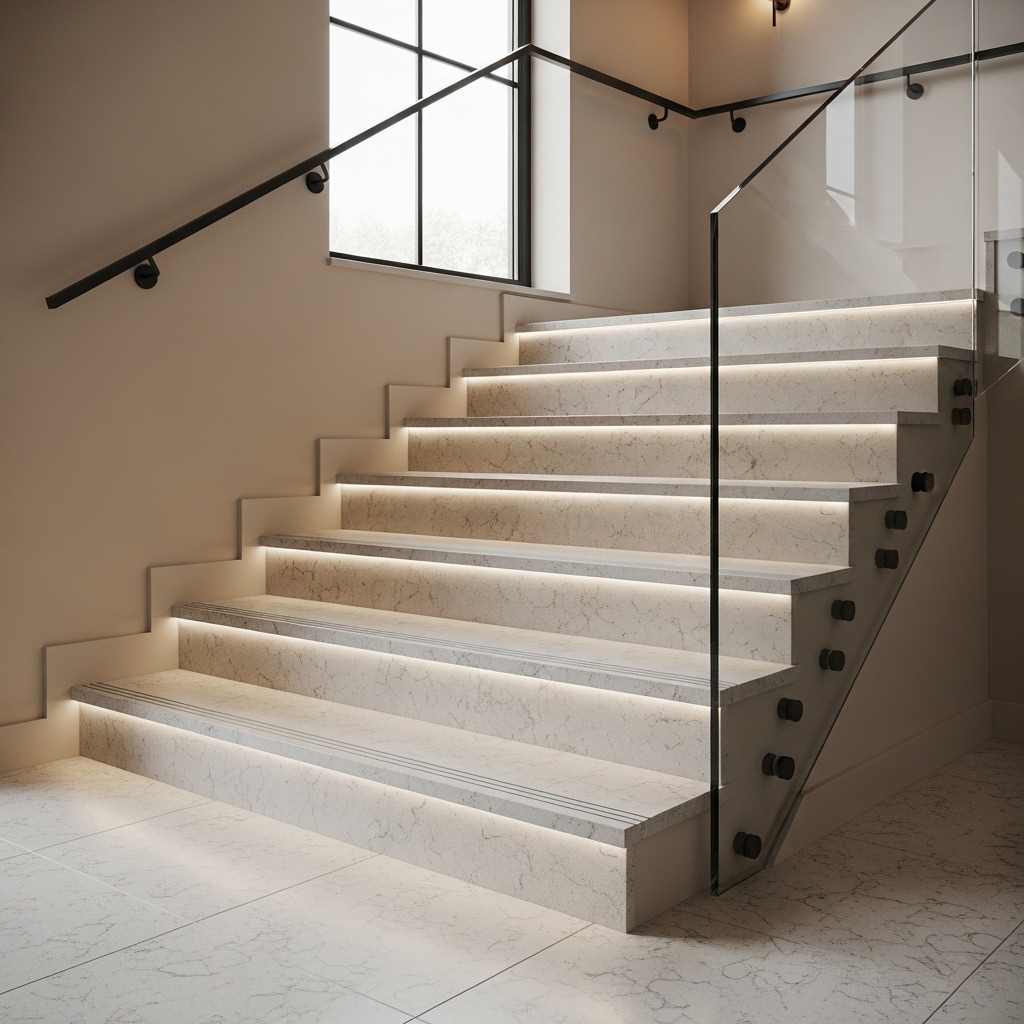
Quartz slabs are increasingly used on stair treads, risers, and feature stringers because they offer consistent color, a refined finish, and the ability to create a clean “wrapped” step look with minimal visual breaks.
Typical quartz slab formats often include large examples like 3000 × 1400 mm or 3200 × 1600 mm, which gives fabricators enough area to cut multiple treads, risers, and landing pieces from the same batch for better shade consistency.
For stair applications, thickness is usually chosen for strength and edge presence—commonly 20 mm for many residential and commercial treads, while build-ups or laminated edges can be used when a thicker visual profile is desired without using a full heavy slab.
As an example, one large slab can often yield several step components (tread pieces plus risers) while keeping the pattern direction consistent so the staircase looks intentionally designed rather than pieced together.
Because stairs are high-traffic, many projects also consider finish choice—honed or matte surfaces can reduce slip feel compared to high polish, and edge detailing (like a small chamfer or eased edge) helps reduce chipping on step noses.
In the UAE, quartz slab size most commonly comes in “standard” 3040 × 1440 mm (about 10 ft × 4.7 ft) and “jumbo” 3200 × 1600 mm (about 10.5 ft × 5.25 ft), which helps reduce seams on long kitchen runs and larger islands. Many premium lines also offer extra-large jumbo options around 3340 × 1640 mm (about 11 ft × 5.4 ft) for wide waterfall ends and single-piece islands; typical thickness stocked by fabricators is 20 mm, with 30 mm available in select colors. When you’re comparing layouts, always cross-check the quartz slab size against granite size because granite inventories in the same UAE market can differ by quarry and batch, which affects how many pieces you’ll need and where seams land.
Quartz Slab Size Guide for Kitchen Counters and Marble Threshold Applications
A quartz slab size guide for kitchen counters and marble threshold applications typically starts with standard slabs around 3040 × 1440 mm and jumbo options reaching approximately 3200 × 1600 mm, which help minimize seams on long counter runs and wide islands. These dimensions comfortably support common kitchen depths of 600–650 mm and island widths up to 1200 mm when planned correctly. During installation, offcuts from the main slab are often used to fabricate a threshold marble, ensuring visual consistency between the countertop and door transitions while maintaining a uniform thickness of 20 mm or 30 mm.
Quartz Slab Size Considerations for Raised Floor Systems
Quartz slab size considerations for modern interiors become especially important when coordinating finishes with a raised floor system. Standard quartz slabs are commonly available in sizes around 3040 × 1440 mm, while jumbo slabs can reach up to 3200 × 1600 mm, allowing wide surface coverage with minimal joints. When used alongside raised flooring, slab thicknesses of 20 mm or 30 mm are preferred to balance load distribution, access panel alignment, and long-term durability in offices, data centers, and high-end commercial spaces.