
Understanding Quartz Size: A Guide to Dimensions and Measurements
Quartz size (for quartz used in countertops, i.e., engineered quartz slabs) is most often available in standard and jumbo slab formats rather than many small sizes: a common standard slab is 56 in × 120 in (142.24 cm × 304.80 cm) and a common jumbo slab is 63 in × 126 in (160.02 cm × 320.04 cm). Some manufacturers add bigger formats such as 65 in × 130 in (165.10 cm × 330.20 cm), and a few premium lines reach super-jumbo sizes like 78 in × 138 in (198.12 cm × 350.52 cm) for very large, seam-minimizing installations. Quartz thickness is typically offered in 2 cm (0.79 in / 20 mm) and 3 cm (1.18 in / 30 mm), with occasional 12 mm (0.47 in / 1.2 cm) slabs depending on the collection.

Regular Size
56 in × 120 in (standard) or 63 in × 126 in (jumbo), thickness 0.79 in (2 cm) or 1.18 in (3 cm).
Jumbo Size
63 in × 126 in, thickness 0.79 in (2 cm) or 1.18 in (3 cm).
Super Size
78 in × 138 in, thickness 0.79 in (2 cm) or 1.18 in (3 cm).
Super Jumbo
137.80 in × 78.74 in, thickness 0.79 in (2 cm) or 1.18 in (3 cm).
Mini Slab
48 in × 96 in, thickness 0.79 in (2 cm) or 1.18 in (3 cm).
Choosing the Right Quartz Measurements
When selecting the right quartz measurements for your project, it is essential to consider various factors that will influence the final outcome.
First, assess the project dimensions; larger spaces may require larger slabs to minimize seams, while smaller areas can accommodate smaller pieces. For instance, a kitchen countertop typically measures around 25-30 square feet, so opting for a slab size of 120″x55″ can reduce the number of joints.
Next, think about the desired aesthetic; quartz comes in a variety of colors and patterns, so choose a style that complements your overall design vision. If you prefer a modern look, consider a solid color or a subtle pattern, while a more traditional space may benefit from a veined design.
Budget constraints are also crucial; high-quality quartz can range from $50 to $150 per square foot, so it’s important to establish a budget early on to guide your choices.
Additionally, the fabricator’s expertise plays a significant role in the selection process; ensure that your chosen fabricator has experience working with the specific type of quartz you desire, as this can affect the quality of the installation.
Lastly, consider any specific design requirements, such as edge profiles or cutouts for sinks and appliances. Custom edge profiles can add to the cost, so be clear about your needs to avoid unexpected expenses. By carefully evaluating these factors, you can choose the right quartz measurements that align with your project goals.
Why Larger Quartz Measurements Matter
Choosing the right quartz measurements is crucial for achieving optimal performance and accuracy in various applications.
Larger quartz measurements often provide enhanced stability and precision, which is particularly important in high-frequency oscillators and timekeeping devices. For instance, a quartz crystal with a larger surface area can resonate more effectively, leading to improved frequency stability and reduced phase noise.
This is especially beneficial in telecommunications, where even minor deviations can result in significant data loss or communication errors. Additionally, larger quartz crystals can withstand higher power levels, making them suitable for demanding environments such as aerospace and military applications.
In terms of cost-effectiveness, investing in larger quartz measurements can lead to longer lifespans and reduced maintenance needs, ultimately saving money in the long run.
Furthermore, the ability to handle higher temperatures and environmental stresses makes larger quartz measurements a reliable choice for industrial applications. Overall, selecting the appropriate quartz measurements not only enhances performance but also ensures durability and reliability across various sectors.
Waste Factor Guide for Quartz Material
When working with quartz materials, understanding the waste factor is crucial for effective project planning and budgeting. The waste factor typically ranges from 10% to 20%, depending on the complexity of the project and the cutting patterns used. For instance, if a project requires 100 square feet of quartz, a waste factor of 15% would mean ordering an additional 15 square feet to account for potential losses during fabrication and installation.
It is essential to consider various factors that contribute to waste, such as the layout of the slabs, the presence of seams, and the intricacies of the design. Complex shapes or custom cuts can significantly increase waste, sometimes necessitating a higher waste factor of up to 25%.
Additionally, the quality of the quartz material can influence the waste factor; lower-quality slabs may have more imperfections, leading to increased waste. To minimize waste, it is advisable to work closely with fabricators who can optimize cutting plans and utilize remnants effectively. By accurately calculating the waste factor and planning accordingly, homeowners and contractors can ensure they have sufficient material while minimizing excess costs.
Quartz Material: Largest Format Options
Quartz material has gained immense popularity in the realm of interior design and architecture, particularly due to its versatility and durability. One of the most significant advancements in quartz technology is the introduction of large format options, which have transformed the way designers and homeowners approach surfaces.
Large format quartz slabs can measure up to 126 inches by 63 inches, providing expansive coverage that minimizes seams and enhances the overall aesthetic of a space. This size is particularly advantageous for countertops, wall cladding, and flooring, as it allows for a seamless appearance that is both modern and sophisticated. The larger dimensions also reduce installation time and labor costs, making it a practical choice for both residential and commercial projects.
The aesthetic appeal of large format quartz is further amplified by the variety of colors and patterns available. Manufacturers have developed advanced printing technologies that enable the replication of natural stone looks, such as marble and granite, while maintaining the non-porous and stain-resistant properties of quartz. This means that homeowners can achieve the luxurious appearance of natural stone without the associated maintenance challenges. For instance, a large format slab with a striking veined pattern can serve as a stunning focal point in a kitchen or bathroom, elevating the entire design.
In addition to aesthetics, the functionality of large format quartz is noteworthy. The non-porous surface is resistant to bacteria and mold, making it an ideal choice for kitchens and bathrooms where hygiene is paramount. Furthermore, quartz is highly resistant to scratches and heat, ensuring that it can withstand the rigors of daily use. With proper care, large format quartz surfaces can maintain their beauty for years, making them a wise investment for any property.
As the demand for large format options continues to grow, manufacturers are also exploring innovative ways to enhance the material’s performance. Some brands are incorporating eco-friendly practices in their production processes, using recycled materials and sustainable methods to create quartz surfaces that are not only beautiful but also environmentally responsible. This trend aligns with the increasing consumer preference for sustainable building materials, further solidifying quartz’s position in the market.
In conclusion, the largest format options in quartz material offer a unique blend of beauty, functionality, and sustainability. With their expansive dimensions, diverse aesthetic choices, and superior performance characteristics, large format quartz slabs are redefining the possibilities for modern design. Whether used in residential or commercial applications, they provide an elegant solution that meets the demands of contemporary living.
Quartz Material: Thickness for Heavy Footfall
Quartz material is increasingly recognized for its durability and aesthetic appeal, making it a popular choice for flooring in high-traffic areas. When considering quartz for heavy footfall applications, thickness plays a crucial role in ensuring longevity and performance. Typically, quartz slabs used for flooring range from 1 cm to 3 cm in thickness. For areas that experience significant foot traffic, such as commercial spaces, retail stores, and busy residential environments, a thickness of at least 2 cm is recommended. This thickness provides enhanced strength and resistance to wear, helping to prevent chipping and cracking over time.
Moreover, the density of quartz contributes to its ability to withstand heavy loads. With a compressive strength often exceeding 20,000 psi, quartz can handle the pressure exerted by foot traffic without compromising its structural integrity. In addition to physical durability, thicker quartz slabs also offer better sound insulation, which can be beneficial in bustling environments where noise reduction is desired.
Another important aspect to consider is the installation method. Thicker quartz slabs may require specialized support and installation techniques to ensure they are securely anchored and level. This is particularly vital in commercial settings where uneven flooring can lead to safety hazards. Furthermore, the choice of finish can also impact the performance of quartz under heavy footfall. A honed finish, for instance, may provide better slip resistance compared to a polished surface, making it a safer option for busy areas.
In summary, selecting the appropriate thickness of quartz material is essential for applications subjected to heavy foot traffic. A thickness of 2 cm or more is advisable to ensure durability, safety, and aesthetic appeal. By considering these factors, property owners can make informed decisions that enhance the longevity and functionality of their flooring solutions.
Quartz format guide for walls & decorative surfaces
A quartz format guide for walls and decorative surfaces explains how quartz is supplied and planned—typically as large slabs, jumbo slabs, or cut-to-panel layouts that suit the space, installation conditions, and visual style of the design.
Standard slab formats (such as 3000 × 1400 mm or 3200 × 1600 mm as common examples) work well for many interiors, while jumbo formats (for example, around 3300 × 1650 mm) help reduce seams in larger feature wall applications.
Panelized layouts are also widely used, where full slabs are cut into manageable pieces to suit elevators, doorways, and safe handling, while still preserving the premium slab appearance through careful seam placement and consistent joint widths.
For example, a tall wall might use two large panels stacked with a seam aligned at a natural architectural band, or it may use several vertical panels sequenced so the pattern flows from left to right without abrupt visual breaks.
Choosing the best quartz format depends on the design pattern: dramatic veining generally benefits from fewer seams and sequenced panels, while more uniform designs can look excellent with a structured, grid-like panel layout.
Quartz format guide for stairs
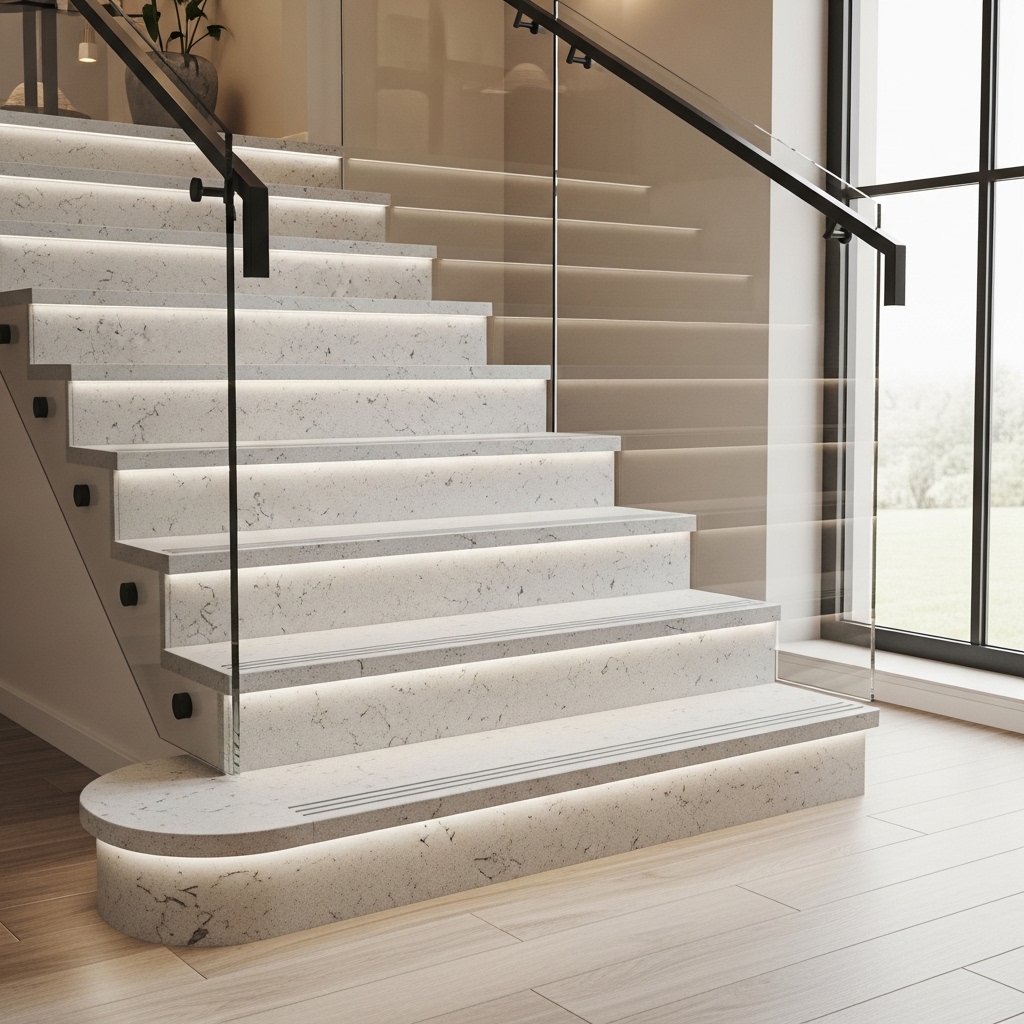
A quartz format guide for stairs explains how quartz can be used as solid tread pieces, risers, landing panels, and even side cladding to create a cohesive, high-end staircase finish.
Many projects use consistent cut orientation for treads to keep pattern direction uniform, while veined designs can be sequenced so the movement appears to “climb” the staircase for a dramatic effect.
For example, a staircase can use calmer quartz areas on risers and stronger movement on treads or landings, creating a balanced look without overwhelming the space.
Format planning also includes finish selection for usability: honed or matte surfaces can feel more practical for steps, while polished quartz is often used when the staircase is more decorative and slip perception is managed by design details.
A complete guide also considers edge detailing, skirting returns, and consistent joint alignment so the stair flight looks precise and professionally fabricated.
From a planning perspective, quartz size in the UAE generally spans standard slabs at 3040 × 1440 mm and jumbo slabs around 3200 × 1600 mm, with 20 mm thickness being most common and 30 mm used for bolder edges. These dimensions are chosen to align with modern kitchen layouts and large islands. Accurate coordination with the kitchen counter size ensures clean lines, proper overhangs of 20–40 mm, and minimal visible joints.
Quartz Size Selection for Self Leveling Surface Preparation
Quartz size selection for self leveling surface preparation is important to ensure the finished surface remains flat and structurally sound, especially over large spans. Standard quartz slabs around 3040 × 1440 mm distribute weight evenly and work well with properly prepared substrates. When combined with self leveling compounds, correctly sized slabs help prevent lippage, cracking, and long-term alignment issues.
Quartz Size Selection for Raised Floor Projects
Quartz size selection plays a vital role in projects that integrate surface finishes with a raised floor. Designers often choose between standard slabs at 3040 × 1440 mm and jumbo slabs at 3200 × 1600 mm depending on span and seam requirements. Selecting the right size improves load distribution, reduces material waste, and ensures compatibility with underfloor service layouts.