
Counter Standard Size
Counter standard size (finished kitchen counter dimensions) is generally consistent because it follows cabinet standards: the most common finished counter height is about 36 in (91.44 cm) from floor to countertop surface, and the standard finished depth is 25–25.5 in (63.50–64.77 cm) over 24 in (60.96 cm) base cabinets with a typical front overhang of about 1–1.5 in (2.54–3.81 cm). Counter lengths are customized to the room, but single-piece straight sections often fall around 72–120 in (182.88–304.80 cm) before seams, and islands commonly range about 36–60 in wide (91.44–152.40 cm) and 72–120 in long (182.88–304.80 cm). Typical countertop thickness for stone/quartz is 2 cm (0.79 in / 20 mm) or 3 cm (1.18 in / 30 mm), and many kitchens use a built-up edge so the front looks about 1.5 in thick (3.81 cm).
Regular Size
36 in high and 25–25.5 in deep, thickness 0.79 in (2 cm) or 1.18 in (3 cm).
Jumbo Size
36 in high and 25–25.5 in deep, thickness 0.79 in (2 cm) or 1.18 in (3 cm).
Super Size
36 in high and 25–25.5 in deep, thickness 0.79 in (2 cm) or 1.18 in (3 cm).
Super Jumbo
36 in high and 25–25.5 in deep, thickness 0.79 in (2 cm) or 1.18 in (3 cm).
Mini Slab
36 in high and 25–25.5 in deep, thickness 0.79 in (2 cm) or 1.18 in (3 cm).
Kitchen Counter Standard Measurements
When planning kitchen counter standard measurements, it is essential to consider project dimensions, desired aesthetic, budget constraints, fabricator’s expertise, and specific design requirements.
The standard height for kitchen counters is typically 36 inches, which accommodates most users comfortably, while the depth usually ranges from 24 to 25 inches. If the kitchen layout allows, an island can be slightly higher, around 42 inches, for bar seating.
Aesthetic preferences play a crucial role; for instance, a modern kitchen may favor sleek, minimalist designs with clean lines, while a rustic kitchen might incorporate thicker, more textured materials. Budget constraints can significantly influence material choices, with options ranging from laminate at $10 to $50 per square foot to high-end granite or quartz, which can cost $50 to $200 per square foot.
The fabricator’s expertise is vital, as intricate designs or custom cuts require skilled craftsmanship, which may increase costs but ensure quality and durability.
Specific design requirements, such as incorporating integrated sinks or cooktops, may necessitate adjustments in standard measurements, ensuring that the final product not only meets functional needs but also aligns with the overall vision for the kitchen space.
Kitchen Counter Standards: Why Bigger Works
Standard measurements for kitchen counters offer numerous advantages that enhance both functionality and aesthetics in kitchen design.
One significant benefit is the ergonomic design that standard heights, typically around 36 inches, provide, allowing for comfortable food preparation and cooking without straining the back.
Additionally, standard depths of 24 inches ensure ample workspace while accommodating various appliances and kitchen tools, making it easier to organize and access items efficiently.
Bigger counters, such as those extending to 42 inches in height for bar seating or larger islands, promote social interaction and create a gathering space for family and friends, transforming the kitchen into a central hub of the home.
Furthermore, adhering to standard measurements simplifies the renovation process, as it allows for easier integration of cabinetry and appliances, reducing the need for custom solutions that can be costly and time-consuming.
Overall, kitchen counter standards not only optimize space and usability but also contribute to a cohesive and inviting kitchen environment.
Countertop Standards: Typical Waste Allowance
Countertop standards are essential for ensuring that installations meet both aesthetic and functional requirements. A typical waste allowance for countertops generally ranges from 10% to 20% of the total material needed, depending on the type of material and the complexity of the design. For instance, when calculating the amount of granite required for a kitchen countertop, if the total area is 50 square feet, a waste allowance of 15% would mean ordering an additional 7.5 square feet, bringing the total to 57.5 square feet.
This allowance accounts for cuts, seams, and potential defects in the material, which are crucial for achieving a polished and professional finish.
Additionally, different materials may have varying waste factors; for example, laminate may require less waste allowance compared to natural stone due to its easier handling and installation. Understanding these standards helps in budgeting accurately and ensuring that the final product meets the desired quality and durability.
Kitchen Counter Standards: Largest Format Options
When considering kitchen counter standards, one of the most significant trends is the use of large format options. These surfaces not only enhance the aesthetic appeal of a kitchen but also offer practical benefits. Large format countertops typically refer to slabs that exceed the traditional dimensions, often measuring 10 feet or more in length and 5 feet in width. This allows for fewer seams, creating a more seamless and visually appealing surface.
The most common materials for large format countertops include quartz, granite, and porcelain. For instance, quartz slabs can be manufactured in sizes up to 126 inches by 63 inches, providing ample coverage for expansive kitchen islands or countertops. Granite, being a natural stone, can also be sourced in large slabs, with some options reaching up to 120 inches in length. This not only reduces the need for multiple pieces but also minimizes the potential for water and dirt accumulation in seams, which can be a concern in kitchen hygiene.
Another advantage of large format countertops is their versatility in design. With fewer seams, homeowners can achieve a more cohesive look, allowing for creative patterns and designs that can enhance the overall kitchen decor. For example, a large slab of marble can serve as a stunning centerpiece, with its unique veining patterns becoming a focal point in the kitchen. Additionally, large format options can be customized to fit specific dimensions, accommodating various kitchen layouts and styles.
In terms of installation, large format countertops require careful handling and professional installation due to their weight and size. It is essential to have a sturdy base and proper support to ensure longevity and durability. The installation process may involve specialized equipment and techniques, which can add to the overall cost. However, the investment is often justified by the long-term benefits and the enhanced value it brings to the home.
Overall, the trend towards large format kitchen countertops reflects a growing preference for both functionality and aesthetics in modern kitchen design. With their ability to create a seamless look, reduce maintenance concerns, and offer a wide range of design possibilities, large format options are becoming a standard choice for homeowners looking to elevate their kitchen spaces.
Kitchen Counter Standards: Thickness for Heavy Use
When selecting a kitchen counter for heavy use, the thickness of the material plays a crucial role in its durability and functionality. Typically, countertops designed for heavy-duty applications range from 1.5 inches to 3 inches in thickness. Thicker countertops not only provide a more robust surface for daily tasks but also enhance the overall aesthetic appeal of the kitchen. For instance, a 2-inch thick granite countertop can withstand significant weight and pressure, making it ideal for heavy cooking and food preparation.
In addition to granite, other materials such as quartz and solid surface countertops also benefit from increased thickness. Quartz countertops, often available in thicknesses of 1.2 inches to 2 inches, offer excellent resistance to scratches and stains, making them suitable for busy kitchens. Solid surface materials, while typically thinner, can be reinforced to achieve greater durability.
Moreover, the thickness of the countertop can influence the installation process. Thicker countertops may require additional support structures, such as brackets or reinforced cabinetry, to ensure stability. For example, a 3-inch thick countertop may necessitate a more robust base to prevent sagging over time. This consideration is essential for maintaining the integrity of the countertop, especially in high-traffic areas where heavy pots and pans are frequently placed.
Ultimately, when choosing a kitchen counter for heavy use, it is vital to consider both the thickness and the material. A well-chosen countertop not only enhances the kitchen’s functionality but also contributes to its overall design. Investing in a thicker, high-quality countertop can lead to long-term satisfaction and performance, making it a worthwhile decision for any serious home cook.
Typical counter measurements for walls & decorative surfaces
Typical counter measurements matter for decorative walls because backsplashes and feature panels are often aligned to countertop runs, cabinet modules, and key focal zones like the sink and hob wall.
Many kitchens follow common planning benchmarks such as a counter height around 900 mm and a depth around 600 mm (typical examples), which helps define where the wall protection zone begins and ends.
Backsplash planning often includes either a short splash (for example, around 100–200 mm) or a full-height panel up to cabinetry, depending on the desired look and cleaning needs.
For example, using one full-height panel behind the hob can reduce joints in a high-splash area, while seams can be aligned to cabinet edges so they visually blend in.
Good measurement also accounts for appliance clearances and socket positions so cut-outs land neatly and the decorative wall remains practical for daily use.
Typical counter measurements for stairs
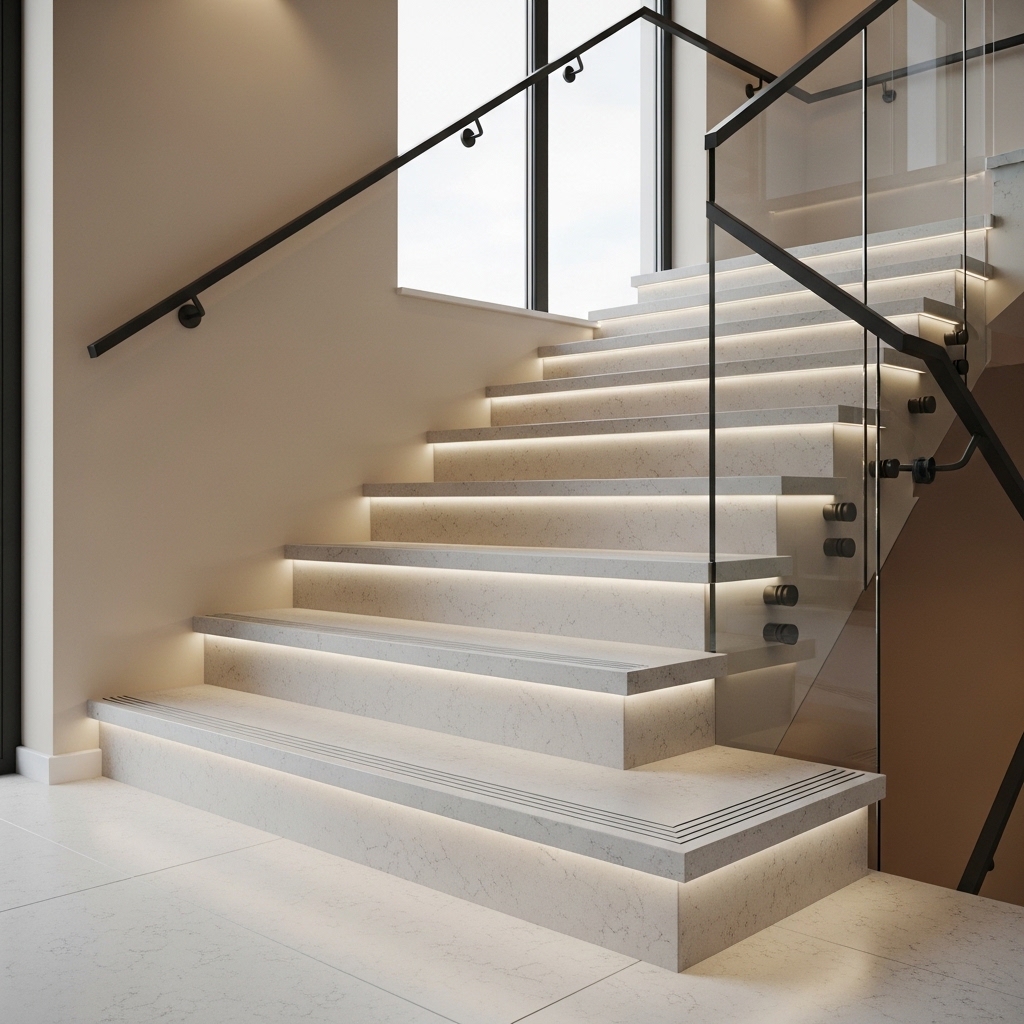
Typical counter measurements can matter for stairs when the same slab material is used across kitchen surfaces and adjacent stair zones, creating continuity in open-plan layouts.
Common kitchen benchmarks include a counter height around 900 mm and a depth around 600 mm (typical examples), and these reference lines can influence seam alignment and pattern direction choices near the stair entry view.
For example, matching the edge profile and finish level from the kitchen worktop to the stair tread nose helps the transition look intentional rather than like separate installations.
Even if the kitchen includes thinner vertical panels, stair treads generally need robust thickness (often 20 mm) because steps take constant impact and abrasion.
Coordinating joint spacing and visual lines between the kitchen and stairs helps the whole space feel cohesive and professionally detailed.
In everyday design discussions, counter standard size in the UAE typically means a depth of 600–650 mm for wall counters and wider dimensions for islands, combined with heights around 900–950 mm. These standards help maintain ergonomic comfort and appliance compatibility. They closely mirror the standard size of kitchen counter used across most residential projects.
Counter Standard Size for Belgium Black Marble Inspired Kitchens
Counter standard size for Belgium Black marble inspired kitchens generally follows depths of 600–650 mm and heights around 900–950 mm, ensuring ergonomic comfort and appliance compatibility. Slab lengths of 2800–3200 mm support long counter runs with minimal seams. Designing counters around belgium black marble aesthetics benefits from these standard dimensions to showcase contrast and veining cleanly.
Counter Standard Size Coordination with Raised Floor Levels
Counter standard size coordination becomes more technical when interiors include a raised floor. Standard counters are designed at heights of 900–950 mm and depths of 600–650 mm, adjusted according to floor build-up. Correct coordination ensures ergonomic comfort and seamless transitions across different floor zones.