
Granite Size Chart
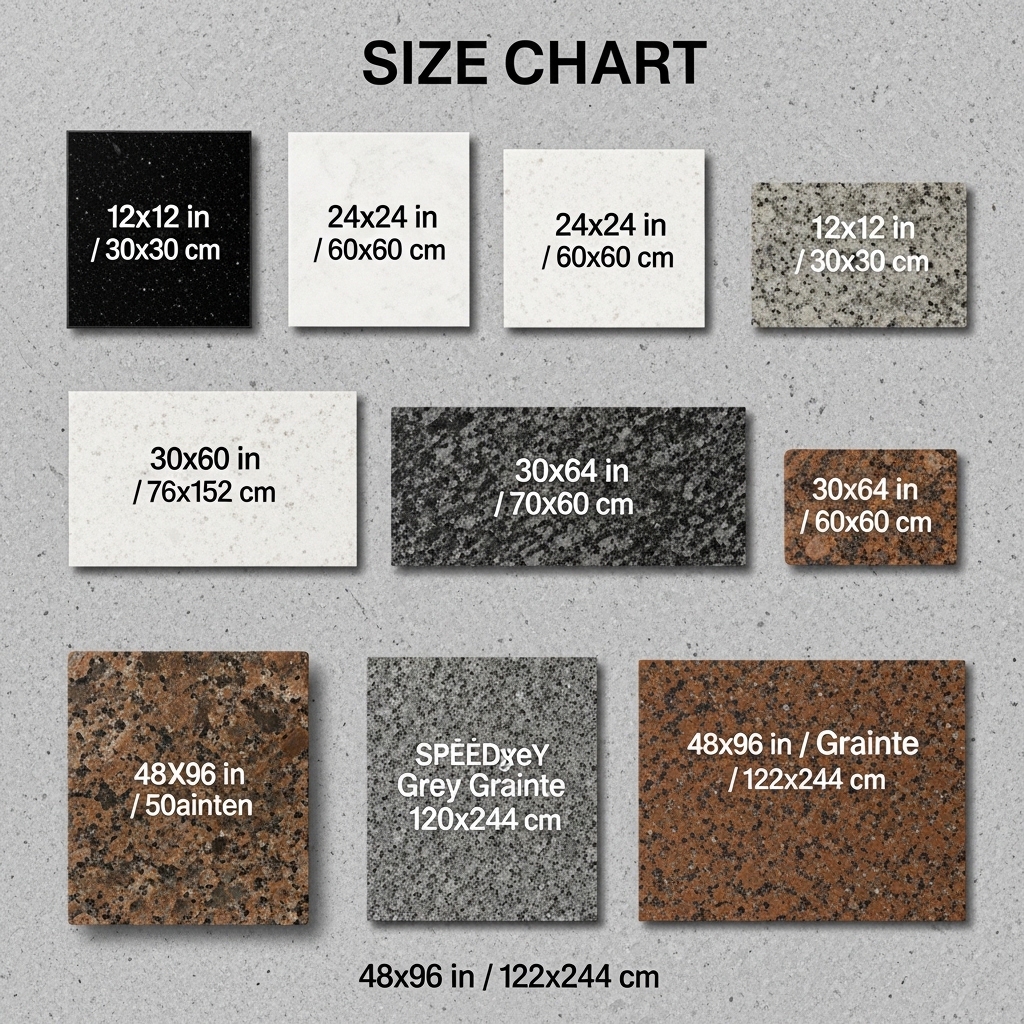
A granite size chart typically includes slab, tile, and thickness options: full granite slabs commonly range about 108–120 in long × 60–72 in wide (274.32–304.80 cm × 152.40–182.88 cm), with larger slabs sometimes around 126 in × 78 in (320.04 cm × 198.12 cm) and smaller half-slabs about 96 in × 48 in (243.84 cm × 121.92 cm). Granite tiles are often stocked in 12 in × 12 in (30.48 cm × 30.48 cm), 18 in × 18 in (45.72 cm × 45.72 cm), and 24 in × 24 in (60.96 cm × 60.96 cm), plus smaller accents like 6 in × 6 in (15.24 cm × 15.24 cm). Thickness is commonly 2 cm (0.79 in / 20 mm) and 3 cm (1.18 in / 30 mm) for slabs, while tiles are often 3/8 in (0.95 cm), 1/2 in (1.27 cm), or 3/4 in (1.905 cm) depending on whether they’re for walls or heavy-duty floors.
Regular Size
Granite slabs 108–120 in × 60–72 in; tiles 12 in × 12 in / 18 in × 18 in / 24 in × 24 in; thickness 0.79 in or 1.18 in (slabs) and ~0.38–0.75 in (tiles).
Jumbo Size
Granite slabs 126 in × 78 in; tiles 24 in × 24 in; thickness 0.79 in or 1.18 in (slabs) and ~0.50–0.75 in (tiles).
Super Size
Granite slabs 138 in × 78 in; tiles 24 in × 24 in; thickness 0.79 in or 1.18 in (slabs) and ~0.50–0.75 in (tiles).
Super Jumbo
Granite slabs 138 in × 78 in; tiles 24 in × 24 in; thickness 0.79 in or 1.18 in (slabs) and ~0.50–0.75 in (tiles).
Mini Slab
Granite slabs 96 in × 48 in; tiles 12 in × 12 in; thickness 0.79 in or 1.18 in (slabs) and ~0.38–0.50 in (tiles).
Granite Dimension Reference Guide
Granite Dimension Reference Guide serves as an essential tool for architects, designers, and homeowners when planning a project involving granite surfaces.
The first consideration is project dimensions, where accurate measurements are crucial; for instance, a standard kitchen countertop typically measures 25 to 30 inches in depth and 1.25 inches in thickness, while islands may require larger slabs of up to 10 feet in length.
Desired aesthetic plays a significant role in selecting granite, with options ranging from classic white and gray patterns to bold blacks and vibrant colors, influencing the overall ambiance of the space.
Budget constraints are another critical factor, as granite prices can vary widely, typically ranging from $40 to $100 per square foot, depending on the rarity and quality of the stone.
The fabricator’s expertise is vital in ensuring that the granite is cut and installed correctly; experienced fabricators can handle intricate designs and edge profiles, which may add an additional 10-20% to the overall cost.
Lastly, specific design requirements, such as the need for custom shapes or integrated sinks, can further impact dimensions and costs, necessitating precise planning and communication with the fabricator to achieve the desired outcome.
Granite Dimension Guide: Jumbo Benefits
The Granite Dimension Reference Guide offers numerous advantages for both professionals and enthusiasts in the stone industry.
One of the primary benefits is the precise specifications it provides, ensuring that fabricators and installers can achieve accurate cuts and measurements, which is crucial for minimizing waste and maximizing efficiency.
For instance, using the guide can reduce material waste by up to 15%, translating to significant cost savings.
Additionally, the guide includes detailed information on various granite types, their properties, and recommended applications, allowing users to make informed decisions based on durability and aesthetic appeal.
The comprehensive nature of the guide also aids in standardizing practices across projects, which can enhance the quality of workmanship and customer satisfaction.
Furthermore, the Granite Dimension Reference Guide serves as an educational tool, helping new entrants in the industry to quickly familiarize themselves with essential terminology and best practices, ultimately fostering a more knowledgeable workforce.
Overall, the guide not only streamlines the granite selection and installation process but also contributes to the long-term success of projects by promoting efficiency and quality.
Granite Reference Guide: Typical Waste Margin
Granite is a popular choice for countertops and other surfaces due to its durability and aesthetic appeal. When working with granite, it is essential to consider the typical waste margin, which can significantly impact project costs and material usage. Generally, the waste margin for granite is estimated to be around 10% to 20%, depending on the complexity of the project and the cutting patterns used.
For instance, if a project requires 100 square feet of granite, it is advisable to order between 110 to 120 square feet to account for potential waste from cuts, breakage, or defects.
Additionally, intricate designs or irregular shapes may increase the waste margin, as more material may be needed to achieve the desired look. Proper planning and accurate measurements can help minimize waste, but it is always prudent to factor in this margin to ensure that the project runs smoothly and stays within budget.
Granite Reference Guide: Largest Format Options
Granite is a popular choice for countertops, flooring, and various architectural applications due to its durability and aesthetic appeal. In recent years, the trend towards larger format granite slabs has gained momentum, offering both practical and design advantages. Large format granite slabs can measure up to 10 feet by 5 feet or even larger, allowing for fewer seams and a more cohesive look in any space. This is particularly beneficial in kitchen countertops and expansive flooring areas, where a seamless appearance can enhance the overall design. One of the significant advantages of using large format granite is the reduction in grout lines, which can be a maintenance concern in smaller tiles. With fewer seams, there is less opportunity for dirt and grime to accumulate, making cleaning easier and more efficient. Additionally, the larger slabs can create a more dramatic visual impact, showcasing the natural beauty and unique patterns of the stone. For instance, a single slab of granite can weigh between 600 to 1,200 pounds, depending on its thickness and density, which underscores the need for proper installation techniques to ensure safety and stability. When considering large format granite options, it is essential to take into account the thickness of the slabs. Most large format granite slabs come in thicknesses ranging from 2 cm to 3 cm. Thicker slabs provide greater durability and are often preferred for high-traffic areas or applications where heavy objects may be placed. Moreover, the weight of these slabs necessitates professional installation, as they require specialized equipment and expertise to handle and position them correctly. In terms of design versatility, large format granite slabs can be used in various applications beyond countertops and flooring. They are increasingly being utilized for wall cladding, fireplace surrounds, and even custom furniture pieces. The expansive surface area allows for creative design possibilities, enabling homeowners and designers to create stunning focal points in any room. For example, a feature wall made from a single large slab can serve as a striking centerpiece, drawing attention and admiration. Overall, the trend towards large format granite options reflects a growing desire for both functionality and style in home design. As technology advances, the availability of larger slabs continues to increase, providing consumers with more choices than ever before. Whether for a modern kitchen, a luxurious bathroom, or an elegant living space, large format granite offers a timeless and sophisticated solution that can elevate any interior design project.
Granite Reference Guide: Floor-Grade Thickness
Granite is a popular choice for flooring due to its durability and aesthetic appeal. When considering granite for flooring applications, one of the most critical factors is the thickness of the slabs. Floor-grade granite typically comes in thicknesses of 1 cm, 2 cm, and 3 cm, with 2 cm being the most common choice for residential and commercial flooring. This thickness provides a balance between weight, durability, and ease of installation.
The 1 cm thickness is often used for wall applications or countertops, while the 3 cm thickness is favored for high-traffic areas where additional strength is required. In terms of weight, a 2 cm thick granite slab can weigh approximately 12-15 pounds per square foot, making it essential to ensure that the subfloor can support the load.
Installation methods can vary based on the thickness of the granite. Thicker slabs may require additional support structures or adhesives, while thinner slabs can be installed directly over a cement backer board. It is also important to consider the expansion and contraction properties of granite, as fluctuations in temperature and humidity can affect the integrity of the flooring.
When selecting granite for flooring, it is advisable to consult with professionals who can provide guidance on the appropriate thickness based on the specific application and environment. Ultimately, the choice of thickness will impact not only the aesthetic appeal but also the longevity and performance of the flooring. Proper care and maintenance, including regular sealing, can further enhance the lifespan of granite floors, ensuring they remain a stunning feature in any space for years to come.
Granite measurement reference guide for walls & decorative surfaces
A granite measurement reference guide for walls and decorative surfaces is built around understanding typical slab availability ranges, choosing thickness suited for vertical use, and mapping the best-looking stone areas into focal zones.
Granite slab supply often varies by quarry yield, so projects commonly work within practical ranges such as 2400–3300 mm length and 1400–2000 mm width (typical examples) rather than a single fixed size.
For wall cladding, thickness is often selected around 10–20 mm to balance strength and manageable load, while thicker 30 mm is generally chosen where bold edges, deep returns, or heavy architectural framing details are part of the design.
As an example, if you want a dramatic grain area or mineral cluster on a feature wall, the reference approach is to position that area at eye level and place seams at corners or trim lines so the best pattern remains uninterrupted.
A complete reference guide also includes finish selection (polished, honed, leathered) because reflection and texture change the way granite reads across large elevations under lighting.
Granite measurement reference guide for stairs
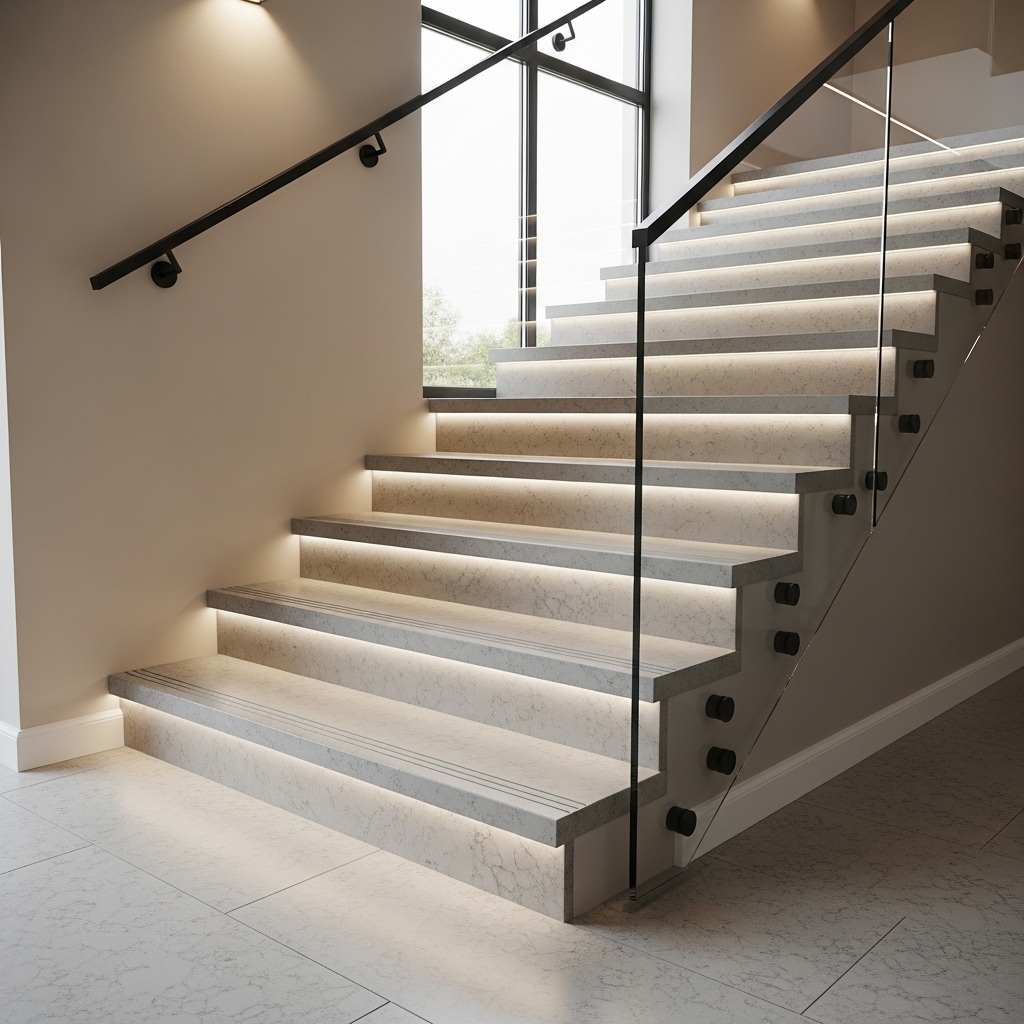
A granite measurement reference guide for stairs is built around slab availability ranges, thickness selection for wear resistance, and layout mapping to keep tone and grain direction consistent across the full flight.
Granite slabs are often supplied in practical ranges such as 2400–3300 mm long and 1400–2000 mm wide (typical examples), which allows multiple treads and risers to be cut from one batch for better visual consistency.
For durability, stair treads commonly use 20–30 mm thickness depending on design and span, and an eased or chamfered step nose helps reduce chipping at the front edge.
For example, the most consistent color zones can be reserved for the most visible treads and landing areas, while risers are cut from calmer sections to keep vertical faces neat and uniform.
A complete reference also includes tolerances for nosing overhang, skirting returns, and consistent joint gaps so the staircase installs straight and looks professionally finished.
A granite size chart used in the UAE usually outlines slab lengths between 2800–3200 mm, widths around 1500–1800 mm, and common thicknesses of 20 mm and 30 mm. This chart helps clients visualize what can be cut from a single slab and where seams may appear. For engineered stone comparisons, these references are often aligned with the slab quartz size offered by major brands.
Granite Size Chart Reference for Armani Grey Marble Style Interiors
A granite size chart reference for Armani Grey marble style interiors typically outlines slab lengths of 2800–3200 mm, widths of 1500–1800 mm, and thickness options of 20 mm or 30 mm. These measurements help designers plan wall panels, vanities, and countertops with minimal joints. Using a size chart when working with armani grey marble aesthetics ensures consistent proportions and a refined, contemporary finish.
Granite Size Chart Reference for Raised Floor Applications
A granite size chart reference helps designers select suitable formats for use with a raised floor. Granite slabs are commonly available in sizes around 2800–3200 mm in length and 1500–1800 mm in width, with thicknesses of 18–30 mm. These dimensions allow precise cutting to match modular floor grids and ensure long-term durability.