
Size of a Granite Slab
Size of a granite slab (full slabs used for fabrication) varies by quarry and bundle, but common countertop slab ranges are often about 108–120 in long × 60–72 in wide (274.32–304.80 cm × 152.40–182.88 cm). Larger, wider slabs can be around 126 in × 78 in (320.04 cm × 198.12 cm) when the quarry produces bigger cuts, while smaller half-slabs may be about 96 in × 48 in (243.84 cm × 121.92 cm) for compact kitchens or vanity projects. Granite thickness is most commonly 2 cm (0.79 in / 20 mm) or 3 cm (1.18 in / 30 mm), with 1.5 cm (0.59 in / 15 mm) sometimes used for wall cladding, backsplashes, and lighter installations.

Regular Size
108–120 in × 60–72 in, thickness 0.79 in (2 cm) or 1.18 in (3 cm).
Jumbo Size
126 in × 78 in, thickness 0.79 in (2 cm) or 1.18 in (3 cm).
Super Size
138 in × 78 in, thickness 0.79 in (2 cm) or 1.18 in (3 cm).
Super Jumbo
138 in × 78 in, thickness 0.79 in (2 cm) or 1.18 in (3 cm).
Mini Slab
96 in × 48 in, thickness 0.79 in (2 cm) or 1.18 in (3 cm).
Granite Slab Measurements Guide
When planning for granite slab measurements, it is essential to consider the project dimensions, as these will dictate the size and number of slabs required. For instance, a standard kitchen countertop typically measures around 25 to 30 inches in depth and can range from 72 to 120 inches in length, depending on the layout.
The desired aesthetic plays a crucial role in selecting the right granite, as colors and patterns can significantly impact the overall look of the space. For example, lighter shades like white or beige can create an airy feel, while darker hues such as black or deep blue can add drama and sophistication.
Budget constraints are another critical factor; granite prices can vary widely, from $40 to $200 per square foot, depending on the quality and rarity of the stone. It’s important to balance the desired aesthetic with what is financially feasible, ensuring that the chosen slabs fit within the overall project budget.
The fabricator’s expertise also influences the selection process, as some fabricators may specialize in certain types of granite or specific cutting techniques. It’s advisable to consult with them early in the planning stage to understand their capabilities and limitations.
Lastly, specific design requirements, such as the need for custom edges or cutouts for sinks and appliances, should be clearly communicated to ensure that the granite slabs are fabricated to meet these needs. For example, a standard sink cutout might require an additional 3 to 5 inches of material around the sink area, which should be factored into the overall measurements. By considering these elements, you can ensure that your granite slab selection aligns perfectly with your project goals.
Granite Slab Measurements: Jumbo Perks
Granite slab measurements are essential for ensuring a perfect fit and optimal use of this durable material in various applications, such as countertops, flooring, and wall cladding. One of the significant advantages of using a granite slab measurements guide is the precision it offers; accurate measurements can prevent costly mistakes, such as purchasing too little material or cutting slabs incorrectly. For instance, a standard granite slab typically measures 120 inches by 72 inches, but jumbo slabs can reach up to 130 inches by 78 inches, providing more surface area for larger projects. This extra size can be particularly beneficial in minimizing seams in countertops, enhancing both aesthetics and functionality. Additionally, a well-structured measurements guide can help homeowners and contractors alike understand the nuances of granite thickness, which usually ranges from 2 cm to 3 cm, ensuring that the right choice is made based on the intended use. Furthermore, having a reliable guide can streamline the installation process, saving time and labor costs, as it allows for better planning and execution. Overall, utilizing a granite slab measurements guide not only enhances the quality of the finished product but also contributes to a more efficient and cost-effective project.
Granite Slab Material: General Waste Estimate
Granite slab material is widely used in construction and design due to its durability and aesthetic appeal. When estimating general waste for granite slabs, it is essential to consider factors such as cutting, shaping, and installation processes. Typically, the waste generated during these processes can range from 5% to 20% of the total material used, depending on the complexity of the project and the skill of the fabricators. For instance, if a project requires 100 square feet of granite slabs, one might expect to waste between 5 to 20 square feet due to off-cuts and imperfections.
Additionally, proper planning and precise measurements can significantly reduce waste. Utilizing advanced cutting techniques and optimizing the layout of the slabs can help minimize the amount of material discarded. It is advisable to consult with experienced professionals who can provide insights into best practices for waste management in granite slab projects.
Ultimately, understanding the general waste estimate not only aids in budgeting but also promotes sustainability by encouraging the efficient use of resources.
Granite Slab Material: Biggest Format Available
Granite slab material is renowned for its durability, aesthetic appeal, and versatility in various applications, particularly in construction and interior design. One of the most significant advantages of granite is its availability in large formats, which can dramatically enhance the visual impact of a space. Granite slabs can be produced in sizes up to 126 inches by 78 inches, allowing for expansive surfaces with minimal seams. This feature is particularly beneficial for countertops, flooring, and wall cladding, where a seamless appearance is often desired. The thickness of granite slabs typically ranges from 2 cm to 3 cm, providing ample strength for heavy-duty applications. In commercial settings, such as restaurants and hotels, large-format granite slabs can withstand high traffic while maintaining their pristine condition. The natural stone is also resistant to scratches, heat, and stains, making it an ideal choice for kitchen countertops where food preparation occurs. Moreover, the aesthetic versatility of granite is unmatched. With a wide array of colors and patterns available, from deep blacks and rich browns to vibrant blues and greens, designers can select the perfect slab to complement any decor. Granite’s unique veining and speckling add character and elegance, making it a favored choice for luxury spaces. The ability to use large-format slabs means that designers can create bold statements, such as expansive kitchen islands or dramatic feature walls, without the interruption of grout lines that smaller tiles would necessitate. In addition to its beauty and practicality, granite is also a sustainable choice. As a natural stone, it is abundant and can be sourced responsibly. Many manufacturers are now adopting eco-friendly practices in quarrying and processing granite, ensuring that the environmental impact is minimized. Investing in granite slabs not only enhances the aesthetic value of a property but also contributes to a sustainable future. Overall, the combination of size, durability, and beauty makes granite slab material a top choice for both residential and commercial projects. Its ability to create seamless, expansive surfaces while offering a wide range of design possibilities ensures that it remains a timeless option in the world of architecture and interior design.
Granite Slab Material: Thickness for High-Traffic Zones
Granite slabs are a popular choice for high-traffic zones due to their durability and aesthetic appeal. When considering granite for areas that experience significant foot traffic, the thickness of the slabs becomes a crucial factor. Typically, granite slabs come in various thicknesses, with the most common being 2 cm (3/4 inch) and 3 cm (1 1/4 inch). For high-traffic areas, a thickness of 3 cm is often recommended. This added thickness not only enhances the slab’s strength but also provides better resistance to chipping and cracking, which can occur in thinner materials under heavy use.
In commercial settings, such as restaurants, retail spaces, or lobbies, the wear and tear on surfaces can be substantial. A thicker granite slab can withstand the pressure of heavy foot traffic, furniture, and equipment without compromising its integrity. Additionally, thicker slabs can be more easily polished and maintained, ensuring that they retain their luster and visual appeal over time.
Moreover, the installation of thicker granite slabs can also contribute to a more stable surface. Thinner slabs may require additional support or reinforcement, which can complicate the installation process and increase costs. In contrast, 3 cm slabs can often be installed directly onto a substrate without the need for additional backing, simplifying the project and reducing labor costs.
In terms of weight, a 3 cm thick granite slab typically weighs around 20-25 pounds per square foot, making it a substantial choice for high-traffic areas. This weight not only adds to the stability of the installation but also enhances the overall feel of the surface, providing a solid and luxurious experience underfoot.
Ultimately, when selecting granite slabs for high-traffic zones, opting for a thickness of 3 cm is a wise investment. It ensures durability, ease of maintenance, and a visually appealing finish that can withstand the rigors of daily use. By prioritizing thickness, property owners can enjoy the beauty and functionality of granite in even the busiest environments.
Granite slab measurement guide for walls & decorative surfaces
A granite slab measurement guide for walls includes choosing slab areas with consistent tone, selecting thickness for vertical use, and designing seam placement so the wall looks intentional and refined.
Granite slabs are often available in broad workable ranges like 2400–3300 mm long and 1400–2000 mm wide (typical examples), allowing large panels and fewer joints on feature elevations.
For walls, thickness commonly sits around 10–20 mm for a practical balance of strength and weight, while 30 mm may be used where strong edge returns or bold architectural details are part of the design.
For example, a fireplace cladding can be planned with two large panels and a seam aligned to a mantel or niche line so the join is visually minimized.
Because granite varies naturally, measurement planning often includes slab selection and panel sequencing so grain direction stays consistent and the most attractive movement remains in the focal zone.
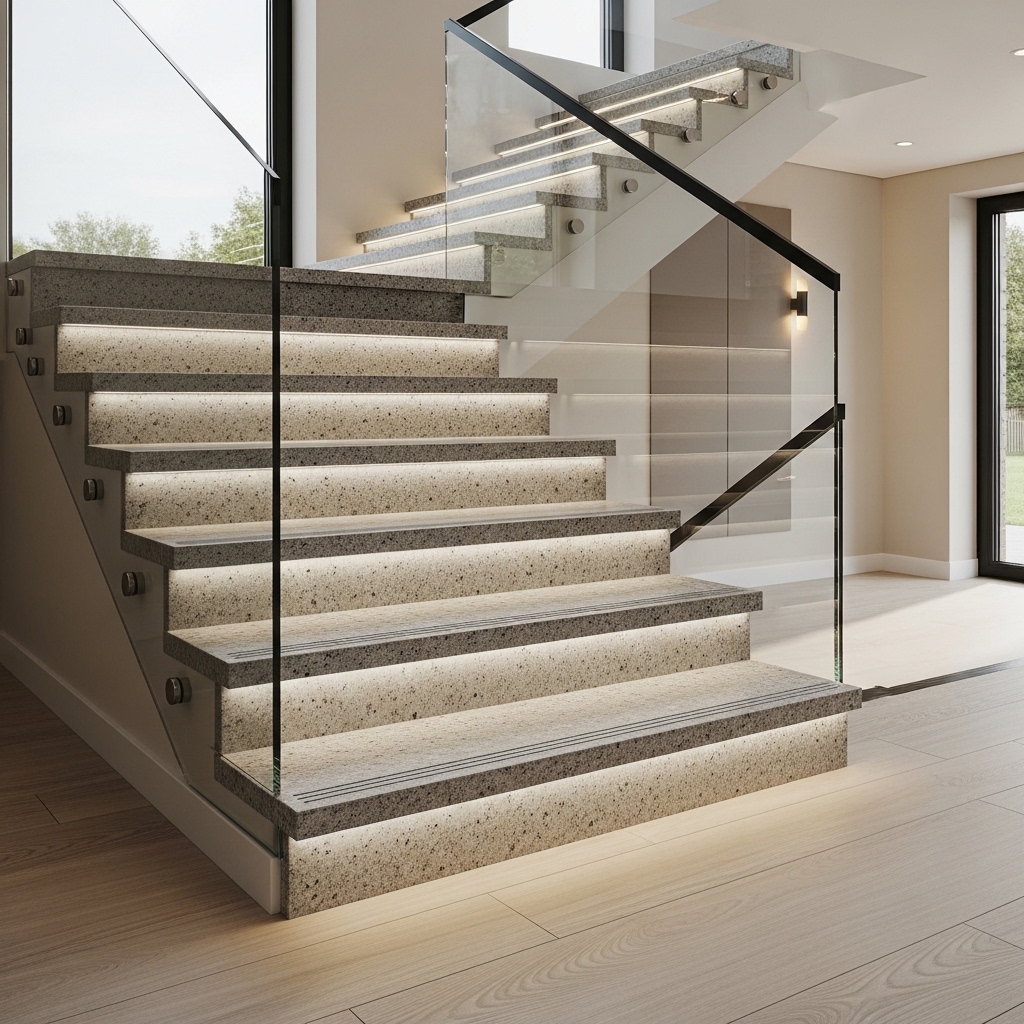
Granite slab measurement guide for stairs
A granite slab measurement guide for stairs converts stair geometry into a cutting plan that maintains consistent grain direction, minimizes seams on landings, and ensures durable tread edges.
Granite slabs are typically supplied in ranges such as 2400–3300 mm long and 1400–2000 mm wide (typical examples), allowing multiple tread pieces and risers to be cut from one batch for better shade consistency.
For example, the landing can be planned as a dominant panel with seams pushed to perimeter edges, while tread pieces are nested as repeats in one orientation for a clean, uniform flight.
Tread thickness commonly sits around 20–30 mm depending on design, and an eased or chamfered step nose helps protect the front edge under heavy foot traffic.
The plan also includes nosing overhang allowances, skirting returns at walls, and uniform joint gaps so the staircase installs cleanly and looks aligned from step to step.
The size of a granite slab available in UAE stone yards generally ranges from about 2800–3200 mm in length and 1500–1800 mm in width, with thickness options of 20 mm and 30 mm. These dimensions are suitable for most kitchens, islands, and vanity tops when planned correctly. Outside interior applications, stone sizing discussions may shift toward topics like what is the standard size of a headstone, which follows very different guidelines.
Size of a Granite Slab for Travertine Tiles Applications
The size of a granite slab for travertine tiles applications typically ranges between 2800–3200 mm in length and 1500–1800 mm in width, allowing efficient cutting into modular tile sizes. These slab dimensions help maintain uniform thickness and consistent color across tiles. Pairing granite slabs cut to size with travertine tiles creates a balanced mix of durability and natural texture for floors and walls.
Size of a Granite Slab Guidelines for Raised Floors
Understanding the size of a granite slab is essential when designing for a raised floor. Standard granite slabs typically measure between 2800–3200 mm in length and 1500–1800 mm in width, with thicknesses of 18–30 mm. These dimensions allow accurate cutting to suit raised floor grids while maintaining durability and visual consistency.