
Standard Size of Granite Slab
Standard size of a granite slab is typically expressed as a range because it depends on quarry output and how slabs are bundled, but a common “standard” band is about 108–120 in long × 60–72 in wide (274.32–304.80 cm × 152.40–182.88 cm). When the quarry yields larger cuts, suppliers may have slabs around 126 in × 78 in (320.04 cm × 198.12 cm), and many also offer smaller half-slabs close to 96 in × 48 in (243.84 cm × 121.92 cm) for smaller projects. Granite is most commonly stocked in 2 cm (0.79 in / 20 mm) and 3 cm (1.18 in / 30 mm) thicknesses, with 1.5 cm (0.59 in / 15 mm) sometimes used for backsplashes, wall cladding, and lighter installations.
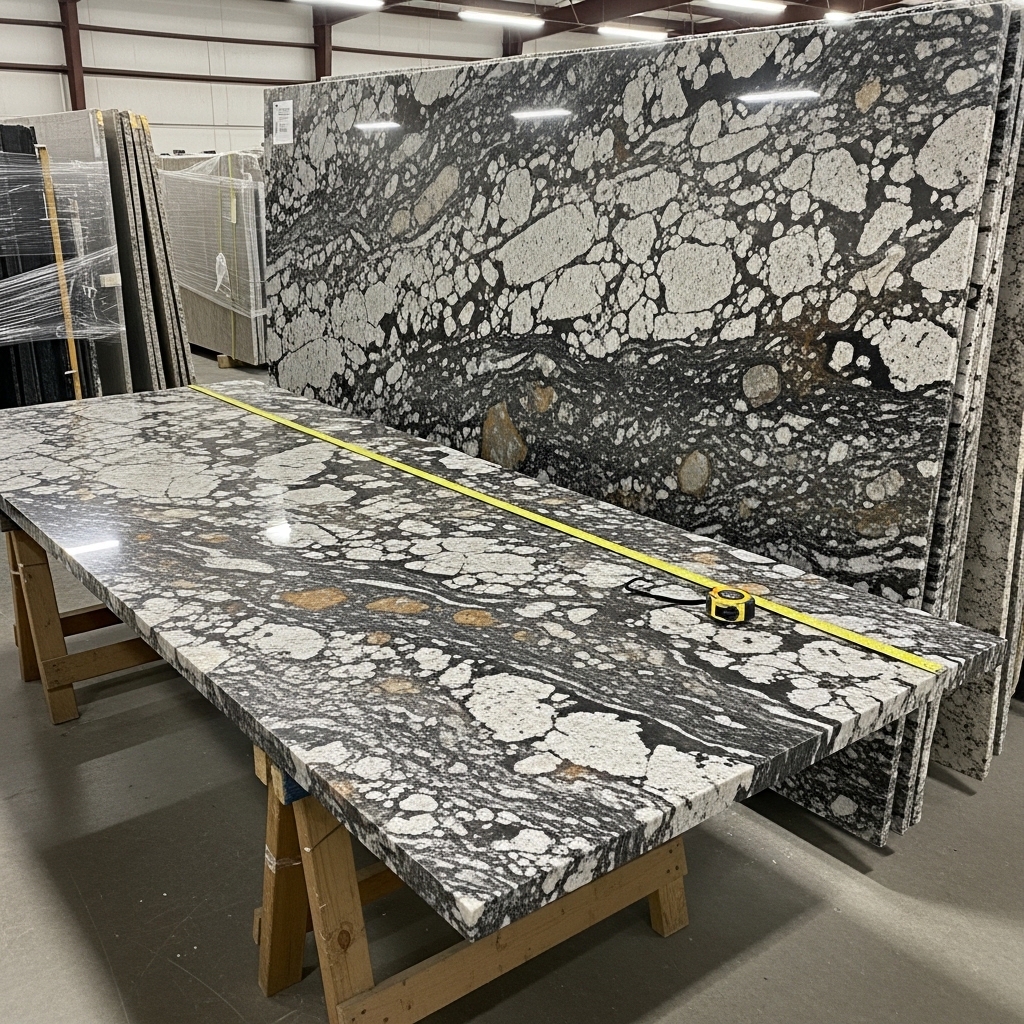
Regular Size
120 in × 72 in (common range), thickness 0.79 in (2 cm) or 1.18 in (3 cm).
Jumbo Size
126 in × 78 in, thickness 0.79 in (2 cm) or 1.18 in (3 cm).
Super Size
138 in × 78 in, thickness 0.79 in (2 cm) or 1.18 in (3 cm).
Super Jumbo
138 in × 78 in, thickness 0.79 in (2 cm) or 1.18 in (3 cm).
Mini Slab
96 in × 48 in, thickness 0.79 in (2 cm) or 1.18 in (3 cm).
Standard Granite Slab Dimension Guide
When selecting standard granite slab dimensions for a project, it is essential to consider various factors that influence the final outcome.
Project dimensions play a crucial role; for instance, a kitchen countertop typically requires slabs that are at least 96 inches long and 25 inches wide to accommodate standard cabinetry.
Desired aesthetic is another significant aspect; larger slabs, such as those measuring 120 inches by 60 inches, can create a seamless look, ideal for expansive surfaces like islands or feature walls.
Budget constraints must also be taken into account, as larger slabs often come at a premium, with prices ranging from $40 to $100 per square foot, depending on the granite quality and finish.
The fabricator’s expertise is vital; some may specialize in intricate designs that require precise cuts and joints, while others may focus on standard installations.
Lastly, specific design requirements, such as the need for custom edges or integrated sinks, can dictate the choice of slab dimensions, ensuring that the final product meets both functional and aesthetic needs.
Standard Granite Slab Dimensions: Bigger Benefits
Standard granite slab dimensions offer numerous advantages that enhance both the aesthetic appeal and functionality of various projects.
One of the primary benefits is the ease of installation; with standard sizes typically ranging from 2 cm to 3 cm in thickness and dimensions like 120 cm x 300 cm, contractors can efficiently plan and execute their designs without the need for extensive customization.
This not only reduces labor costs but also minimizes waste, as standard slabs are produced in bulk, leading to more competitive pricing.
Additionally, using standard dimensions ensures consistency in appearance, which is crucial for large-scale projects such as countertops, flooring, and wall cladding.
The predictability of these dimensions allows designers to create seamless transitions and uniform patterns, enhancing the overall visual impact.
Furthermore, standard granite slabs are readily available in a variety of colors and finishes, making it easier for homeowners and designers to find the perfect match for their aesthetic vision.
Overall, the use of standard granite slab dimensions streamlines the construction process, reduces costs, and provides a cohesive look that elevates any space.
Granite Slab Material: Standard Waste Factor
Granite slabs are a popular choice for countertops, flooring, and various architectural applications due to their durability and aesthetic appeal. When working with granite, it is essential to consider the standard waste factor, which typically ranges from 10% to 20%. This waste factor accounts for the natural imperfections in the stone, such as fissures and color variations, as well as the cuts and seams necessary for installation. For instance, if a project requires 100 square feet of granite, a waste factor of 15% would mean ordering an additional 15 square feet, bringing the total to 115 square feet.
Proper planning and measurement are crucial to minimize waste and ensure that the desired look is achieved without overspending. Additionally, factors such as the layout of the installation and the complexity of the cuts can influence the waste factor, making it important to consult with professionals who can provide tailored guidance based on the specific project requirements.
By understanding the implications of the waste factor and incorporating it into the overall project budget, homeowners and contractors can make informed decisions that lead to successful granite installations.
Standard Granite Slab Material: Biggest Format
Standard granite slab material is renowned for its durability, aesthetic appeal, and versatility in various applications, particularly in construction and interior design. One of the most significant advantages of granite slabs is their size. The biggest format available can reach dimensions of up to 126 inches by 78 inches, allowing for expansive surfaces that minimize seams and create a more cohesive look in spaces such as kitchens and bathrooms.
The large format of granite slabs not only enhances the visual impact of a space but also contributes to easier installation. With fewer seams, there is a reduced risk of water infiltration and staining, which are common concerns in areas like countertops and backsplashes. Moreover, the thickness of these slabs typically ranges from 2 cm to 3 cm, providing substantial strength and resistance to chipping and cracking. This durability makes granite an ideal choice for high-traffic areas and surfaces that endure daily wear and tear.
In terms of maintenance, granite slabs are relatively easy to care for. They require periodic sealing to maintain their resistance to stains and moisture, but with proper care, they can last a lifetime. Granite’s natural beauty is another compelling factor, as it comes in a variety of colors and patterns, allowing homeowners and designers to select options that best fit their aesthetic preferences. From classic whites and blacks to vibrant blues and greens, the diversity in granite’s appearance can complement any design scheme.
Additionally, the environmental impact of using granite is worth noting. As a natural stone, granite is a sustainable choice when sourced responsibly. Many suppliers now offer eco-friendly options, ensuring that the extraction and processing of granite slabs adhere to environmental standards. In conclusion, the combination of size, durability, aesthetic versatility, and sustainability makes standard granite slab material an exceptional choice for both residential and commercial projects. Its ability to create stunning, seamless surfaces while providing long-lasting performance solidifies its status as a favored material in the world of design and construction.
Granite Slab Material: Best Thickness for Busy Areas
Granite slab material is renowned for its durability and aesthetic appeal, making it a popular choice for various applications, especially in busy areas such as kitchens, commercial spaces, and high-traffic flooring. When selecting granite slabs for these environments, the thickness of the material plays a crucial role in ensuring longevity and performance.
Typically, granite slabs come in thicknesses of 2 cm (3/4 inch) and 3 cm (1 1/4 inch). For busy areas, the 3 cm thickness is often recommended due to its superior strength and resistance to chipping and cracking. This thickness provides a more robust surface that can withstand heavy use, making it ideal for countertops that experience frequent cutting, heavy pots, and other daily activities.
Moreover, the added weight of a 3 cm slab can contribute to its stability, reducing the likelihood of movement or shifting over time. In contrast, while 2 cm slabs can be suitable for less demanding applications, they may require additional support, such as plywood backing, to ensure they can handle the stresses of a busy environment.
In terms of aesthetics, thicker slabs also offer a more substantial appearance, which can enhance the overall design of a space. The visual impact of a 3 cm granite slab can create a sense of luxury and permanence, making it a preferred choice for high-end residential and commercial projects.
In conclusion, when considering granite slab material for busy areas, opting for a thickness of 3 cm is advisable. This choice not only provides enhanced durability and stability but also contributes to the overall visual appeal of the space, ensuring that the investment in granite will stand the test of time while maintaining its beauty and functionality.
Standard granite slab dimension guide for walls & decorative surfaces
A standard granite slab dimension guide for walls and decorative surfaces focuses on selecting practical slab ranges and converting them into installable panels while keeping natural movement aligned across the elevation.
Granite slab sizes often vary, but many projects work within typical ranges like 2400–3300 mm long and 1400–2000 mm wide (illustrative ranges), then cut panels based on site access and design rhythm.
For vertical use, thickness commonly sits around 10–20 mm, while heavier thickness may be used when the design includes deep returns, framing, or a more substantial architectural appearance.
As a practical example, a feature wall may use two or three large granite panels with seams aligned to niches or lighting channels, keeping the main visible face clean and intentional.
Standard planning also includes consistent joint widths and careful edge finishing so the final wall looks straight, refined, and professionally composed.
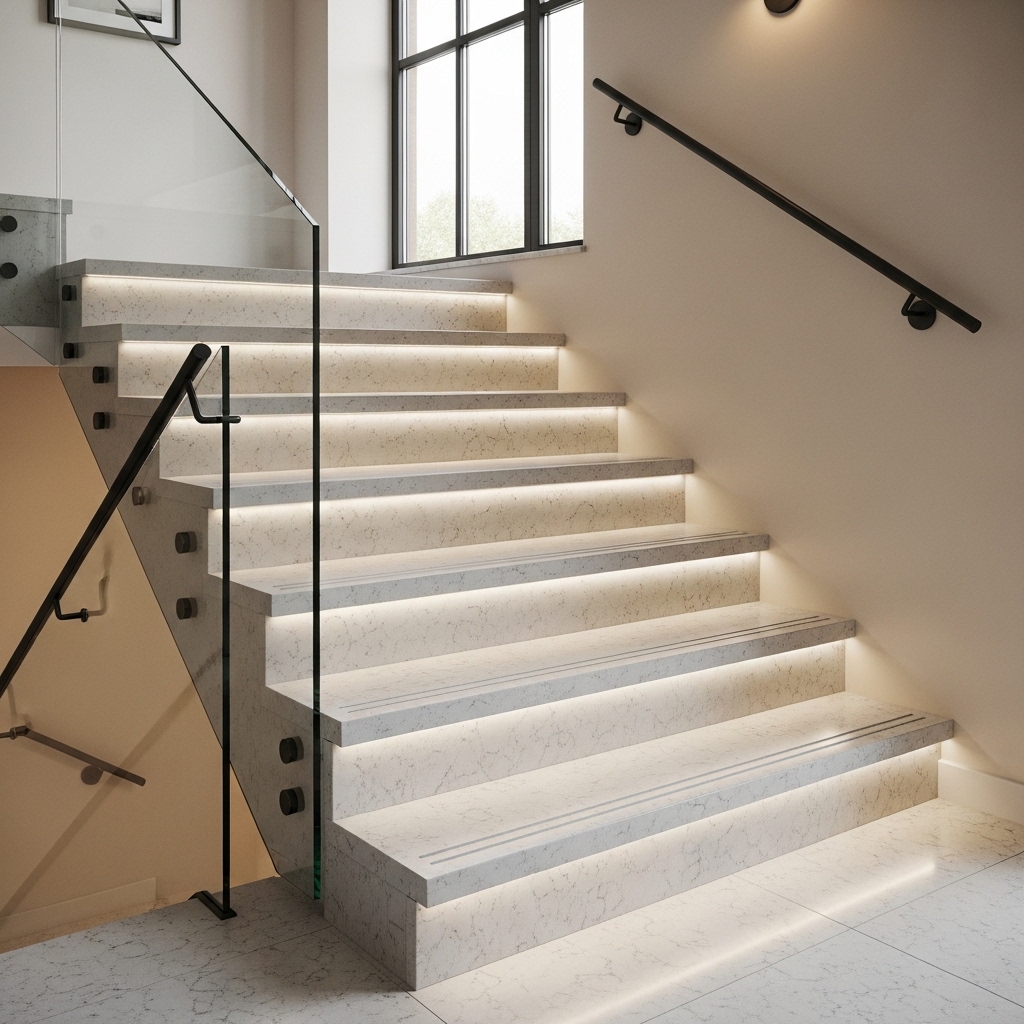
Standard granite slab dimension guide for stairs
A standard granite slab dimension guide for stairs explains how common slab availability ranges and thickness options translate into durable treads, neat risers, and clean landing surfaces.
Granite supply often comes in broad ranges such as 2400–3300 mm long and 1400–2000 mm wide (typical examples), and those ranges provide flexibility to cut repeated tread pieces with consistent tone.
Thickness options often include 20 mm and 30 mm for stair treads, with thicker profiles or built-up noses used when a bolder step edge is desired.
For example, planning the landing with fewer joints and pushing seams to the perimeter edges helps keep the turning point visually calm and more premium.
The guide also emphasizes consistent edge finishing and tight tolerances so every tread aligns cleanly and the stair line looks straight from all viewpoints.
Within the UAE stone trade, standard size of granite slab is often cited as a benchmark for natural stone planning, typically around 3000 mm long and 1600 mm wide, with slight variations by source. This size offers a good balance between coverage and manageability during fabrication. Designers also consider the average size of granite slab to estimate seams and overall material yield.
Standard Size of Granite Slab for Travertine Tiles Projects
Standard size of granite slab for travertine tiles projects usually refers to slabs around 2800–3200 mm in length, which are then cut into modular tile sizes for floors and walls. These slab dimensions allow efficient yield and consistent thickness across tiles. Coordinating slab cuts with travertine tiles layouts helps maintain uniform color tones and precise edge finishing.
Standard Size of Granite Slab for Raised Floor Applications
Standard size of granite slab for raised floor applications is usually selected within the range of 3000 × 1600 mm to allow modular planning. These dimensions support cutting into panels, counters, or borders that align with access floor grids. Using granite of this size alongside a raised floor ensures strength, stability, and clean detailing.