
Standard Quartz Slab Size
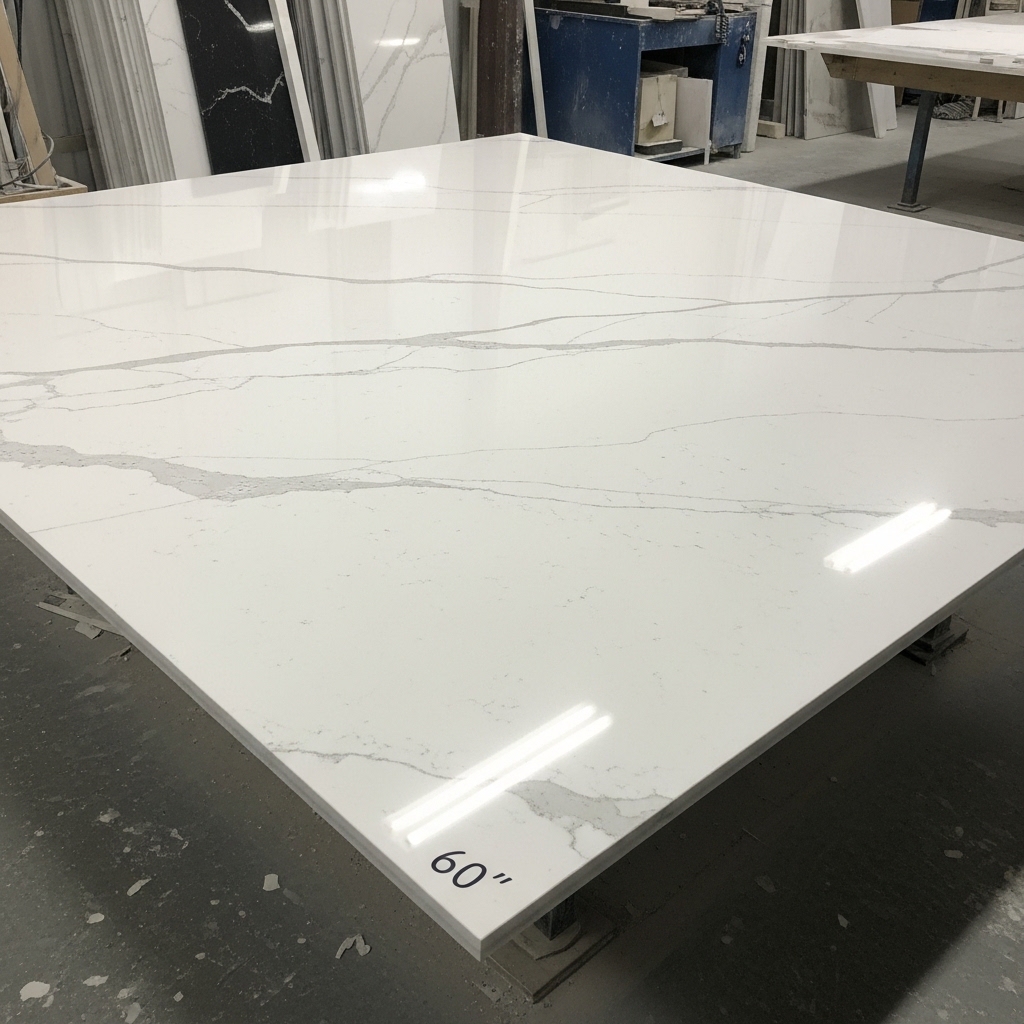
Standard quartz slab size is most commonly supplied in two mainstream formats used by fabricators: a “standard” slab around 56 in × 120 in (142.24 cm × 304.80 cm) and a “jumbo” slab around 63 in × 126 in (160.02 cm × 320.04 cm), which helps reduce seams on large countertops and islands. Many collections are produced primarily in 2 cm (0.79 in) and 3 cm (1.18 in; often sold as “1¼ in” nominal) thicknesses, and some lines also offer thinner options such as 12 mm (1.2 cm / 0.47 in) for applications that don’t require full countertop thickness.
Regular Size
56 in × 120 in, thickness 0.79 in (2 cm) or 1.18 in (3 cm).
Jumbo Size
63 in × 126 in, thickness 0.79 in (2 cm) or 1.18 in (3 cm).
Super Size
78 in × 138 in, thickness 0.79 in (2 cm) or 1.18 in (3 cm).
Super Jumbo
137.80 in × 78.74 in, thickness 0.79 in (2 cm) or 1.18 in (3 cm).
Mini Slab
48 in × 96 in, thickness 0.79 in (2 cm) or 1.18 in (3 cm).
A Guide to Standard Quartz Sheet Dimensions
When selecting standard quartz sheet dimensions for a project, it is essential to consider various factors that influence the final outcome.
Project dimensions play a crucial role; for instance, standard quartz sheets typically come in sizes such as 120” x 55” or 126” x 63”, which can affect how well they fit into your designated space.
The desired aesthetic is another significant consideration; larger sheets can create a seamless look, ideal for modern designs, while smaller pieces may be better suited for intricate patterns or traditional styles.
Budget constraints must also be taken into account, as larger sheets may reduce waste and labor costs, but they can also be more expensive upfront.
Additionally, the fabricator’s expertise can influence the choice of dimensions; some may specialize in larger formats, while others excel in custom cuts, which can affect both the quality and the cost of the installation.
Finally, specific design requirements, such as the need for cutouts for sinks or appliances, should guide the selection of dimensions to ensure functionality without compromising the overall aesthetic. By carefully evaluating these factors, you can make informed decisions that align with your vision and practical needs.
Why Choose a Jumbo Standard Quartz Sheet Format
A Guide to Standard Quartz Sheet Dimensions offers numerous advantages for both homeowners and professionals in the construction and design industries.
One of the primary benefits is the consistency in size, which simplifies the planning and installation process. Standard dimensions, such as 120 inches by 55 inches for jumbo sheets, allow for fewer seams and a more cohesive look in countertops and surfaces.
Additionally, using jumbo standard quartz sheets can significantly reduce waste, as larger sheets can cover more area with minimal cuts, leading to cost savings on materials.
The durability and low maintenance of quartz also make it an attractive option; it is non-porous, resistant to stains, and easy to clean, which is particularly beneficial in high-traffic areas.
Furthermore, the availability of various colors and patterns in standard dimensions ensures that designers can achieve their desired aesthetic without compromising on quality.
Overall, choosing a guide to standard quartz sheet dimensions not only enhances the efficiency of the installation process but also contributes to a polished and professional finish in any project.
Standard Waste Margin for Quartz Sheets
Standard Waste Margin for quartz sheets is an essential consideration in the fabrication process, as it directly impacts both cost and material efficiency. Typically, the waste margin for quartz sheets ranges from 10% to 20%, depending on the complexity of the design and the cutting patterns used.
When planning a project, it is crucial to account for this waste margin to ensure that sufficient material is ordered. For instance, if a project requires 100 square feet of finished quartz, one should order between 110 to 120 square feet of material to accommodate for potential waste.
Factors influencing the waste margin include the size of the slabs, the intricacy of the cuts, and the presence of any defects in the material. Additionally, using advanced cutting techniques and optimizing layout designs can help minimize waste, potentially reducing the margin to as low as 5% in some cases.
Ultimately, understanding and planning for the standard waste margin is vital for achieving a successful and cost-effective quartz installation.
Largest Standard Quartz Sheet Format
The largest standard quartz sheet format available in the market is typically 126 inches by 63 inches, which translates to approximately 10.5 feet by 5.25 feet. This expansive size allows for fewer seams in installations, making it an ideal choice for large countertops, wall cladding, and other applications where a seamless appearance is desired.
Quartz surfaces are engineered from natural quartz crystals, resins, and pigments, resulting in a durable and versatile material that is resistant to scratches, stains, and heat. The large format sheets not only enhance the aesthetic appeal of spaces but also provide practical benefits, such as easier maintenance and cleaning.
In terms of thickness, these sheets are commonly available in 1 cm, 2 cm, and 3 cm options, allowing for flexibility in design and application. The weight of a standard 2 cm thick quartz sheet can be around 20 pounds per square foot, making it essential to consider proper support and installation techniques, especially for larger formats.
The use of large standard quartz sheets is becoming increasingly popular in both residential and commercial projects. For instance, in kitchen renovations, a single sheet can cover an entire island or countertop, minimizing the need for joints and creating a sleek, modern look. Additionally, these sheets can be used in bathrooms for vanities and shower walls, providing a cohesive design element throughout the space.
Overall, the largest standard quartz sheet format offers a combination of beauty, durability, and functionality, making it a favored choice among designers and homeowners alike. The ability to create expansive surfaces with minimal seams not only enhances the visual appeal but also contributes to the longevity and ease of maintenance of the installations.
Standard Quartz Sheet Thickness for Heavy-Use Areas
Standard quartz sheets are increasingly popular in heavy-use areas due to their durability and aesthetic appeal. When considering the thickness of these sheets, it is essential to recognize that standard options typically range from 1 cm (approximately 0.39 inches) to 3 cm (about 1.18 inches).
For heavy-use applications, such as kitchen countertops or commercial surfaces, a thickness of 2 cm (0.79 inches) is often recommended. This thickness provides a balance between strength and weight, ensuring that the surface can withstand daily wear and tear without compromising structural integrity.
In environments where heavy objects are frequently placed on the surface, or where there is a risk of impact, opting for a thicker 3 cm (1.18 inches) quartz sheet can offer additional peace of mind. This thickness not only enhances the durability of the surface but also allows for more intricate edge profiles, which can elevate the overall design aesthetic.
Moreover, the choice of thickness can also influence the installation process. Thicker sheets may require additional support during installation, particularly in larger spans, to prevent sagging or cracking over time.
It is crucial to consult with professionals who can assess the specific needs of the space and recommend the appropriate thickness based on usage patterns and design preferences.
Ultimately, selecting the right thickness for quartz sheets in heavy-use areas is vital for ensuring longevity, functionality, and visual appeal.
Typical quartz slab dimensions for walls & decorative panels
Quartz is widely used for decorative wall panels because it offers consistent patterning across large surfaces, helping designers create clean, modern feature walls with predictable aesthetics and fewer variations than many natural stones.
Common slab formats used for wall panels often include 3000 × 1400 mm and 3200 × 1600 mm, with some collections offering larger formats around 3300 × 1650 mm to help span wider wall sections with fewer joints (figures shown as typical examples).
For decorative vertical paneling, thickness is often chosen in the 6–12 mm range to manage wall loading while still achieving a solid-surface appearance; thicker 20 mm options are usually selected when edges will be visible, when matching thick countertop profiles, or when a heavier architectural look is desired.
As a planning example, a 3200 × 1600 mm panel can anchor a feature wall zone, and seams can be placed along architectural breaks—like niche borders, door returns, or cabinet edges—so they visually disappear into the design.
For the most premium finish, fabricators typically pre-map vein direction, sequence panels for continuity, and keep joint spacing consistent so the wall reads like a unified stone-like canvas from end to end.
Standard quartz slab measurements for stairs
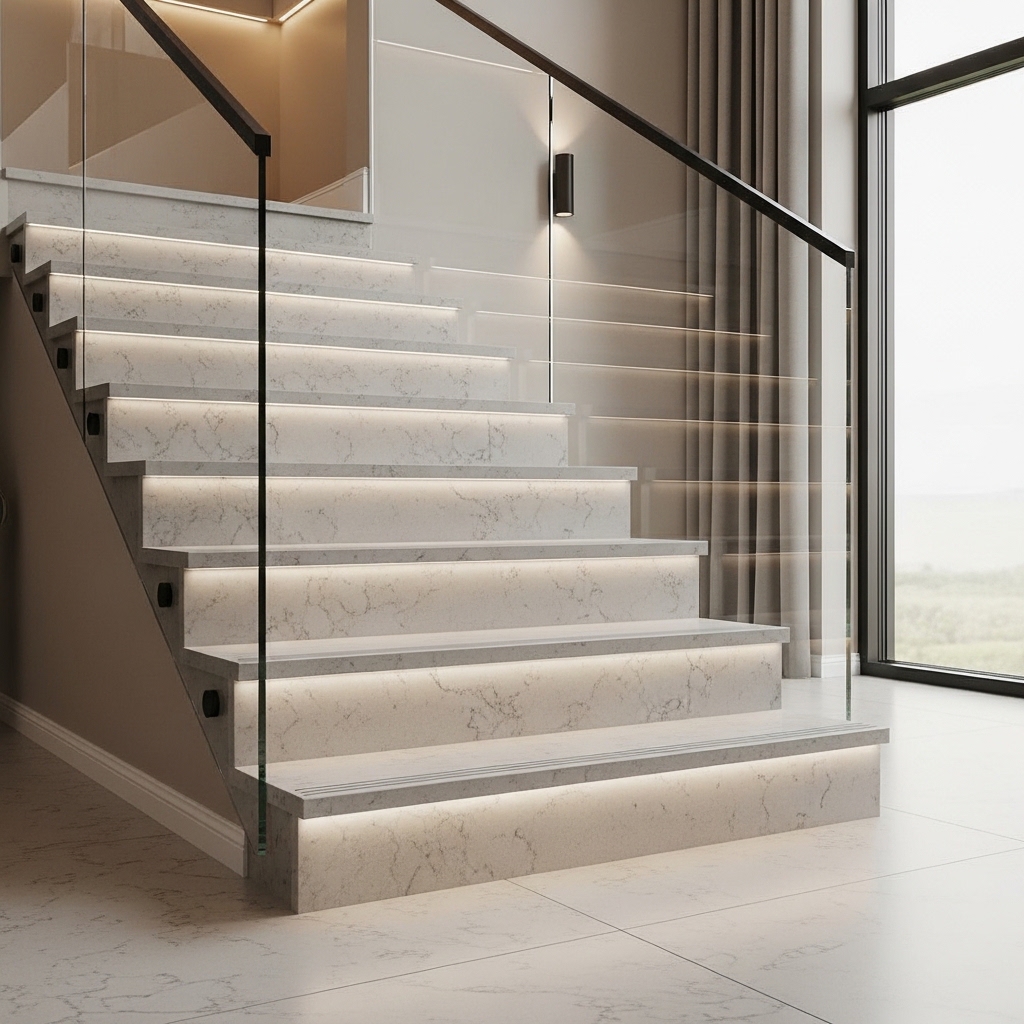
Standard quartz slab measurements are popular for stairs because they are widely available and provide enough surface area to cut repeated tread-and-riser components with consistent tone and pattern control.
Common standard formats often include examples like 3000 × 1400 mm and 3200 × 1600 mm, which can be planned to yield multiple treads plus risers while keeping the design coherent across a full flight.
For stair performance, thickness selection is usually around 20 mm, while thicker-looking edges can be achieved with build-ups at the step nose to create a stronger architectural profile without increasing overall weight too much.
As an example, one 3200 × 1600 mm slab covers about 5.12 m² (around 55 ft²), allowing efficient cutting for stairs and landings depending on your step geometry and layout plan.
Careful cut mapping helps keep veining direction consistent step-to-step and places any unavoidable seams in less visible areas such as side skirting or underneath nosing returns.
In the UAE, the standard quartz slab size most frequently supplied by major brands is about 3040 × 1440 mm (roughly 10 ft × 4.7 ft), with common thickness options of 20 mm and 30 mm depending on the project style and edge build-up. This format is popular because it efficiently covers typical counter depths (600–650 mm) and allows many L-shaped kitchens to be planned with fewer seams when layouts are templated correctly. Always confirm the size of quartz slab for the specific color series you choose, since some collections shift to jumbo formats like 3200 × 1600 mm, which can change seam placement and waste calculations.
Standard Quartz Slab Size Guide for Door Threshold Marble Installations
A standard quartz slab size guide for door threshold marble installations usually starts with slabs measuring approximately 3040 × 1440 mm, with 20 mm thickness being the most commonly used for residential projects. These dimensions allow fabricators to cut long countertop runs while also producing smaller transition pieces from the same slab. When detailing entryways and room transitions, a matching door threshold marble can be fabricated from slab offcuts, ensuring consistent color, thickness, and finish throughout the space.
Standard Quartz Slab Size Options for Raised Floor Fit-Outs
Standard quartz slab size options are well suited for premium interiors that integrate a raised floor fit-out. Most quartz manufacturers supply slabs in sizes close to 3040 × 1440 mm, which comfortably support long counter runs and modular layouts. These dimensions help maintain consistent floor-to-counter heights while coordinating with raised access panels, making quartz a practical choice for offices, laboratories, and contemporary kitchens.