
Kitchen Counter Size Guide
Kitchen counter size is usually planned around standard cabinet dimensions: the most common finished countertop depth is 25–25.5 in (63.50–64.77 cm) to cover 24 in (60.96 cm) base cabinets with a front overhang of about 1–1.5 in (2.54–3.81 cm). Typical finished countertop height is about 36 in (91.44 cm) from the floor, though this can vary slightly with cabinet height and flooring thickness. Straight countertop runs are cut to the kitchen layout, but common single-piece sections often land around 72–120 in long (182.88–304.80 cm) before seams, and islands commonly range about 36–60 in wide (91.44–152.40 cm) and 72–120 in long (182.88–304.80 cm). For stone/quartz counters, the most common thicknesses are 2 cm (0.79 in / 20 mm) and 3 cm (1.18 in / 30 mm), and thicker-looking edges are often “built up” to appear about 1.5 in (3.81 cm) without using a full 1.5 in slab.
Regular Size
25–25.5 in deep and 36 in high, thickness 0.79 in (2 cm) or 1.18 in (3 cm).
Jumbo Size
25–25.5 in deep and commonly 120–144 in long per section, thickness 0.79 in (2 cm) or 1.18 in (3 cm).
Super Size
25–25.5 in deep and commonly 144–168 in long per section, thickness 0.79 in (2 cm) or 1.18 in (3 cm).
Super Jumbo
25–25.5 in deep and commonly 168–180 in long per section, thickness 0.79 in (2 cm) or 1.18 in (3 cm).
Mini Slab
25–25.5 in deep and 36 in high, thickness 0.79 in (2 cm) or 1.18 in (3 cm).
Kitchen Countertop Dimension Guide
When planning a kitchen countertop, understanding the dimensions is crucial for both functionality and aesthetics.
The standard height for countertops is typically 36 inches, which accommodates most users comfortably. However, if the primary users are taller or shorter, adjustments may be necessary, with heights ranging from 34 to 38 inches.
The depth of countertops generally measures 25 to 26 inches, allowing for adequate workspace while ensuring that overhangs for seating areas are properly supported.
Desired aesthetics play a significant role in selecting materials and finishes; for instance, a sleek, modern look may favor quartz or granite with minimal seams, while a rustic design might incorporate butcher block or reclaimed wood.
Budget constraints are also a key factor, as high-end materials like marble can cost upwards of $100 per square foot, while laminate options may start around $20 per square foot.
It’s essential to consider the fabricator’s expertise, as some materials require specialized skills for installation; for example, intricate edge profiles or large slabs of stone may necessitate a fabricator experienced in handling heavy materials.
Lastly, specific design requirements, such as integrated sinks or unique shapes, can influence dimensions significantly. Custom countertops may need to be tailored to fit around appliances or accommodate specific layouts, often leading to dimensions that deviate from standard sizes. Overall, careful consideration of these factors will ensure a successful kitchen countertop project that meets both functional and aesthetic needs.
Kitchen Counter Dimensions: Jumbo Benefits
A kitchen countertop dimension guide offers numerous advantages that can significantly enhance both functionality and aesthetics in your cooking space.
First and foremost, having precise measurements ensures that your countertops fit seamlessly within your kitchen layout, preventing awkward gaps or overcrowding. For instance, standard countertop height is typically around 36 inches, which is ergonomically designed for comfortable food preparation.
Additionally, understanding the recommended depth of 25 to 26 inches allows for ample workspace while accommodating appliances and sinks without compromising usability.
A well-planned countertop dimension can also improve workflow; for example, a kitchen triangle formed by the stove, sink, and refrigerator should ideally be between 12 to 26 feet to facilitate efficient movement.
Furthermore, a dimension guide can help in selecting materials and finishes that complement your kitchen’s design, ensuring that your countertops not only serve their practical purpose but also enhance the overall aesthetic appeal.
Ultimately, investing time in understanding kitchen countertop dimensions can lead to a more organized, efficient, and visually pleasing cooking environment.
Practical Waste Allowance for Kitchen Countertops
Practical Waste Allowance for Kitchen Countertops is an essential consideration in kitchen design and renovation, ensuring that the materials used are sufficient to cover the intended surface area while accounting for potential waste during installation. Typically, a waste allowance of 10% to 15% is recommended for natural stone countertops, such as granite or marble, due to the possibility of cracks, chips, or color variations that may occur in the slabs. For engineered materials like quartz, a waste allowance of around 5% to 10% is often adequate, as these materials are generally more uniform and less prone to defects. When calculating the total amount of material needed, it is crucial to measure the countertop area accurately, taking into account any cutouts for sinks or appliances. For instance, if the total countertop area is 50 square feet, adding a 10% waste allowance would mean ordering an additional 5 square feet, resulting in a total of 55 square feet of material. This practice not only helps in achieving a seamless and aesthetically pleasing finish but also minimizes the risk of delays and additional costs associated with ordering extra materials later on. Proper planning and consideration of waste allowances can lead to a more efficient installation process and a beautifully finished kitchen space.
Kitchen Counters: Biggest Format Options
Kitchen counters come in a variety of formats, each offering unique benefits and aesthetic appeal. One of the biggest format options available is the slab countertop, which typically measures 10 to 12 feet in length and 5 to 6 feet in width. These large slabs provide a seamless look that is not only visually striking but also functional, as they minimize the number of seams and joints that can trap dirt and bacteria.
Another popular option is the modular countertop, which consists of smaller sections that can be combined to create a larger surface. These sections usually come in dimensions of 3 to 4 feet in length and 2 to 3 feet in width. Modular countertops are particularly advantageous for homeowners who want to customize their kitchen layout or who may need to navigate tight spaces. The flexibility of modular designs allows for easy installation and replacement, making them a practical choice for many.
In addition to size, the material of the countertop plays a crucial role in its overall appearance and durability. For instance, quartz countertops are available in large slabs that can reach up to 120 inches in length, providing a luxurious and modern look. On the other hand, natural stone options like granite and marble can also be found in expansive formats, often exceeding 10 feet in length, which enhances their elegance and creates a stunning focal point in any kitchen.
When considering the biggest format options for kitchen counters, it is essential to think about the installation process as well. Larger slabs often require professional installation due to their weight and the precision needed to fit them correctly. This can add to the overall cost, but the investment is often worth it for the high-end finish and durability that these countertops provide.
Ultimately, the choice of kitchen counter format will depend on personal preferences, budget, and the specific needs of the kitchen space. Whether opting for a large slab or a modular design, the right countertop can significantly enhance both the functionality and aesthetic appeal of the kitchen.
Kitchen Worktops: Thickness for High-Use Zones
When selecting kitchen worktops, the thickness of the material plays a crucial role, especially in high-use zones where durability and resilience are paramount. Typically, worktops range from 20mm to 40mm in thickness, with thicker options providing enhanced strength and longevity. In areas that experience frequent use, such as around the sink and cooking zones, opting for a thicker worktop can significantly reduce the risk of damage from impacts, heat, and moisture.
For instance, a 30mm thick granite or quartz worktop can withstand heavy pots and pans being placed on it without the fear of chipping or cracking. In contrast, a 20mm worktop may be more susceptible to wear and tear, particularly in busy kitchens where multiple activities occur simultaneously. Moreover, thicker worktops often provide a more substantial visual presence, contributing to the overall aesthetic appeal of the kitchen. A 40mm thick worktop can create a luxurious look, making it a popular choice for homeowners looking to elevate their kitchen design.
In addition to aesthetics and durability, the thickness of the worktop can also influence the installation process. Thicker materials may require additional support during installation, especially if they are being fitted over cabinets without a solid base. It is essential to consider the weight of the material as well; for example, a 30mm thick granite worktop can weigh significantly more than a 20mm laminate option, necessitating careful planning to ensure that the cabinetry can support the load.
Ultimately, when choosing the thickness of kitchen worktops for high-use zones, it is vital to balance functionality, durability, and design preferences. Investing in a thicker worktop can provide peace of mind in a busy kitchen environment, ensuring that the surface remains not only beautiful but also practical for years to come.
Kitchen counter dimensions for walls & decorative surfaces
Kitchen counter dimensions influence wall and decorative surface planning when countertops extend into full-height backsplashes, waterfall side panels, bar fronts, or matching wall cladding, because the goal is usually a visually continuous material story.
Many kitchens plan the countertop and backsplash together so the slab pattern aligns, especially around key zones like the sink wall and hob wall where the decorative surface is seen up close and must remain easy to clean.
A common approach is to cut a backsplash panel from the same slab as the countertop run, ensuring tone consistency and allowing veins to “climb” the wall in a natural direction rather than appearing mismatched.
For example, one slab can be optimized to create the main counter surface plus a full-height backsplash section, with seams positioned at cabinet edges or in corners so joints are less noticeable during daily use.
When counters become decorative wall elements, designers often coordinate edge details and returns so the vertical pieces look intentionally integrated—especially on waterfall ends where the side panel is a prominent visual feature.
Kitchen counter dimensions for stairs
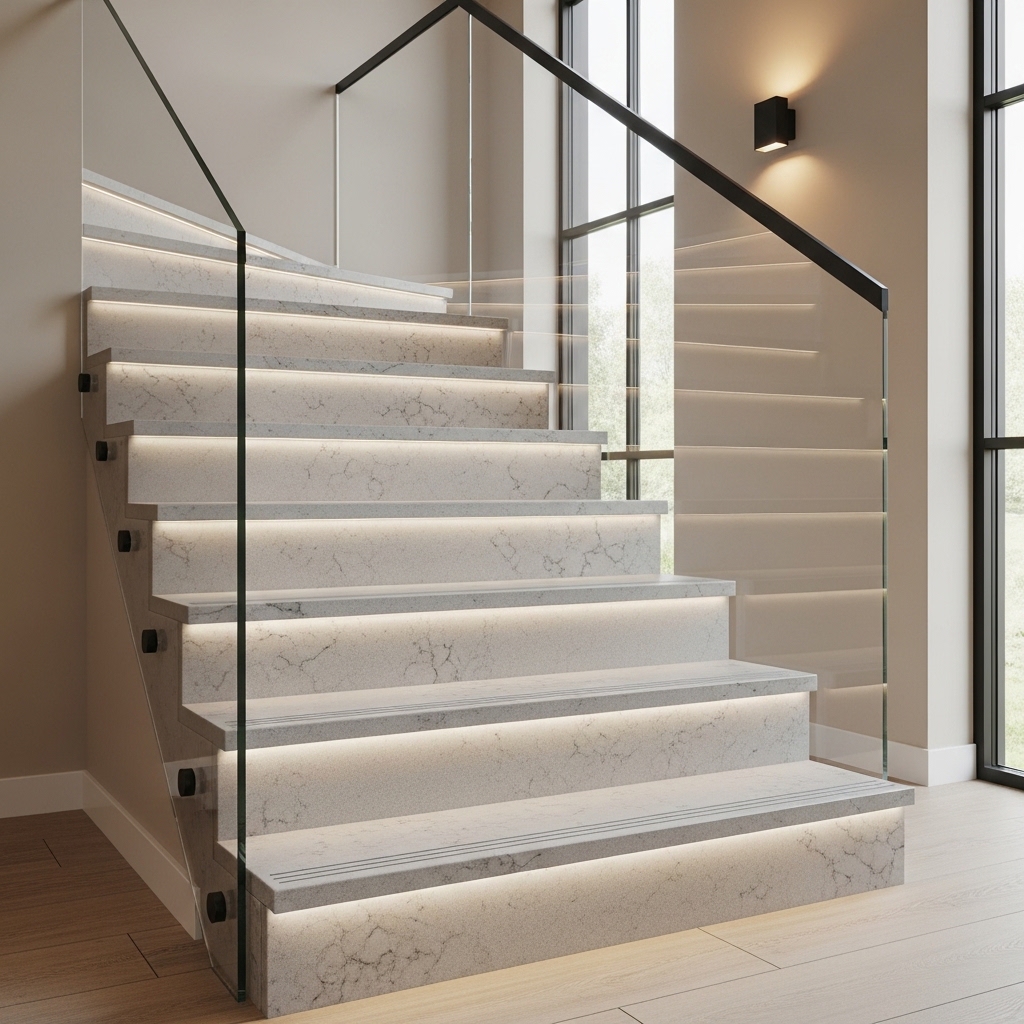
Kitchen counter dimensions can influence stair design when the same slab material is used across open-plan spaces to create a unified interior language between the kitchen and adjacent stair zones.
Common planning benchmarks for counters include a height around 900 mm and depth around 600 mm (typical examples), and those module lines often guide where seams and pattern directions are aligned on nearby architectural elements like stairs.
For example, using the same quartz design on a kitchen island and stair treads can create visual continuity, especially when the pattern direction is coordinated and finishes are matched.
In many projects, stair treads use durable thickness (often 20 mm) while vertical cladding or side panels may use lighter builds to reduce load and simplify installation.
Coordinating the detailing—edge profiles, joint spacing, and finish level—helps the kitchen and staircase feel like part of one coherent design rather than separate material decisions.
Modern UAE homes typically follow a kitchen counter size of 600–650 mm depth for perimeter counters, island widths of 900–1200 mm, and working heights around 900–950 mm including the stone. These standards influence slab selection because longer runs benefit from fewer seams and wider slabs. During consultations, clients often ask what is the size of a slab of quartz to understand whether their layout can be fabricated from a single piece.
Kitchen Counter Size Ideas for Calacatta Viola Inspired Interiors
Kitchen counter size ideas for Calacatta Viola inspired interiors usually follow standard dimensions of 600–650 mm depth and heights around 900–950 mm, with island widths extending to 1000–1200 mm for visual impact. These proportions allow bold veining to remain the focal point without overcrowding the space. Designing counters around calacatta viola aesthetics benefits from generous slab coverage and carefully planned seam placement.
Kitchen Counter Size Coordination with Raised Floor Levels
Kitchen counter size coordination is especially important when counters are installed adjacent to or above a raised floor. Standard counter depths of 600–650 mm and finished heights of 900–950 mm must be carefully aligned with floor build-up levels. Proper coordination prevents step differences, maintains ergonomic comfort, and ensures seamless transitions between fixed and access flooring areas.