
Kitchen Slab Standard Size
Kitchen slab standard size (kitchen countertop standard sizing) is based on typical cabinet dimensions and ergonomic height: the most common finished countertop depth is 25–25.5 in (63.50–64.77 cm) to cover 24 in (60.96 cm) base cabinets with a front overhang of about 1–1.5 in (2.54–3.81 cm), and the standard finished countertop height is about 36 in (91.44 cm) from the floor. Straight counter runs are cut to the kitchen plan, but a common single-piece section length is often around 72–120 in (182.88–304.80 cm) before seams are added for longer walls, while islands are frequently about 36–60 in wide (91.44–152.40 cm) and 72–120 in long (182.88–304.80 cm). For stone or quartz kitchen slabs, the most common thicknesses are 2 cm (0.79 in / 20 mm) and 3 cm (1.18 in / 30 mm), and thicker-looking edges are often built up to about 1.5 in (3.81 cm) using laminated edging.

Regular Size
25–25.5 in deep and commonly 96–120 in long per section, thickness 0.79 in (2 cm) or 1.18 in (3 cm).
Jumbo Size
25–25.5 in deep and commonly 120–144 in long per section, thickness 0.79 in (2 cm) or 1.18 in (3 cm).
Super Size
25–25.5 in deep and commonly 144–168 in long per section, thickness 0.79 in (2 cm) or 1.18 in (3 cm).
Super Jumbo
25–25.5 in deep and commonly 168–180 in long per section, thickness 0.79 in (2 cm) or 1.18 in (3 cm).
Mini Slab
25–25.5 in deep and commonly 60–72 in long per section, thickness 0.79 in (2 cm) or 1.18 in (3 cm).
Choosing Standard Kitchen Counter Dimensions
When choosing standard kitchen counter dimensions, it is essential to consider project dimensions, desired aesthetic, budget constraints, fabricator’s expertise, and specific design requirements.
The standard height for kitchen counters is typically 36 inches, which accommodates most users comfortably, while the depth usually ranges from 24 to 30 inches. If space allows, a depth of 30 inches can provide additional workspace.
Aesthetic preferences play a significant role; for instance, a modern kitchen may benefit from sleek, minimalist counters, while a traditional design might call for thicker, more ornate surfaces.
Budget constraints are crucial as well; high-end materials like quartz or granite can range from $50 to $200 per square foot, while laminate options may only cost $10 to $40 per square foot.
The expertise of the fabricator should also be considered, as some materials require specialized skills for installation.
Lastly, specific design requirements, such as incorporating a breakfast bar or accommodating appliances, may necessitate custom dimensions, which can affect overall costs and layout. Balancing these factors will ensure a functional and visually appealing kitchen counter that meets your needs.
Standard Kitchen Worktop Dimensions: Why Jumbo Helps
Choosing standard kitchen counter dimensions offers numerous advantages that can significantly enhance both functionality and aesthetics in your kitchen. Standard dimensions, typically around 36 inches in height and 24 inches in depth, provide an ergonomic workspace that accommodates a wide range of users, ensuring comfort during meal preparation.
This uniformity simplifies the design process, allowing for easier planning and installation, as most cabinetry and appliances are designed to fit these standard measurements.
Additionally, opting for standard worktop dimensions can lead to cost savings, as materials are often more readily available and less expensive due to their widespread use.
For instance, a standard countertop size of 96 inches in length can easily fit into most kitchen layouts without the need for custom fabrication, which can be both time-consuming and costly.
Furthermore, standard dimensions facilitate better resale value; potential buyers are often more attracted to homes with kitchens that adhere to conventional sizes, as they can envision their own furniture and appliances fitting seamlessly into the space.
Jumbo helps guide homeowners in selecting the right dimensions by providing expert advice and a wide range of options that cater to both standard and custom needs, ensuring that every kitchen is not only functional but also tailored to individual preferences.
Typical Waste Allowance for Standard Kitchen Worktops
When planning for a kitchen renovation, it’s essential to consider the typical waste allowance for standard kitchen worktops, which generally ranges from 5% to 10% of the total material required. This allowance accounts for potential mistakes during cutting, fitting, and installation, as well as any defects in the material itself. For instance, if you are installing a worktop that measures 20 square meters, you should plan for an additional 1 to 2 square meters of material to cover any unforeseen issues.
It’s important to note that different materials may have varying waste factors; for example, natural stone may require a higher allowance due to its unique patterns and the need for careful selection of pieces to ensure aesthetic continuity.
Additionally, when ordering materials, it’s advisable to consult with your supplier, as they can provide insights based on their experience and the specific characteristics of the worktop material you choose. By incorporating a proper waste allowance into your budget and planning, you can avoid delays and additional costs, ensuring a smoother installation process and a beautifully finished kitchen.
Kitchen Worktops: Largest Standard Format
Kitchen worktops are a crucial element in any kitchen design, serving both functional and aesthetic purposes. When considering the largest standard format for kitchen worktops, it is essential to understand the dimensions and materials available. Typically, the largest standard size for a kitchen worktop is around 3 meters in length and 1.2 meters in width, although some manufacturers offer even larger slabs, reaching up to 3.6 meters in length. This expansive size allows for fewer seams, creating a more seamless and visually appealing surface.
The choice of material also plays a significant role in the overall performance and durability of the worktop. Common materials include granite, quartz, laminate, and solid wood, each offering unique benefits. For instance, granite is renowned for its heat resistance and durability, while quartz provides a non-porous surface that is easy to maintain. The thickness of these worktops typically ranges from 20mm to 30mm, with thicker options available for those seeking a more robust appearance.
In terms of installation, larger worktops can pose challenges due to their weight and size. It is advisable to have professional installers handle the fitting to ensure proper support and alignment. Additionally, larger worktops may require reinforced cabinetry to bear the weight, especially when using heavier materials like granite or quartz.
The aesthetic appeal of large-format worktops cannot be overstated. They can create a striking focal point in the kitchen, especially when paired with complementary cabinetry and backsplash designs. The continuous surface allows for creative design possibilities, such as integrated sinks and cooktops, which enhance both functionality and style.
In conclusion, opting for the largest standard format kitchen worktops can significantly elevate the kitchen’s overall look and usability. With careful consideration of materials, dimensions, and installation, homeowners can achieve a stunning and practical kitchen space that meets their needs for years to come.
Kitchen Worktops: Thickness for High-Traffic Floors
When selecting kitchen worktops for high-traffic areas, thickness plays a crucial role in ensuring durability and longevity. Typically, worktops range from 20mm to 40mm in thickness, with thicker options providing enhanced strength and resistance to wear and tear. For high-traffic kitchens, a thickness of at least 30mm is often recommended, as it can better withstand the daily rigors of cooking, chopping, and other activities that occur in busy households.
In addition to thickness, the material of the worktop significantly influences its performance. For instance, granite and quartz are popular choices due to their inherent strength and resistance to scratches and heat. Granite worktops, often available in 30mm and 40mm thicknesses, can handle heavy pots and pans without showing signs of damage. Similarly, quartz surfaces, which can also be found in similar thicknesses, offer a non-porous surface that resists staining, making them ideal for high-traffic environments.
Another factor to consider is the edge profile of the worktop. Thicker edges not only provide a more robust appearance but also contribute to the overall strength of the worktop. For example, a 40mm thick worktop with a rounded edge can help prevent chipping and damage that may occur from daily use. Furthermore, the aesthetic appeal of thicker worktops can enhance the overall design of the kitchen, providing a more substantial and luxurious look.
Ultimately, investing in a thicker worktop for high-traffic kitchens is a wise decision. It not only ensures that the surface can withstand the demands of a bustling kitchen but also adds to the visual appeal of the space. Choosing a thickness of 30mm or more can provide peace of mind, knowing that the worktop will remain functional and beautiful for years to come.
Typical kitchen slab measurements for walls & decorative surfaces
Typical kitchen slab measurements for walls and decorative surfaces are usually planned around creating continuity between worktops and vertical areas like full-height backsplashes, hob walls, bar fronts, and waterfall ends.
Many kitchens use large slab formats (often in the same family as countertop slabs) so the visual field stays clean and grout-free, while still allowing practical handling and installation on-site.
For vertical applications, fabricators frequently choose 6–12 mm thickness panels where available to reduce wall load, while thicker 20 mm pieces may be selected for waterfall sides or areas with exposed edges that need a stronger profile.
As an example, a full-height backsplash can be planned as one main panel plus small side returns, keeping seams away from the focal zone behind the hob and aligning them to cabinet edges for a neat finish.
Good planning also considers outlets, tap penetrations, and window reveals so cut-outs sit cleanly and the final wall surface stays visually balanced and easy to maintain.
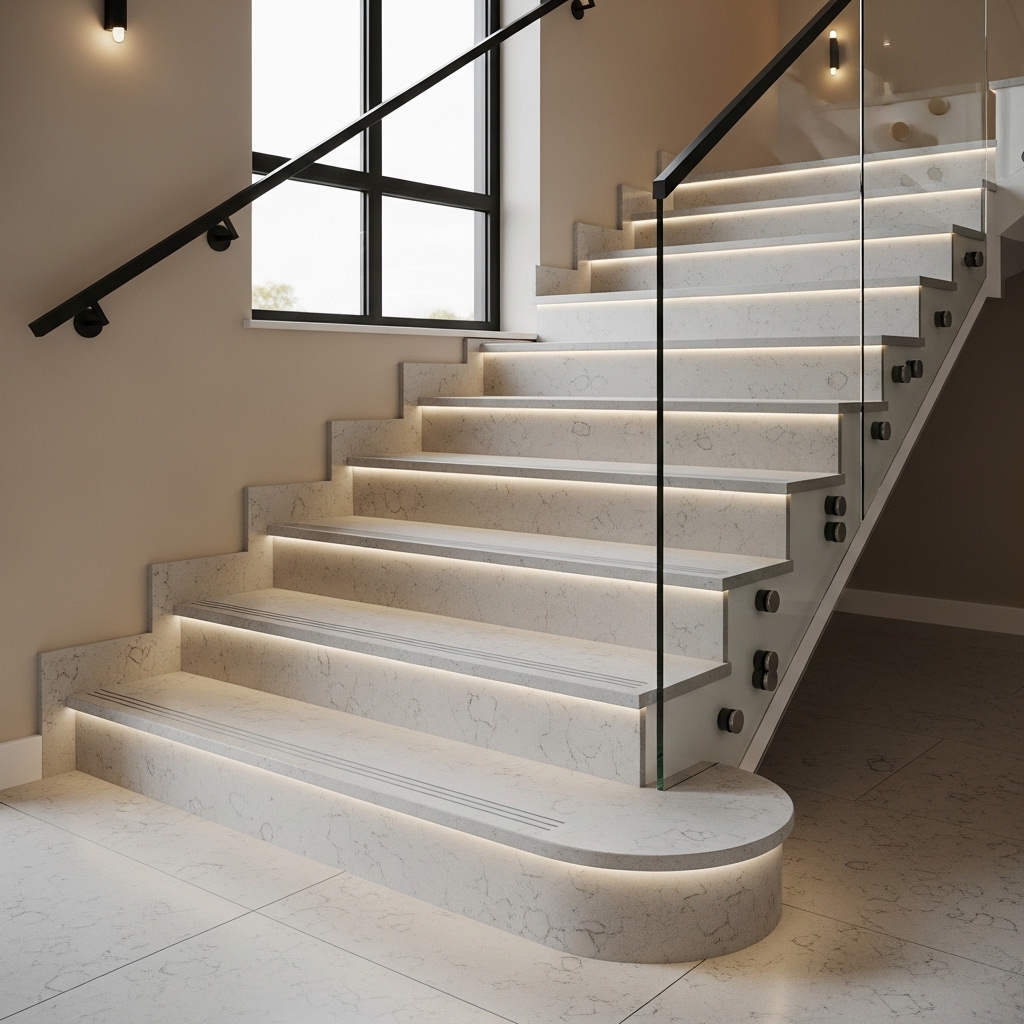
Typical kitchen slab measurements for stairs
Kitchen slabs used on stairs are typically sourced from the same product families as countertop materials, so they come in large formats that can be cut into repeated treads, risers, and a coordinated landing surface.
Common supply examples include large slabs like 3000 × 1400 mm or 3200 × 1600 mm, which provide enough area to maintain consistent tone across the full stair run when pieces are cut from the same batch.
For stair durability, tread thickness is often planned around 20 mm, while a thicker-looking step nose can be created using an edge build-up to achieve a bold profile without using full heavy thickness everywhere.
For example, matching a kitchen island cladding to stair treads works best when all tread cuts follow the same orientation, so any veining or movement looks intentional as it climbs the staircase.
Finish selection matters on steps—many choose a matte or honed surface for a more practical feel and specify an eased or small chamfered edge to reduce chipping at the nose.
In UAE residential projects, kitchen slab standard size is generally planned around functional ergonomics, with counter depths of 600–650 mm, island widths of 900–1200 mm, and finished heights close to 900–950 mm including the stone. These dimensions are chosen to balance comfort, appliance clearance, and efficient slab utilization. For material planning, fabricators often benchmark layouts against the average quartz slab size, which helps determine seam placement and waste before fabrication begins.
Kitchen Slab Standard Size for Blue Onyx Marble Feature Installations
Kitchen slab standard size for Blue Onyx marble feature installations is usually planned around common kitchen dimensions, with counter depths of 600–650 mm, island widths of 900–1200 mm, and finished heights close to 900–950 mm. Standard slab selections around 2800–3000 mm in length allow feature panels, backsplashes, and counters to be cut with controlled seams. Using blue onyx marble within these slab standards highlights its translucency and veining while maintaining structural stability and visual balance.
Kitchen Slab Standard Size for Raised Floor Fit-Outs
Kitchen slab standard size selection is a key factor in raised floor fit-outs where finished heights and service access must align accurately. Standard kitchen slabs are usually planned at depths of 600–650 mm with an overall finished height of 900–950 mm, accounting for subfloor build-up. When integrated with a raised floor, slab thicknesses of 20 mm or 30 mm help maintain strength, clean transitions, and long-term performance.