
Kitchen Countertop Size Guide
Kitchen countertop size is generally standardized around cabinet modules and comfort height: the most common finished countertop depth is 25–25.5 in (63.50–64.77 cm) to cover 24 in (60.96 cm) base cabinets with a front overhang of about 1–1.5 in (2.54–3.81 cm), and finished counter height is usually about 36 in (91.44 cm) from the floor. Countertop lengths are custom-cut to the room, but common single-piece straight sections often fall around 72–120 in (182.88–304.80 cm) before seams are needed, while islands frequently range about 36–60 in wide (91.44–152.40 cm) and 72–120 in long (182.88–304.80 cm). Typical countertop material thickness (stone/quartz) is 2 cm (0.79 in / 20 mm) or 3 cm (1.18 in / 30 mm), and many kitchens use a built-up edge to make the front look about 1.5 in thick (3.81 cm) without using a full 1.5 in slab.
Regular Size
25–25.5 in deep and 36 in high, thickness 0.79 in (2 cm) or 1.18 in (3 cm).
Jumbo Size
25–25.5 in deep and 36 in high, thickness 0.79 in (2 cm) or 1.18 in (3 cm).
Super Size
25–25.5 in deep and 36 in high, thickness 0.79 in (2 cm) or 1.18 in (3 cm).
Super Jumbo
25–25.5 in deep and 36 in high, thickness 0.79 in (2 cm) or 1.18 in (3 cm).
Mini Slab
25–25.5 in deep and 36 in high, thickness 0.79 in (2 cm) or 1.18 in (3 cm).
Kitchen Counter Measurements Guide
When planning a kitchen counter, precise measurements are crucial to ensure functionality and aesthetic appeal.
Start by considering project dimensions; standard countertop height is typically 36 inches, while depth ranges from 24 to 30 inches. For islands, a height of 42 inches is common for bar seating.
Desired aesthetic plays a significant role in material selection and design; for instance, quartz and granite offer a modern look, while butcher block provides a rustic charm.
Budget constraints must also be factored in, as high-end materials can range from $50 to $200 per square foot, while more affordable options like laminate can start as low as $10 per square foot.
The fabricator’s expertise is essential; experienced professionals can provide insights on material durability and maintenance, ensuring the chosen design is practical.
Lastly, specific design requirements, such as integrated sinks or unique edge profiles, should be clearly communicated to the fabricator to achieve the desired outcome. By carefully considering these factors, homeowners can create a kitchen counter that is both functional and visually appealing.
Kitchen Counter Measurements: Jumbo Benefits
A kitchen counter measurements guide offers numerous advantages that can significantly enhance both functionality and aesthetics in your cooking space.
First and foremost, accurate measurements ensure that your countertops fit perfectly within your kitchen layout, preventing gaps or overcrowding that can disrupt workflow. For instance, standard counter height is typically around 36 inches, which is ideal for most users, while the depth usually ranges from 24 to 25 inches, providing ample workspace for food preparation.
Additionally, having a reliable guide helps in planning for appliances and fixtures, ensuring that everything from your sink to your stove is positioned optimally for convenience. This can lead to a more efficient kitchen triangle, where the stove, sink, and refrigerator are ideally spaced within a 26 to 27-foot perimeter, minimizing unnecessary movement while cooking.
Furthermore, a well-measured kitchen counter can enhance the overall aesthetic appeal of the space, allowing for a cohesive design that complements cabinetry and flooring. By adhering to a measurement guide, homeowners can avoid costly mistakes and ensure that their investment in countertops yields the best possible results, both in terms of usability and visual impact.
Ultimately, a kitchen counter measurements guide serves as an essential tool for anyone looking to create a functional and beautiful kitchen environment.
Kitchen Countertops: General Waste Allowance
When selecting kitchen countertops, understanding the general waste allowance is crucial for accurate budgeting and planning. Typically, a waste allowance of 10% to 15% is recommended to account for cuts, seams, and potential defects in the material. For instance, if you are purchasing 50 square feet of granite, you should consider ordering an additional 5 to 7.5 square feet to ensure you have enough material for installation. This allowance helps to mitigate the risk of running short during the project, especially when dealing with natural stone, which can have variations in color and pattern. Additionally, different materials may have varying waste factors; for example, quartz may require a lower waste allowance due to its engineered nature, often resulting in more consistent sizing. It’s also essential to consult with your fabricator, as they can provide insights based on their experience and the specific characteristics of the material you choose. By factoring in the general waste allowance, you can avoid unexpected costs and ensure a smoother installation process, ultimately leading to a more satisfying kitchen renovation experience.
Kitchen Countertops: Biggest Format Options
When considering kitchen countertops, one of the most significant factors is the format size. Large format countertops have gained immense popularity due to their aesthetic appeal and practical benefits. These countertops typically come in dimensions that exceed the standard sizes, often measuring 60 inches by 120 inches or even larger. This expansive size allows for fewer seams, creating a more seamless and visually appealing surface.
One of the most sought-after materials for large format countertops is porcelain. Porcelain slabs can be manufactured in sizes up to 10 feet long and 5 feet wide, making them ideal for expansive kitchen islands or continuous countertop runs. The durability of porcelain, combined with its resistance to scratches, stains, and heat, makes it a practical choice for busy kitchens.
Another popular option is quartz, which can also be found in large slabs. Quartz countertops can be produced in sizes up to 120 inches by 55 inches, providing ample surface area for cooking and entertaining. The non-porous nature of quartz means it does not require sealing, making maintenance easier for homeowners.
Granite is another classic choice, with large slabs available that can measure up to 10 feet long. While granite is a natural stone and offers unique patterns and colors, it does require periodic sealing to maintain its appearance and prevent staining. The size of granite slabs allows for expansive designs, making it a favorite for those looking to create a luxurious kitchen space.
In addition to aesthetics and functionality, large format countertops can also enhance the overall value of a home. According to industry experts, homes with high-quality, large format countertops can see an increase in resale value by as much as 10%. This makes investing in larger slabs not only a design choice but also a financial one.
Ultimately, the choice of kitchen countertops in larger formats can significantly impact the look and feel of a kitchen. With options like porcelain, quartz, and granite available in impressive sizes, homeowners can create stunning, functional spaces that cater to their cooking and entertaining needs while also adding value to their property.
Kitchen Countertops: Best Thickness for Busy Areas
When selecting kitchen countertops for busy areas, the thickness of the material plays a crucial role in both functionality and aesthetics. Typically, countertops range from 1 to 3 centimeters in thickness, with 2 centimeters (approximately ¾ inch) being a common choice for many homeowners. This thickness strikes a balance between durability and weight, making it suitable for various applications.
For high-traffic kitchens, opting for a thicker countertop, such as 3 centimeters (about 1¼ inches), can provide added strength and resistance to chipping or cracking. This is particularly important in environments where heavy pots and pans are frequently placed on the surface, as well as in homes with children or pets that may inadvertently cause damage.
Moreover, thicker countertops often offer a more substantial appearance, which can enhance the overall design of the kitchen. A 3-centimeter countertop can create a more luxurious look, especially when paired with a waterfall edge or a dramatic overhang. In addition to aesthetics, thicker materials can also provide better support for heavy appliances, such as built-in mixers or food processors, which are common in busy kitchens.
Another factor to consider is the type of material used for the countertops. For instance, natural stones like granite and quartzite are often available in various thicknesses, and their inherent durability makes them ideal for busy areas. On the other hand, materials like laminate or solid surface may not require as much thickness to achieve the same level of durability, but they may not offer the same visual impact.
Ultimately, the best thickness for kitchen countertops in busy areas depends on a combination of personal preference, design goals, and practical considerations. Choosing a thickness that aligns with your lifestyle and kitchen usage will ensure that your countertops not only look great but also stand the test of time. Investing in a thicker countertop can be a wise decision for those who frequently cook or entertain, as it provides peace of mind knowing that the surface can withstand the rigors of daily use.
Kitchen countertop measurement guide for walls & decorative surfaces
A kitchen countertop measurement guide for walls and decorative surfaces focuses on coordinating vertical panels with the countertop layout so pattern flow, seam placement, and functional cut-outs all work together.
Many designs extend the countertop material into a full-height backsplash or feature wall behind the hob, so measuring includes not only length runs but also heights up to cabinets, shelves, or ceiling lines.
For example, a single slab batch can be planned to produce both the countertop and a matching backsplash panel, allowing veining to “continue” upward for a more intentional, high-end look.
Wall-friendly thicknesses like 6–12 mm are often preferred for vertical panels, while thicker 20 mm may be used for waterfall ends or exposed edges where profile matters.
Precise measuring also includes sink and hob clearances, socket locations, and window reveals so the finished surface remains easy to clean and visually aligned with cabinetry lines.
Kitchen countertop measurement guide for stairs
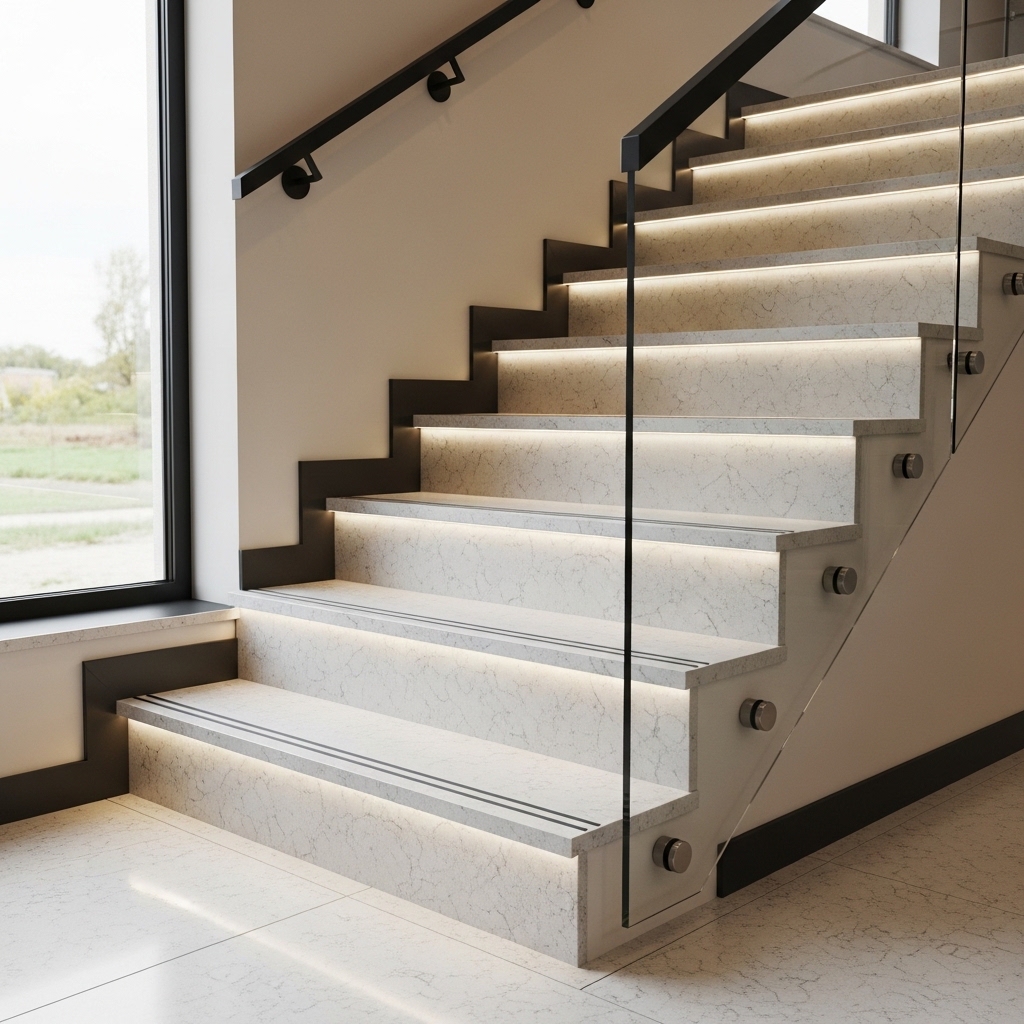
A kitchen countertop measurement guide for stairs is most useful when the same surface material is being extended from the kitchen into stair treads, landings, or adjacent feature cladding for a cohesive interior look.
Start by confirming the countertop slab selection and batch consistency, then measure the stair flight (width, tread depth, riser height) and map which pieces need to visually match the kitchen focal points like islands or waterfall ends.
For example, if the kitchen island cladding uses a strong vein direction, the stair treads can be cut in the same orientation so the material story continues naturally through the space.
Stair treads typically need robust thickness (often 20 mm), and a durable edge profile (eased or small chamfer) helps protect the step nose in heavy use.
The guide also includes seam strategy—keeping joints away from the center of landings and aligning any necessary seams to side returns or skirting lines to keep the stair finish clean and premium.
Typical kitchen countertop size in UAE homes follows well-established norms, with depths of about 600–650 mm for wall counters and island widths reaching 900–1200 mm, depending on space and layout. Heights are usually set around 900–950 mm to suit daily use and appliance integration. These standards closely align with the kitchen platform size used by designers and contractors during planning.
Kitchen Countertop Size Planning for Corian Countertop Installations
Kitchen countertop size planning for Corian countertop installations generally follows standard depths of 600–650 mm, island widths of 900–1200 mm, and working heights around 900–950 mm including the surface. These dimensions support ergonomic use and seamless integration of sinks and appliances. Choosing a corian countertop within these size parameters allows smooth joints, curved details, and integrated backsplashes without visual breaks.
Kitchen Countertop Size Coordination with Raised Floors
Kitchen countertop size coordination is essential when working with raised floors, as floor height directly affects finished counter levels. Standard countertop depths of 600–650 mm and heights around 900 mm must be adjusted based on the raised floor build-up below. Proper coordination prevents uneven transitions and maintains ergonomic comfort.