
Cambria Slab Size Guide
Cambria slab size (Cambria quartz) is generally supplied in the standard large-format quartz sizes used for countertop fabrication, most commonly a slab around 56 in × 120 in (142.24 cm × 304.80 cm) and, in many markets, a jumbo slab around 63 in × 126 in (160.02 cm × 320.04 cm) to reduce seams on large islands. Availability of specific slab formats can vary by region and design, and some lines may be stocked primarily in the most common sizes. Cambria thicknesses are typically offered in 2 cm (0.79 in / 20 mm) and 3 cm (1.18 in / 30 mm), depending on the collection and local inventory.
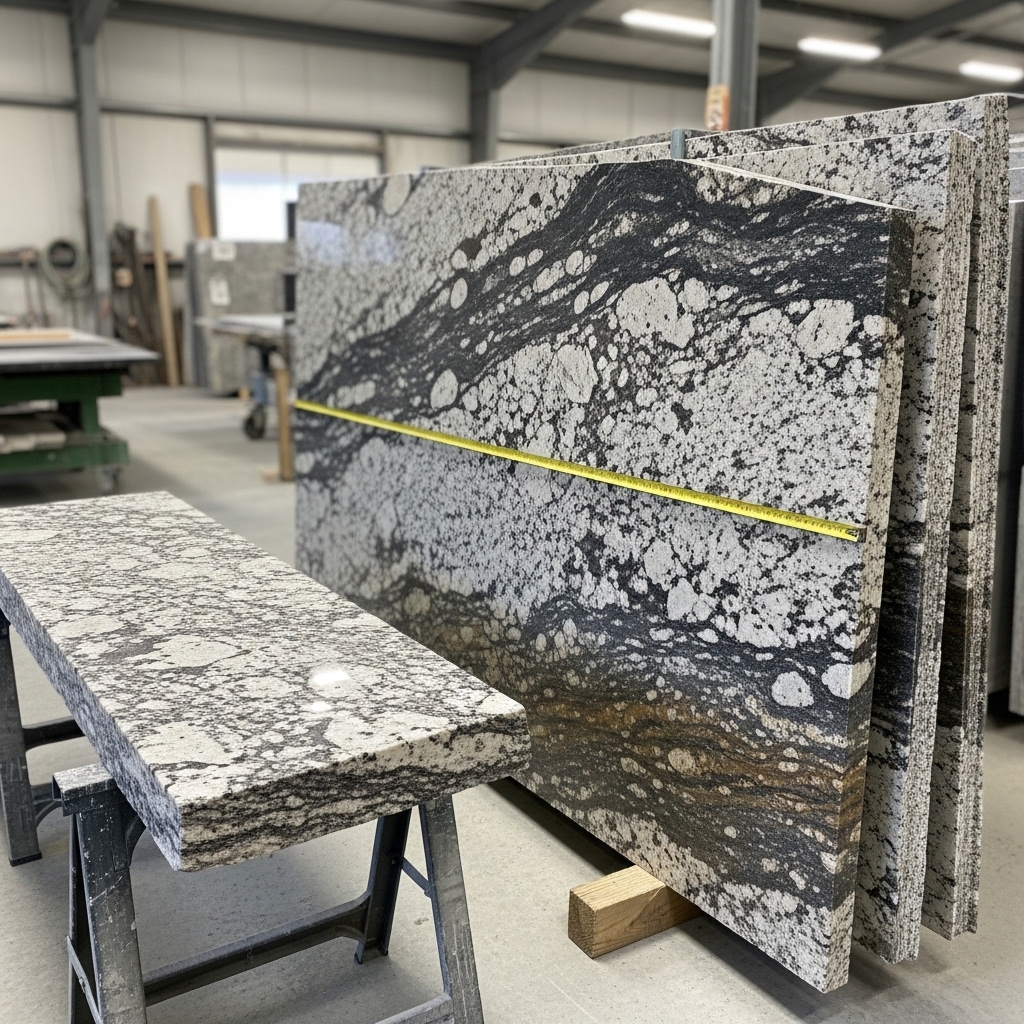
Regular Size
56 in × 120 in (standard) or 63 in × 126 in (jumbo), thickness 0.79 in (2 cm) or 1.18 in (3 cm).
Jumbo Size
63 in × 126 in, thickness 0.79 in (2 cm) or 1.18 in (3 cm).
Super Size
78 in × 138 in, thickness 0.79 in (2 cm) or 1.18 in (3 cm).
Super Jumbo
137.80 in × 78.74 in, thickness 0.79 in (2 cm) or 1.18 in (3 cm).
Mini Slab
48 in × 96 in, thickness 0.79 in (2 cm) or 1.18 in (3 cm).
Cambria Quartz Sheet Dimensions
Cambria Quartz sheets typically come in standard dimensions of 120 inches by 56 inches, with thicknesses ranging from 1 cm to 3 cm, making them versatile for various applications. When considering project dimensions, it is essential to evaluate the desired aesthetic; for instance, larger sheets can create a seamless look in expansive countertops, while smaller pieces may be suitable for intricate designs or smaller spaces. Budget constraints also play a crucial role, as larger sheets may incur higher costs, and the price per square foot can vary significantly based on the color and pattern chosen, often ranging from $50 to $100. The fabricator’s expertise is another critical factor; experienced fabricators can better handle complex cuts and installations, ensuring that the final product meets both functional and aesthetic requirements. Specific design requirements, such as edge profiles or integrated sinks, should also be discussed early in the planning process, as they can influence the dimensions and layout of the quartz sheets needed. Ultimately, a careful balance of these elements will lead to a successful project outcome that aligns with the homeowner’s vision and practical needs.
Cambria Quartz Formats: Jumbo Benefits
Cambria Quartz sheets offer significant advantages, particularly in their jumbo dimensions, which typically measure 132 inches by 65 inches. This larger format reduces the number of seams required in a project, creating a more seamless and visually appealing surface.
The expansive size also allows for more extensive applications, making it ideal for large countertops, islands, and wall cladding, which can enhance the overall aesthetic of a space.
Additionally, the durability of Cambria Quartz, being non-porous and resistant to stains, scratches, and heat, ensures that these larger sheets maintain their beauty and functionality over time.
The variety of colors and patterns available in jumbo formats allows homeowners and designers to achieve a unique look tailored to their preferences, with options that mimic natural stone without the associated maintenance.
Furthermore, the ease of installation with fewer seams can lead to reduced labor costs and time, making Cambria Quartz an efficient choice for both residential and commercial projects. Overall, the benefits of Cambria Quartz sheet dimensions, particularly in jumbo formats, make it a highly desirable option for modern design needs.
Cambria Quartz Material: Expected Offcuts
Cambria Quartz is a popular choice for countertops and surfaces due to its durability and aesthetic appeal. When working with Cambria Quartz, it is essential to consider the expected offcuts during the fabrication process. Typically, offcuts can range from 10% to 20% of the total material used, depending on the complexity of the design and the layout of the slabs. For instance, if a project requires 50 square feet of Cambria Quartz, one might anticipate offcuts of approximately 5 to 10 square feet.
To minimize waste, it is advisable to plan the layout meticulously, ensuring that the most significant pieces are utilized first and that smaller sections are strategically placed to maximize the use of the material. Additionally, many fabricators offer guidance on how to best use offcuts, suggesting creative applications such as backsplashes, shelves, or even decorative accents.
By understanding the potential for offcuts and planning accordingly, homeowners and designers can make the most of their investment in Cambria Quartz while also contributing to a more sustainable approach to material usage.
Cambria Quartz Material: Largest Format Options
Cambria Quartz is renowned for its exceptional quality and aesthetic appeal, making it a popular choice for countertops, backsplashes, and other surfaces in both residential and commercial spaces. One of the standout features of Cambria Quartz is its availability in large format options, which can significantly enhance the visual impact of any design.
The largest format options available from Cambria can reach dimensions of up to 132 inches by 65 inches, allowing for expansive surfaces with minimal seams. This is particularly advantageous in creating a seamless look in kitchens and bathrooms, where large slabs can provide a continuous flow and a more cohesive design. The larger slabs not only reduce the number of seams but also make installation more efficient, as fewer pieces are required to cover a given area.
Additionally, the large format options of Cambria Quartz come in a variety of stunning colors and patterns, ranging from classic whites and grays to bold, dramatic hues. This versatility allows homeowners and designers to select the perfect slab that complements their overall aesthetic vision. For instance, a large slab featuring intricate veining can serve as a striking focal point in a kitchen island, while a solid color can provide a sleek and modern look.
The durability of Cambria Quartz is another significant advantage, as it is non-porous and resistant to stains, scratches, and heat. This makes it an ideal choice for high-traffic areas where both beauty and functionality are essential. With proper care, large format Cambria Quartz surfaces can maintain their luster and integrity for years, making them a worthwhile investment for any space.
In summary, the largest format options of Cambria Quartz not only offer aesthetic benefits but also practical advantages that enhance the overall functionality of surfaces in various settings. With impressive dimensions, a wide range of designs, and unmatched durability, Cambria Quartz stands out as a premier choice for those seeking to elevate their interior spaces.
Cambria Quartz Material: Thickness for Busy Floors
Cambria quartz is a popular choice for busy floors due to its durability and aesthetic appeal. Thickness plays a crucial role in determining the material’s performance in high-traffic areas. Typically, Cambria quartz slabs are available in thicknesses of 1 cm, 2 cm, and 3 cm. For busy floors, a thickness of 2 cm or 3 cm is often recommended, as these thicker options provide enhanced strength and resistance to wear and tear.
In environments such as commercial spaces, restaurants, and busy households, the flooring must withstand heavy foot traffic, spills, and potential impacts. A 3 cm thick Cambria quartz slab, for instance, offers superior durability, making it less prone to chipping and cracking compared to thinner alternatives.
Moreover, the weight of thicker slabs can contribute to their stability, ensuring that they remain securely in place over time. This is particularly important in settings where heavy furniture or equipment may be moved frequently.
Additionally, the non-porous nature of Cambria quartz means that it is resistant to staining and easy to clean, further enhancing its suitability for busy floors. With a variety of colors and patterns available, homeowners and designers can achieve both functionality and style, creating spaces that are not only practical but also visually appealing.
In summary, when selecting Cambria quartz for busy floors, opting for a thickness of 2 cm or 3 cm is advisable to ensure longevity and performance. The combination of durability, ease of maintenance, and aesthetic versatility makes Cambria quartz an excellent choice for high-traffic areas.
Cambria slab measurement guide for walls & decorative surfaces
A Cambria slab measurement guide for walls focuses on accurate elevation measurement, panel mapping for clean seam placement, and sequencing pieces for consistent pattern continuity across the wall.
Large slab formats commonly used for engineered stone wall applications (such as 3200 × 1600 mm as a typical example) can help reduce joints and create a more monolithic decorative finish.
For vertical installations, wall-friendly thickness like 6–12 mm is often preferred where available to reduce load, while thicker material may be chosen when exposed edges, returns, or bold reveals are part of the design.
For example, a feature wall can be planned with a main central panel kept seam-free, and joints pushed to side returns or aligned with cabinetry lines so they blend into the architecture.
Measurement planning also includes marking all cut-outs (switches, niches), confirming substrate flatness, and keeping joint gaps consistent for a clean, premium result.
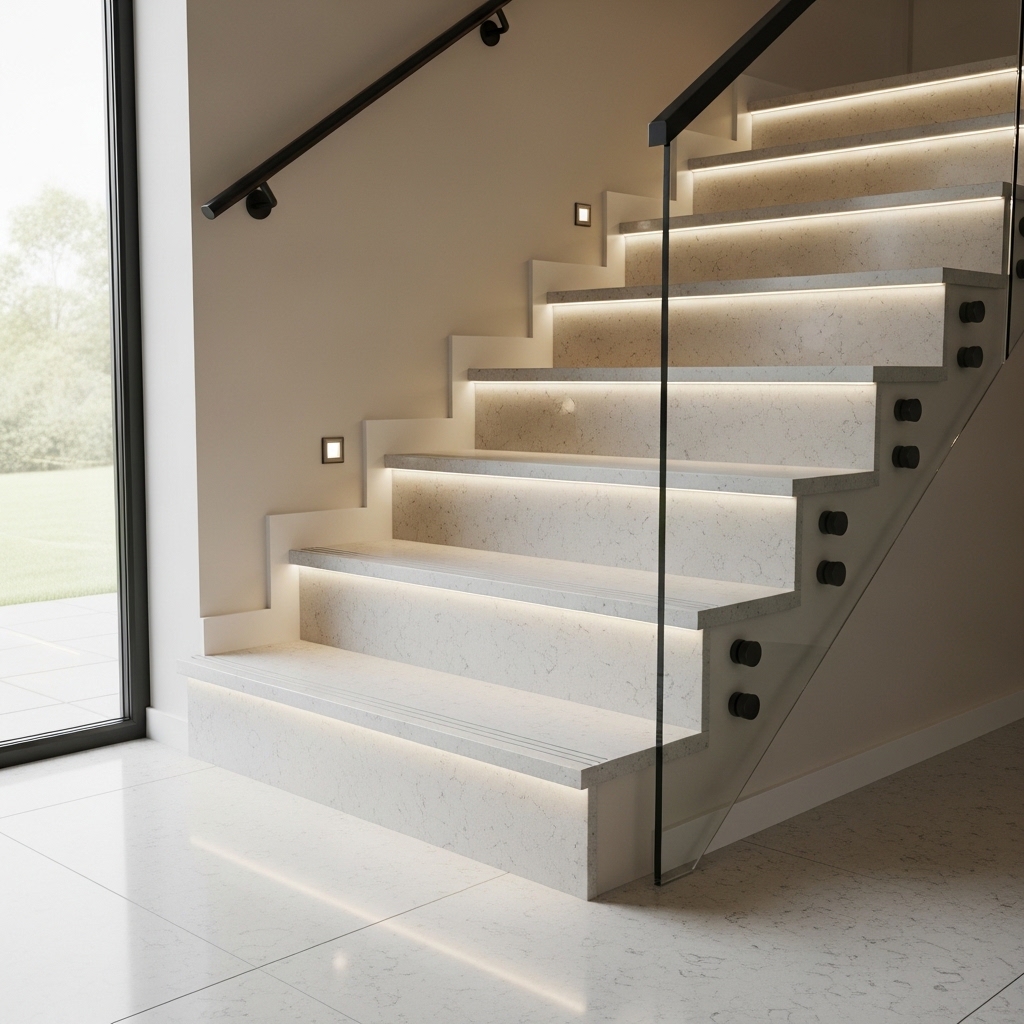
Cambria slab measurement guide for stairs
A Cambria slab measurement guide for stairs focuses on precision measurement, careful cut mapping, and pattern control so the staircase looks consistent and well-composed across repeated treads and prominent landings.
Large slab formats commonly used for engineered stone stair applications (for example, 3200 × 1600 mm as a typical reference) help reduce seams and allow multiple components to be cut from one batch for consistent tone.
For example, the landing can be planned as a focal panel using a balanced pattern area, while all tread faces are cut in a repeated orientation so movement stays consistent from bottom to top.
Tread thickness is commonly planned around 20 mm, with edge detailing (eased or small chamfer) specified to protect the step nose and keep the profile crisp under heavy use.
A complete guide also includes seam placement away from the center of landings, uniform joint gaps, and careful allowance for wall returns and skirting so installation lines remain straight and clean.
Cambria slab size supplied in the UAE is typically available in large-format slabs around 3050 × 1440 mm, designed for consistent quality and predictable fabrication. These slabs suit most residential kitchens and many commercial projects with minimal waste. During natural stone comparisons, clients often ask what size are granite slabs to understand how quartz alternatives differ.
Cambria Slab Size Planning for Marble Threshold Details
Cambria slab size planning for marble threshold details often involves slabs measuring approximately 3050 × 1440 mm, which allow countertops and doorway transitions to be fabricated from one continuous material source. This approach minimizes shade variation and alignment issues. Producing a coordinated marble threshold from Cambria slab offcuts results in a clean, seamless transition between rooms.
Cambria Slab Size Standards for Raised Floor Projects
Cambria slab size standards are designed to support precision installations on a raised floor. Typical Cambria slabs are produced at approximately 3050 × 1400 mm with 20 or 30 mm thickness, offering consistency and strength. These proportions work well with raised floor layouts that demand accuracy and clean finishes.