
Granite Size in mm
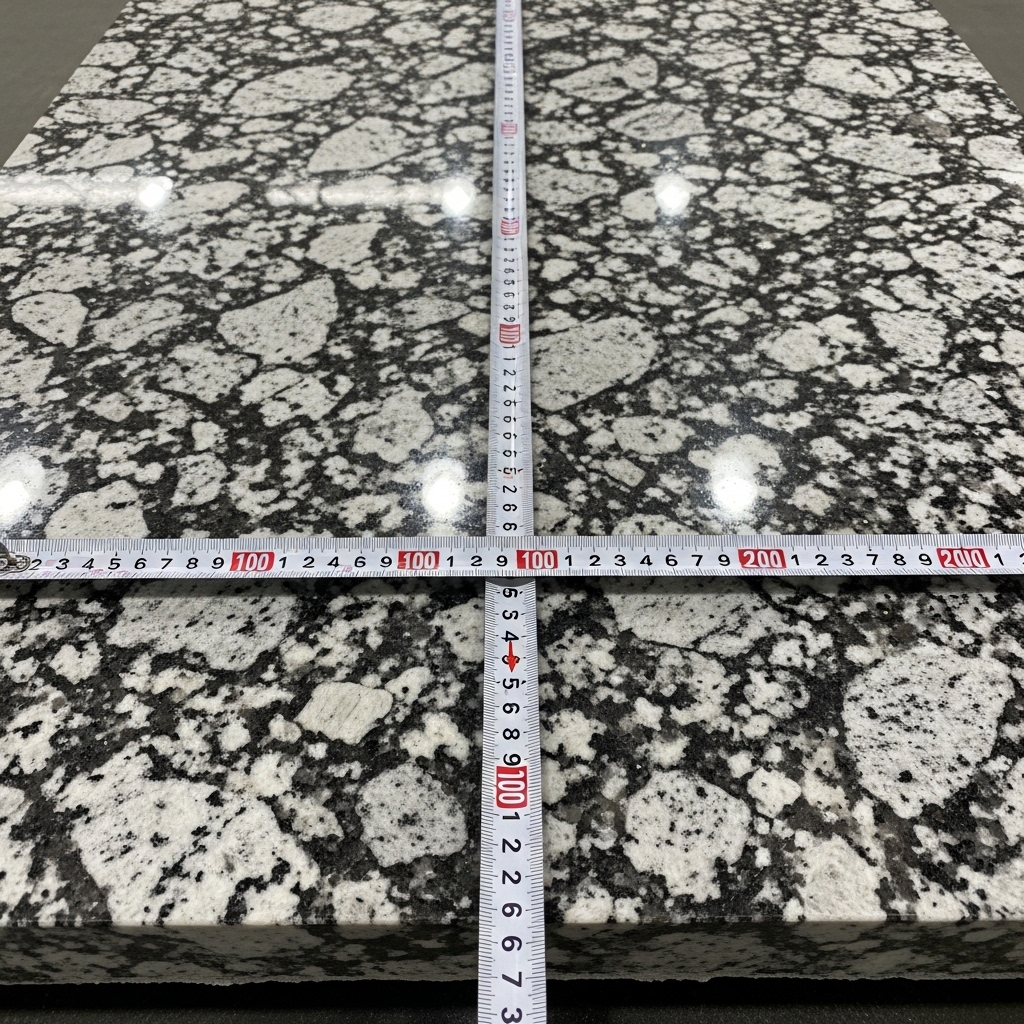
Granite size in mm is often listed by suppliers in approximate slab ranges such as 3000 mm × 1800 mm (300 cm × 180 cm = 118.11 in × 70.87 in) or 3200 mm × 2000 mm (320 cm × 200 cm = 125.98 in × 78.74 in), with exact dimensions varying by quarry and bundle. Another commonly seen size band is around 3050 mm × 1650 mm (305 cm × 165 cm = 120.08 in × 64.96 in), especially for stones shipped in more standardized lots. Granite thickness in metric terms is most commonly 20 mm (2 cm / 0.79 in) or 30 mm (3 cm / 1.18 in), with 15 mm (1.5 cm / 0.59 in) appearing occasionally for certain applications.
Regular Size
118.11 in × 70.87 in (3000 mm × 1800 mm), thickness 0.79 in (20 mm) or 1.18 in (30 mm).
Jumbo Size
125.98 in × 78.74 in (3200 mm × 2000 mm), thickness 0.79 in (20 mm) or 1.18 in (30 mm).
Super Size
137.80 in × 78.74 in (3500 mm × 2000 mm), thickness 0.79 in (20 mm) or 1.18 in (30 mm).
Super Jumbo
137.80 in × 78.74 in (3500 mm × 2000 mm), thickness 0.79 in (20 mm) or 1.18 in (30 mm).
Mini Slab
94.49 in × 47.24 in (2400 mm × 1200 mm), thickness 0.79 in (20 mm) or 1.18 in (30 mm).
Granite Measurements in Millimeters Made Simple
Granite measurements in millimeters can be simplified by considering several key factors that influence the final outcome of a project.
First, understanding the project dimensions is crucial; for instance, if you are designing a kitchen countertop, you might need a slab measuring 3000mm x 600mm to fit your space perfectly.
Next, the desired aesthetic plays a significant role; if you prefer a modern look, you might opt for a thinner edge profile of around 20mm, while a more traditional style may require a thicker edge of 30mm or more.
Budget constraints also dictate the choice of granite; high-quality slabs can range from 2000mm to 5000mm in price, so it’s essential to balance quality with affordability.
Additionally, the fabricator’s expertise should not be overlooked; a skilled fabricator can work with complex designs, such as intricate cutouts for sinks or unique edge profiles, which may require precise measurements down to the millimeter.
Lastly, specific design requirements, such as accommodating appliances or ensuring seamless joints, necessitate careful planning and accurate measurements, often requiring adjustments in the granite slab size to achieve the desired fit. By considering these aspects, you can effectively navigate granite measurements in millimeters to create a stunning and functional space.
Metric Granite Dimensions: Jumbo Advantages
Granite measurements in millimeters offer several advantages that simplify the process of working with this durable material. One significant benefit is the precision that metric dimensions provide; for instance, a granite slab measured at 3000 mm x 1500 mm ensures exact fitting for countertops or flooring, reducing the likelihood of costly errors during installation.
Additionally, using millimeters allows for easier calculations and conversions, especially in international projects where metric is the standard. This uniformity can streamline communication between architects, designers, and contractors, minimizing misunderstandings.
The jumbo size of granite slabs, often exceeding 3200 mm in length, further enhances design possibilities, allowing for fewer seams and a more cohesive look in large installations. Moreover, the availability of metric dimensions can lead to better inventory management, as suppliers can easily track stock levels in standardized measurements. Overall, adopting granite measurements in millimeters not only simplifies the design and installation process but also enhances the overall quality and aesthetic of the finished product.
Standard Waste Factor for Granite (Metric Units)
The Standard Waste Factor for granite is an essential consideration in the stone industry, particularly when planning for projects that involve cutting and installing granite slabs. Typically, the waste factor for granite ranges from 10% to 20%, depending on the complexity of the project and the layout of the stone. For instance, if a project requires 100 square meters of granite, a waste factor of 15% would mean that an additional 15 square meters should be ordered to account for potential waste during cutting and installation.
Factors influencing the waste factor include the size and shape of the granite pieces, the intricacy of the design, and the skill level of the installers. In cases where intricate cuts or patterns are involved, a higher waste factor may be necessary, potentially reaching up to 25%.
It is crucial for contractors and designers to accurately calculate the waste factor to avoid underestimating the amount of material needed, which can lead to project delays and increased costs. By considering the Standard Waste Factor, professionals can ensure a smoother workflow and a more efficient use of materials, ultimately leading to a successful granite installation.
Largest Granite Format in Millimeters
The largest granite format available in the market typically measures around 3200 mm by 1600 mm. This expansive size allows for fewer seams and a more cohesive look when installed, making it particularly appealing for large surfaces such as countertops, flooring, and wall cladding.
The thickness of these large granite slabs usually ranges from 20 mm to 30 mm, providing both durability and aesthetic appeal.
One of the significant advantages of using large granite formats is the reduction in the number of joints required during installation. Fewer joints not only enhance the visual continuity of the surface but also minimize the potential for dirt accumulation and maintenance issues.
Additionally, the large size can significantly reduce installation time, as fewer pieces need to be handled and fitted together.
In terms of design versatility, the expansive surface area allows for intricate patterns and designs to be showcased without interruption. This is particularly beneficial for high-end residential and commercial projects where visual impact is paramount.
Furthermore, the availability of various colors and finishes in large granite formats means that designers and homeowners can achieve their desired aesthetic while enjoying the inherent strength and longevity of granite.
Overall, the introduction of large granite formats has revolutionized the way granite is used in architectural and interior design, providing both functional and aesthetic benefits that cater to modern design needs.
Granite (Metric Units): Thickness for High-Use Spaces
Granite is a popular choice for high-use spaces due to its durability and aesthetic appeal. When considering granite thickness for areas that experience heavy foot traffic or frequent use, it is essential to select the appropriate dimensions to ensure longevity and performance. Typically, granite slabs come in various thicknesses, with the most common being 2 cm (20 mm) and 3 cm (30 mm). For high-use spaces such as commercial kitchens, retail environments, or public areas, a thickness of 3 cm is often recommended. This thickness provides enhanced strength and resistance to chipping or cracking, which is crucial in environments where heavy objects may be dropped or where there is constant movement.
In addition to thickness, the installation method also plays a significant role in the performance of granite in high-use areas. For instance, a thicker slab can be installed without the need for additional support, while thinner slabs may require a substrate or backing to prevent flexing and potential damage. The weight of 3 cm granite is approximately 79 pounds per square foot, making it a substantial choice that can withstand the rigors of daily use.
Moreover, the choice of granite finish can also impact its suitability for high-use spaces. Polished finishes, while visually appealing, can be more susceptible to scratching and staining, especially in environments where spills are common. In contrast, honed or textured finishes may offer better resistance to wear and tear, making them ideal for areas that require both functionality and style.
Ultimately, selecting the right thickness and finish for granite in high-use spaces is crucial for ensuring that the material not only meets aesthetic expectations but also performs effectively over time. By opting for a thicker slab and considering the specific demands of the environment, property owners can enjoy the beauty and resilience of granite for years to come.
Granite measurement standards for walls & decorative surfaces
Granite measurement standards for walls and decorative surfaces are usually expressed as practical ranges rather than one fixed “standard,” because granite slab sizes depend on quarry blocks, cutting yield, and the natural movement of the stone.
In many markets, workable granite slab ranges commonly fall around 2400–3300 mm in length and 1400–2000 mm in width (typical examples), which provides enough coverage for feature cladding while allowing fabricators to select the best-looking areas of each slab for prominent wall zones.
For vertical applications, thickness often sits around 10–20 mm to balance strength with manageable weight, while heavier 30 mm material is more commonly used when a bold, substantial edge detail is part of the design or when matching thick horizontal surfaces in the same space.
As an example, a granite wall panel plan might standardize on consistent panel modules (such as repeatable cut sizes) to keep joints aligned and installation predictable, even though the starting slab sizes may vary from batch to batch.
These “standards” also include workmanship expectations—consistent joint widths, controlled lippage between panels, and carefully finished edges—so granite looks refined on walls rather than appearing like randomly placed stone pieces.
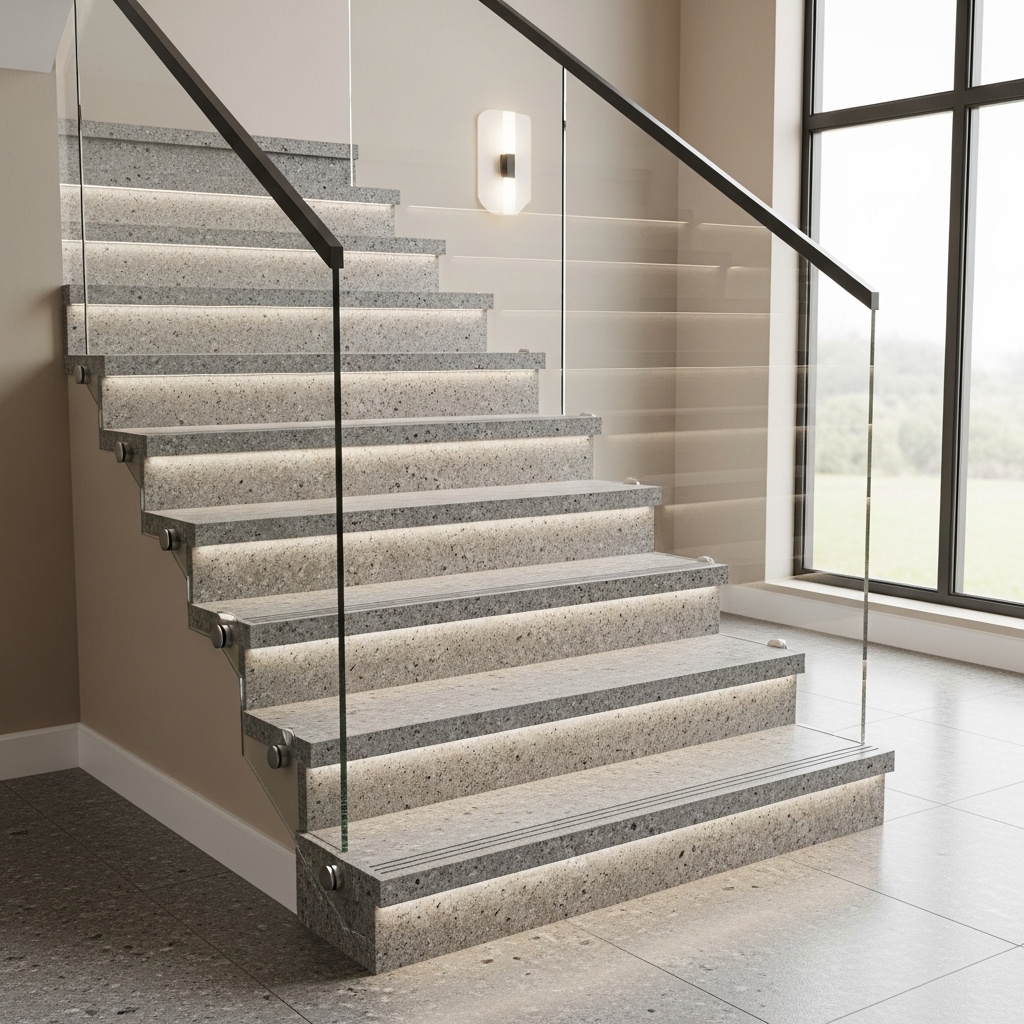
Granite measurement standards for stairs
Granite measurement standards for stairs are usually expressed as practical industry ranges and detailing expectations rather than one single universal size, because granite supply depends on quarry yield and stone selection.
Many stair projects work with granite slab ranges such as 2400–3300 mm in length and 1400–2000 mm in width (typical examples), then cut repeatable tread and riser components sized to the staircase geometry.
A common performance standard for granite stair treads is selecting thickness around 20–30 mm and specifying durable edge finishing (eased or chamfered) to reduce chipping at the step nose under heavy traffic.
For example, consistent joint widths and uniform riser heights are treated as “standards” in stair finishing—small alignment issues are highly visible on stairs, so precision and repeatability matter as much as the stone itself.
These standards also include finish choice: flamed, honed, or leathered finishes can provide a more slip-friendly feel compared with high polish, especially in entry stairs or semi-outdoor conditions.
In the UAE, granite size in mm is the most precise way suppliers describe slab dimensions, with many commonly stocked slabs measuring between 2800–3200 mm in length and 1500–1800 mm in width, depending on the quarry and color. Thickness is usually 20 mm or 30 mm, chosen based on structural needs and aesthetic preference. When planning mixed-material projects, these measurements are often reviewed alongside the maximum quartz slab size to decide which surface offers better coverage and fewer seams for the intended layout.
Granite Size in MM Standards for Belgium Black Marble Projects
Granite size in mm standards for UAE projects generally fall between 2800–3200 mm in length and 1500–1800 mm in width, with 20 mm and 30 mm thicknesses commonly stocked. These measurements are suitable for countertops, staircases, wall cladding, and vanity tops. For darker, premium finishes like belgium black marble, precise slab sizing in millimeters is essential to achieve clean edges, consistent polishing, and accurate joint alignment.
Granite Size in MM Standards for Raised Floor Applications
Granite size in mm standards are crucial for technical coordination with a raised floor. Most granite slabs are supplied in sizes ranging from 2800–3200 mm in length and 1500–1800 mm in width, with thicknesses between 18 mm and 30 mm. These standardized measurements allow accurate planning of slab cutting, level matching, and load distribution above access flooring systems.