
Maximum Quartz Slab Size
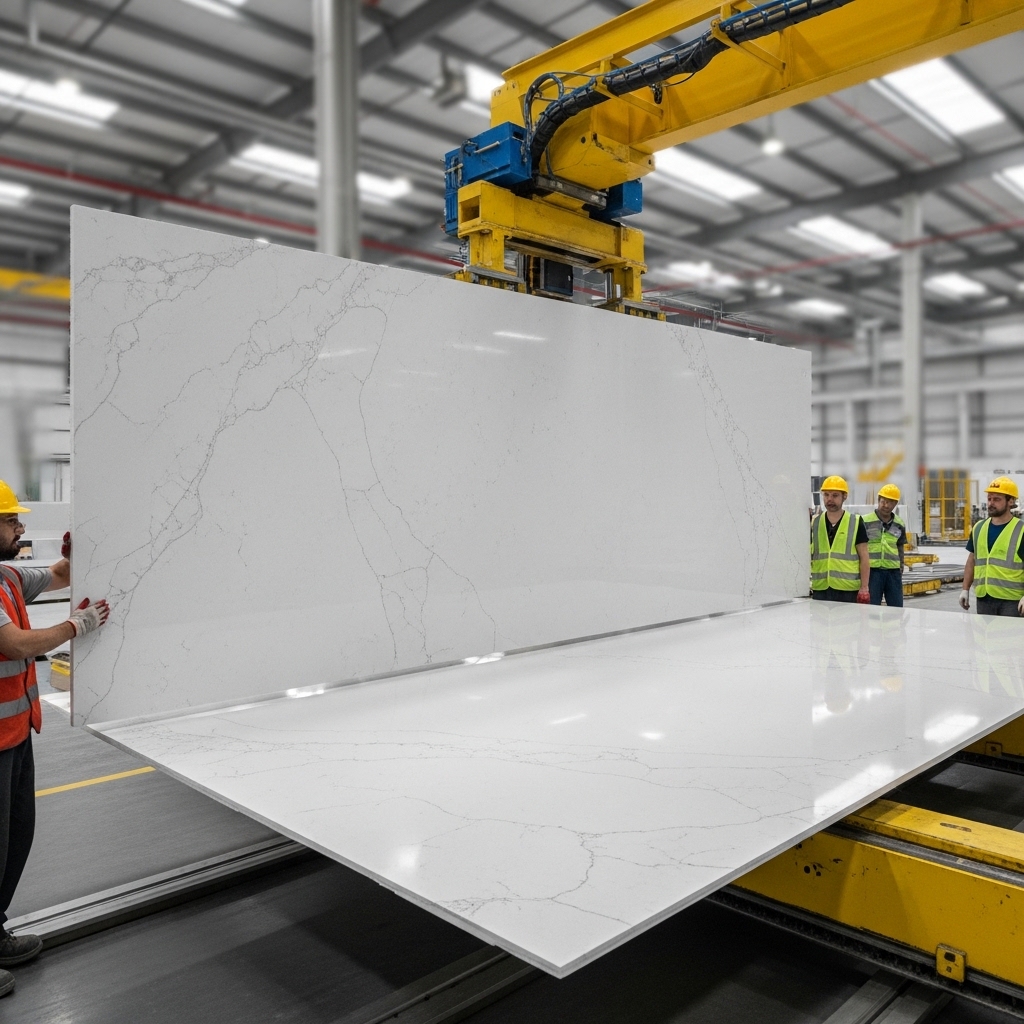
Maximum quartz slab size depends on the manufacturer and product line, but the biggest “max” formats commonly marketed as extra-large or super-jumbo reach approximately 350 cm × 200 cm (137.80 in × 78.74 in), which is chosen to create long, nearly seam-free spans on oversized islands and feature walls. In many markets, another top-end maximum that’s frequently available across more colors is around 330 cm × 165 cm (129.92 in × 64.96 in), still significantly larger than standard slabs. Even at these maximum sizes, thickness usually remains the familiar 2 cm (0.79 in / 20 mm) or 3 cm (1.18 in / 30 mm), with occasional 12 mm (0.47 in / 1.2 cm) offerings in select collections.
Regular Size
137.80 in × 78.74 in, thickness 0.79 in (2 cm) or 1.18 in (3 cm).
Jumbo Size
137.80 in × 78.74 in, thickness 0.79 in (2 cm) or 1.18 in (3 cm).
Super Size
137.80 in × 78.74 in, thickness 0.79 in (2 cm) or 1.18 in (3 cm).
Super Jumbo
137.80 in × 78.74 in, thickness 0.79 in (2 cm) or 1.18 in (3 cm).
Mini Slab
63 in × 126 in (max in mini context), thickness 0.79 in (2 cm) or 1.18 in (3 cm).
Choosing the Largest Quartz Format for Your Project
Choosing the largest quartz format for your project involves careful consideration of several factors that can significantly impact the final outcome.
First, project dimensions play a crucial role; larger slabs can minimize seams and create a more cohesive look, making them ideal for expansive countertops or wall applications. For instance, if your kitchen island measures 10 feet by 4 feet, opting for a single slab of quartz that can cover this area without joints is preferable.
The desired aesthetic also influences your choice; larger formats often provide a more modern and streamlined appearance, enhancing the visual impact of the space. If you’re aiming for a minimalist design, a continuous surface with fewer interruptions can achieve that sleek look.
Budget constraints are another critical consideration, as larger slabs may come at a premium. It’s essential to balance your vision with your financial plan; for example, while a large, high-end quartz slab might cost around $100 per square foot, smaller pieces could be more budget-friendly, averaging $50 per square foot.
Additionally, the fabricator’s expertise is vital; not all fabricators are equipped to handle large formats, which may require specialized tools and techniques. Ensuring that your chosen fabricator has experience with large quartz slabs can prevent potential issues during installation.
Finally, specific design requirements, such as intricate patterns or custom cuts, may dictate the size of the quartz you can use. If your design includes complex shapes or features, it may be more practical to work with smaller pieces that can be more easily manipulated. By carefully evaluating these factors, you can make an informed decision that aligns with your project’s goals.
Max-Format Quartz: The Seam-Saving Edge
Choosing the largest quartz format for your project, often referred to as max-format quartz, offers numerous advantages that can significantly enhance both the aesthetic and functional aspects of your design. One of the primary benefits is the reduction of seams, which not only creates a more visually appealing surface but also minimizes the potential for dirt and bacteria accumulation in grout lines. For instance, using a slab that measures 126 inches by 63 inches can cover larger areas with fewer pieces, resulting in a cleaner, more cohesive look. Additionally, the larger format allows for more creative design possibilities, enabling the incorporation of expansive countertops, wall cladding, or even flooring without interruption. This seamless appearance can elevate the overall value of the space, making it more attractive to potential buyers or renters. Furthermore, the durability of quartz ensures that these large slabs maintain their integrity over time, resisting scratches, stains, and heat, which is particularly beneficial in high-traffic areas. The ease of maintenance associated with fewer seams also contributes to long-term cost savings, as cleaning becomes more straightforward and less time-consuming. In summary, opting for max-format quartz not only enhances the visual appeal of a project but also provides practical benefits that can lead to a more efficient and sustainable design.
Expected Waste Margin for Max-Format Quartz
The expected waste margin for Max-Format Quartz is a critical consideration in the production process, as it directly impacts both cost efficiency and material utilization. Typically, the waste margin is estimated to be around 10-15% of the total material used, depending on the complexity of the design and the cutting techniques employed.
For instance, when processing a slab of Max-Format Quartz that measures 126 inches by 63 inches, the effective yield can be significantly influenced by the layout of the cuts and the presence of any defects in the material.
It is essential to optimize the cutting patterns to minimize waste; advanced software tools can assist in maximizing the usable area while reducing the scrap generated. Additionally, factors such as the thickness of the quartz and the intricacy of the installation can further affect the waste margin.
By carefully analyzing these variables and implementing best practices, manufacturers can aim to reduce the waste margin to as low as 5-7%, thereby enhancing profitability and sustainability in the production of Max-Format Quartz surfaces.
Maximum-Format Quartz: How Big Can It Be?
Maximum-format quartz refers to the largest sizes of quartz crystals that can be naturally formed or synthesized for various applications, particularly in the fields of electronics and optics.
The size of quartz crystals can vary significantly, with natural crystals typically found in sizes ranging from a few millimeters to several meters in length. The largest recorded natural quartz crystal, discovered in the Brazilian state of Minas Gerais, measured an astonishing 12 meters in length and weighed over 44 tons.
Such massive formations are rare and often occur in specific geological conditions, where the right combination of temperature, pressure, and mineral-rich fluids allows for the slow growth of these crystals over millions of years.
In contrast, synthetic quartz crystals can be produced in controlled environments, allowing for the creation of larger and more uniform crystals. The hydrothermal method is one of the most common techniques used to grow synthetic quartz, where silica is dissolved in a high-temperature, high-pressure solution. This method can produce crystals that exceed 30 centimeters in length, and advancements in technology have led to the development of quartz crystals that are not only larger but also possess superior optical and electronic properties.
For instance, quartz crystals used in oscillators and resonators for telecommunications can be manufactured to precise specifications, ensuring optimal performance in devices such as smartphones and GPS systems.
The potential for maximum-format quartz is not limited to size alone; the quality and purity of the crystals are equally important. High-purity quartz, which contains minimal impurities, is essential for applications in the semiconductor industry, where even the slightest contamination can affect the performance of electronic components.
As technology continues to evolve, the demand for larger and higher-quality quartz crystals is expected to grow, prompting ongoing research into new methods of synthesis and extraction. The future of maximum-format quartz may see the development of crystals that not only push the boundaries of size but also enhance the capabilities of modern technology, paving the way for innovations in various fields.
Max-Format Quartz: Thickness for Floors & Heavy Footfall
Max-Format Quartz is an innovative flooring solution designed to withstand heavy foot traffic while maintaining aesthetic appeal and durability. This type of quartz surface is engineered with a thickness that typically ranges from 12mm to 20mm, making it suitable for both residential and commercial applications. The thicker the slab, the more resilient it is against wear and tear, which is crucial in high-traffic areas such as shopping malls, airports, and office buildings.
One of the standout features of Max-Format Quartz is its ability to resist scratches, stains, and impacts, which are common challenges in environments with heavy footfall. For instance, a 20mm thick slab can endure significant pressure and is less likely to chip or crack compared to thinner alternatives. This durability not only extends the lifespan of the flooring but also reduces maintenance costs over time.
Moreover, the aesthetic versatility of Max-Format Quartz allows it to be available in a wide range of colors and finishes, enabling designers and architects to create visually stunning spaces without compromising on functionality. The non-porous surface of the quartz also contributes to its hygiene, making it an ideal choice for areas that require strict cleanliness standards, such as hospitals and restaurants.
In terms of installation, the weight of Max-Format Quartz slabs necessitates careful handling and professional expertise. Proper installation techniques are essential to ensure that the flooring performs optimally under heavy loads. With the right thickness and installation, Max-Format Quartz can provide a seamless and elegant look that enhances the overall design of any space while standing up to the rigors of daily use.
In conclusion, Max-Format Quartz offers a robust and stylish flooring option that meets the demands of high-traffic environments. Its thickness, ranging from 12mm to 20mm, plays a crucial role in its durability and performance, making it a preferred choice for both commercial and residential projects. The combination of strength, aesthetic appeal, and low maintenance makes Max-Format Quartz an excellent investment for any space that experiences heavy footfall.
Maximum quartz slab formats for walls & decorative surfaces
Maximum quartz slab formats are typically selected for walls and decorative surfaces when designers want the fewest possible seams, a more dramatic continuous veining effect, and larger uninterrupted visual fields across tall or wide elevations.
Depending on the product line, maximum-format slabs can reach large examples like 3400 × 1700 mm or similar expanded sizes (illustrative figures), which can help cover big feature walls or tall backsplashes with fewer breaks than standard slab formats.
For instance, a wall section close to 3.0–3.2 m in height can sometimes be planned so a single large panel runs nearly full-height with minimal trimming, keeping the focal area free of mid-wall seams that interrupt the pattern.
Because maximum formats are physically larger, many wall projects specify 6–12 mm thickness to reduce load, and use careful seam placement and panel sequencing so the surface reads as one continuous composition from left to right.
In real-world planning, the “maximum format” is also limited by site logistics—door widths, elevator access, and lifting capability—so the best approach is often to use the largest feasible panels while still ensuring safe handling and precise alignment on the wall.
Maximum quartz slab formats for stairs
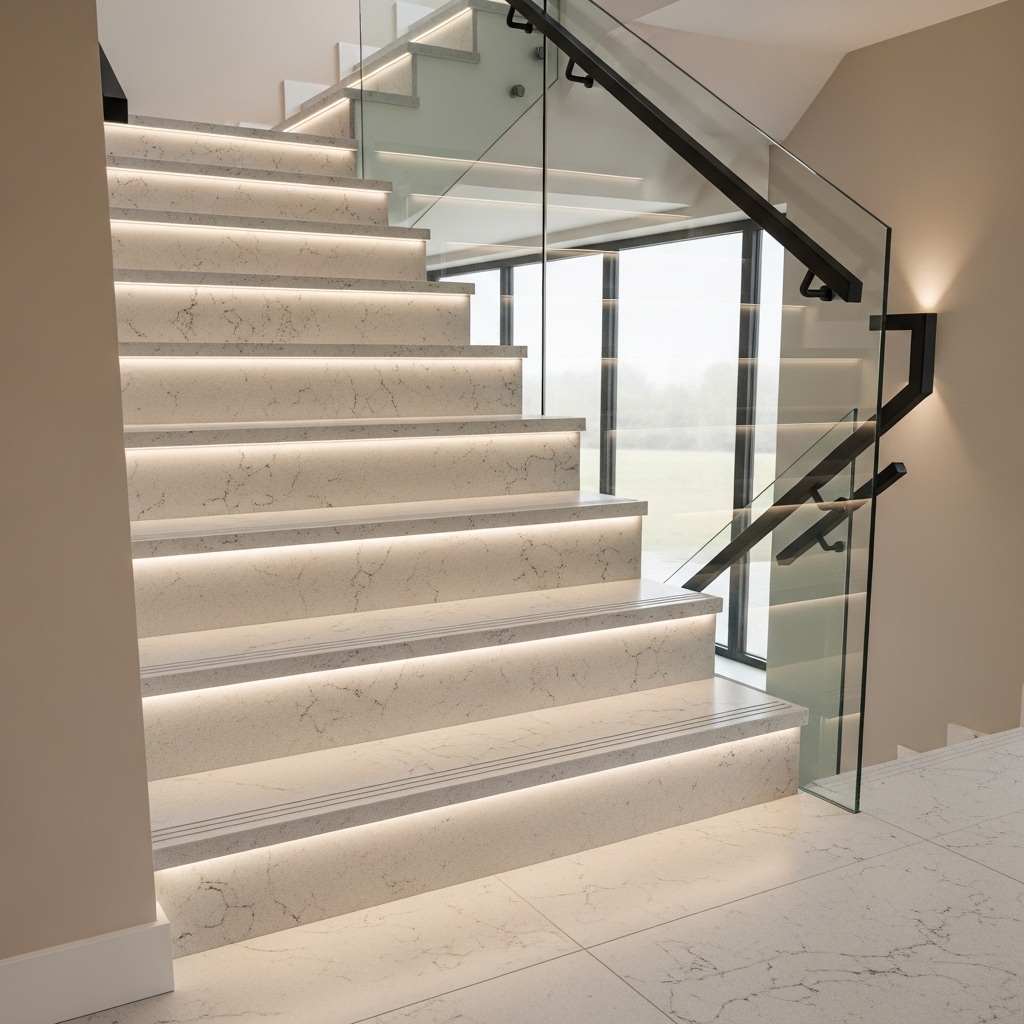
Maximum quartz slab formats for stairs are selected when the design needs the largest possible continuous pieces—particularly for wide landings, long straight flights, or highly visible feature staircases where seams would break the visual flow.
Some expanded-format collections can reach examples like 3400 × 1700 mm (illustrative figure), offering extra cutting flexibility beyond common standard and jumbo sizes and allowing fewer joints in prominent stair zones.
For example, a large landing can sometimes be cut as one dominant panel from a maximum-format slab, avoiding a central seam and creating a cleaner architectural statement at the turn of the staircase.
Tread thickness is often chosen around 20 mm for strength, while thicker-looking nosing details can be created through edge build-ups if a heavier profile is desired without using full-thickness slabs everywhere.
Because maximum formats are larger to transport and handle, practical limits like access routes and lifting capability often decide whether the full maximum format can be used on-site without compromising installation safety.
In the UAE, the maximum quartz slab size available from select premium manufacturers can reach approximately 3340 × 1640 mm, making it possible to fabricate very large islands or long counters with minimal or no joints. These slabs are typically offered in 20 mm thickness, with 30 mm options available for specific collections or upon request. Clients evaluating these options often ask what is the size of a quartz slab so they can understand how standard, jumbo, and maximum formats differ in real installation scenarios.
Maximum Quartz Slab Size Details for Marwa Marble Interior Works
Maximum quartz slab size details for Marwa marble interior works highlight premium slab formats that can reach approximately 3340 × 1640 mm in select collections. These extra-large slabs are ideal for expansive islands, long counter runs, and feature installations where seams must be minimized. Pairing quartz in these maximum sizes with marwa marble elements helps create a balanced interior where both materials feel intentional and proportionally aligned.
Maximum Quartz Slab Size for Large Raised Floor Areas
The maximum quartz slab size available today is highly beneficial for large areas constructed over a raised floor. Super jumbo slabs can reach approximately 3200 × 1600 mm, significantly minimizing joint lines across expansive surfaces. Fewer seams improve aesthetics and make it easier to coordinate slab placement with the modular grid of raised floors.