
Size of Granite: Understanding Dimensions and Variations
Size of granite (as a general product category) can mean full slabs, tiles, or prefab countertop pieces: full granite slabs are commonly around 108–120 in long × 60–72 in wide (274.32–304.80 cm × 152.40–182.88 cm), while granite tiles are often 12 in × 12 in (30.48 cm × 30.48 cm), 18 in × 18 in (45.72 cm × 45.72 cm), or 24 in × 24 in (60.96 cm × 60.96 cm). Prefabricated granite countertop blanks are also common, such as 96 in × 26 in (243.84 cm × 66.04 cm) before trimming and edging to fit. Granite thickness is typically 2 cm (0.79 in / 20 mm) or 3 cm (1.18 in / 30 mm), with 1.5 cm (0.59 in / 15 mm) sometimes used for lighter or vertical applications.
Regular Size
108–120 in × 60–72 in (slab) or 24 in × 24 in (tile), thickness 0.79 in (2 cm) or 1.18 in (3 cm).
Jumbo Size
120 in × 72 in (slab range), thickness 0.79 in (2 cm) or 1.18 in (3 cm).
Super Size
138 in × 78 in (slab range), thickness 0.79 in (2 cm) or 1.18 in (3 cm).
Super Jumbo
138 in × 78 in (slab range), thickness 0.79 in (2 cm) or 1.18 in (3 cm).
Mini Slab
96 in × 48 in (slab range), thickness 0.79 in (2 cm) or 1.18 in (3 cm).
Picking the Right Granite Measurements
When selecting granite for your project, it is essential to consider the project dimensions, as these will dictate the size and layout of the granite slabs needed. For instance, if you are working on a kitchen countertop that measures 10 feet by 2.5 feet, you will need to ensure that the granite slabs you choose can accommodate these dimensions without excessive seams.
The desired aesthetic also plays a crucial role; whether you prefer a classic look with white or beige tones or a more modern appearance with bold colors and patterns, the choice of granite should reflect your vision.
Budget constraints are another critical factor; granite prices can range from $40 to $200 per square foot, depending on the quality and rarity of the stone. It is vital to establish a budget early on to narrow down your options effectively.
Additionally, the fabricator’s expertise should not be overlooked; some fabricators specialize in intricate designs and custom cuts, while others may focus on standard installations. Choosing a fabricator with experience in your specific design requirements, such as curved edges or integrated sinks, can significantly impact the final outcome.
Lastly, consider any specific design requirements, such as thickness or finish; for example, a 3 cm thick slab may be more suitable for a high-traffic area than a 2 cm slab. By carefully evaluating these factors, you can ensure that you select the right granite measurements for your project.
Granite Measurements: Benefits of Going Big
Choosing the right granite measurements is crucial for both aesthetic appeal and functional efficiency in any space.
One of the primary advantages of selecting the appropriate size is the seamless integration it offers in design; larger slabs, for instance, can create a more cohesive look with fewer seams, enhancing the overall visual impact.
Additionally, opting for bigger measurements can lead to improved durability, as larger pieces are less likely to crack or chip compared to smaller, pieced-together sections.
For example, a standard granite countertop typically measures 1.25 inches thick, but going for a thicker slab of 2 inches not only adds to the robustness but also provides a more luxurious appearance.
Furthermore, the right measurements can optimize the use of space; a well-measured granite island can serve as a functional centerpiece in a kitchen, often measuring around 6 feet by 3 feet, providing ample surface area for cooking and entertaining.
Ultimately, investing time in selecting the right granite measurements can lead to long-term satisfaction, ensuring that the installation not only meets practical needs but also elevates the overall ambiance of the environment.
Granite Material: Standard Waste Margin
Granite is a popular material in construction and design, known for its durability and aesthetic appeal. When working with granite, it is essential to consider the standard waste margin, which typically ranges from 5% to 15% of the total material required. This margin accounts for potential errors during cutting, shaping, and installation, as well as any unforeseen damage that may occur. For instance, if a project requires 100 square feet of granite, a waste margin of 10% would mean ordering an additional 10 square feet, bringing the total to 110 square feet.
Proper planning and measurement are crucial to minimize waste and ensure that the project stays within budget. Additionally, it is advisable to consult with suppliers and fabricators who can provide insights into the specific waste factors associated with different granite types, as variations in color and pattern may affect how pieces can be utilized effectively.
By understanding the standard waste margin and incorporating it into project planning, contractors and designers can achieve a more efficient use of materials, ultimately leading to a successful installation and a beautiful finished product.
Granite Material: Largest Format Options
Granite is a natural stone that has gained immense popularity in the construction and design industries due to its durability, aesthetic appeal, and versatility. One of the most significant advancements in granite material is the availability of large format options. These larger slabs can measure up to 10 feet by 5 feet or even larger, allowing for expansive surfaces with fewer seams.
The use of large format granite not only enhances the visual impact of a space but also simplifies installation. With fewer seams, there is a reduced risk of dirt and grime accumulating in the joints, making maintenance easier. Additionally, the seamless appearance of large slabs creates a more cohesive and elegant look, which is particularly desirable in high-end residential and commercial projects.
In terms of thickness, large format granite slabs typically range from 2 cm to 3 cm, providing ample strength for various applications, including countertops, flooring, and wall cladding. The thickness contributes to the overall durability of the material, ensuring it can withstand heavy use and resist chipping or cracking.
Furthermore, the advancements in technology have made it possible to produce these large slabs with intricate designs and patterns, showcasing the natural beauty of granite. With options available in a wide array of colors and finishes, designers and homeowners can find the perfect match for their aesthetic preferences.
The trend towards large format granite is not just limited to residential spaces; it has also made significant inroads into commercial applications. Restaurants, hotels, and retail spaces are increasingly opting for large granite surfaces to create striking focal points and enhance the overall ambiance. The ability to customize sizes and finishes means that large format granite can be tailored to fit any design vision, making it a favored choice among architects and designers alike.
In conclusion, the largest format options in granite material offer a combination of beauty, functionality, and ease of maintenance. As technology continues to evolve, the possibilities for using large format granite in both residential and commercial settings will only expand, solidifying its place as a premier choice in the world of natural stone.
Granite Material: Best Thickness for Heavy Use
Granite is a popular choice for countertops, flooring, and various architectural applications due to its durability and aesthetic appeal. When considering granite for heavy use, the thickness of the material plays a crucial role in its performance and longevity. Typically, granite slabs come in thicknesses of 2 cm (3/4 inch) and 3 cm (1 1/4 inch). For heavy-use areas such as kitchen countertops or commercial spaces, a thickness of 3 cm is often recommended. This added thickness provides greater strength and resistance to chipping, cracking, and warping, making it ideal for high-traffic environments. In addition to its structural benefits, a thicker slab allows for more intricate edge profiles and reduces the need for additional support structures. For instance, when installing a granite countertop with an overhang, a 3 cm thickness can support more weight without the risk of sagging. Moreover, the weight of a 3 cm slab is significantly greater, typically around 20-25% more than a 2 cm slab, which contributes to its stability. This is particularly important in commercial settings where heavy appliances and frequent use can put additional stress on the material. Another factor to consider is the installation process. Thicker granite slabs may require specialized equipment and expertise for handling and installation, which can increase labor costs. However, the investment in a thicker slab often pays off in the long run due to its durability and lower maintenance needs. In summary, for heavy-use applications, opting for a 3 cm granite thickness is advisable to ensure maximum durability, aesthetic versatility, and long-term satisfaction.
Granite measurement guide for walls & decorative surfaces
A granite measurement guide for walls and decorative surfaces covers not only slab sizing, but also how natural variation affects layout, seam placement, and final visual balance.
Because granite is quarried, “standard” availability is often given as ranges, and projects typically choose panel cuts that suit access conditions while preserving the most attractive sections of the stone.
Thickness selection matters on walls: many interiors use 10–20 mm for a practical balance, while thicker material can be specified where exposed edges or stronger detailing is part of the design intent.
As an example, when designing a focal wall, mineral clusters or dramatic movement are usually placed at eye level, with seams aligned to architectural breaks to avoid interrupting the best visual areas.
A good guide also accounts for finish choice (polished, honed, leathered) since surface finish changes light reflection and can make large wall areas feel brighter, softer, or more textured.
Granite measurement guide for stairs
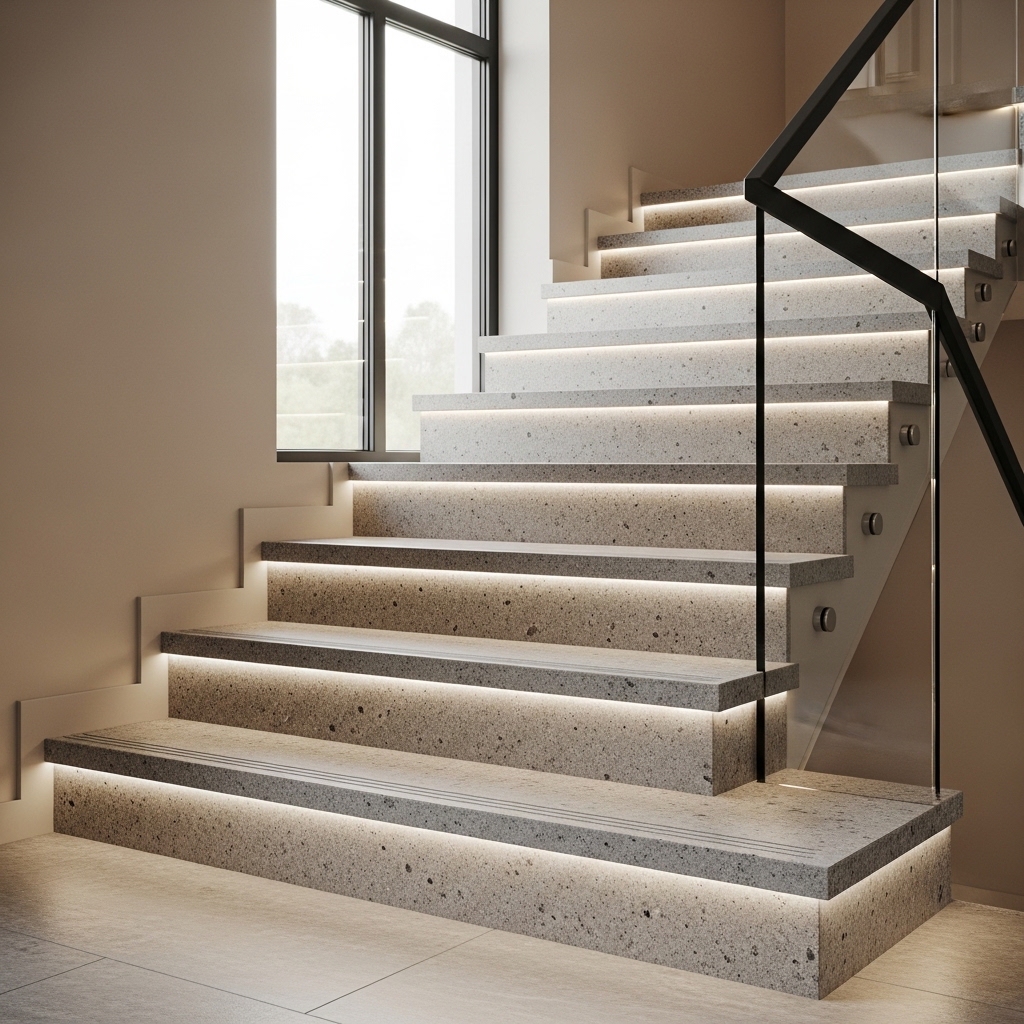
A granite measurement guide for stairs focuses on translating stair geometry into stone components while accounting for natural variation and ensuring consistent alignment across repeated steps.
Start by measuring each step and landing precisely, then decide which surfaces must appear continuous—typically the landing and the main tread faces—so seams can be placed on returns or perimeter edges.
Granite is often planned at 20–30 mm tread thickness for durability, and finish choice can be tailored to use conditions: honed or leathered finishes can feel more practical on steps, while polished is often used in decorative indoor flights.
For example, mapping slab selection helps keep the color field consistent and avoids putting dramatic mineral clusters on random steps where they could look uneven or distracting.
Good guidance also covers edge detailing, skirting returns, and tight tolerances so every tread line is crisp and joints remain uniform from bottom to top.
When referring to size of granite in the UAE, most professionals mean the usable slab dimensions supplied by local yards, typically falling within the 2800–3200 mm length range and up to about 1800 mm in width. These sizes influence seam placement and yield for kitchen and vanity installations. Exact measurements are usually confirmed per batch when reviewing granite slabs size on site.
Size of Granite Guide for Moon White Granite Kitchen Projects
A size of granite guide for Moon White Granite kitchen projects often references slabs measuring approximately 2800–3100 mm long and 1500–1700 mm wide. These dimensions are suitable for counters, islands, and backsplashes with controlled seam placement. Using moon white granite in these slab sizes helps achieve a bright, clean kitchen aesthetic while preserving consistent grain and strength.
Size of Granite Considerations for Raised Floor Projects
Size of granite considerations for raised floor projects include both slab dimensions and overall weight distribution. Granite slabs averaging 3000 × 1600 mm are commonly preferred, as they can be modularly cut to align with a raised floor grid. Proper sizing ensures long-term durability and accurate level control across connected surfaces.