
Standard Size of Kitchen Countertop
Standard size of a kitchen countertop usually refers to the standard height and depth used with base cabinets: the finished height is commonly about 36 in (91.44 cm), and the finished depth is typically 25–25.5 in (63.50–64.77 cm) to cover 24 in (60.96 cm) cabinets with about 1–1.5 in (2.54–3.81 cm) overhang. Countertop lengths are cut to the kitchen plan, but many straight sections are often fabricated in 72–120 in lengths (182.88–304.80 cm) before seams, while islands commonly range about 36–60 in wide (91.44–152.40 cm) and 72–120 in long (182.88–304.80 cm). Common countertop material thicknesses (stone/quartz) are 2 cm (0.79 in / 20 mm) and 3 cm (1.18 in / 30 mm), and a built-up edge can make the front look about 1.5 in (3.81 cm) thick.
Regular Size
36 in high and 25–25.5 in deep, thickness 0.79 in (2 cm) or 1.18 in (3 cm).
Jumbo Size
36 in high and 25–25.5 in deep, thickness 0.79 in (2 cm) or 1.18 in (3 cm).
Super Size
36 in high and 25–25.5 in deep, thickness 0.79 in (2 cm) or 1.18 in (3 cm).
Super Jumbo
36 in high and 25–25.5 in deep, thickness 0.79 in (2 cm) or 1.18 in (3 cm).
Mini Slab
36 in high and 25–25.5 in deep, thickness 0.79 in (2 cm) or 1.18 in (3 cm).
Standard Kitchen Worktop Dimensions
Standard kitchen worktop dimensions typically range from 600mm to 900mm in height, with a depth of 600mm, accommodating various kitchen layouts and user preferences.
When considering project dimensions, it’s essential to measure the available space accurately, ensuring that the worktop fits seamlessly within the kitchen design.
The desired aesthetic plays a crucial role in selecting materials and finishes; for instance, a sleek quartz surface may appeal to modern tastes, while a rustic wooden countertop might suit a farmhouse style.
Budget constraints are also a significant factor, as high-end materials like granite or marble can cost between £100 to £300 per square meter, while laminate options may start as low as £20 per square meter.
The fabricator’s expertise should not be overlooked; experienced professionals can provide valuable insights into material selection and installation techniques, ensuring durability and functionality.
Lastly, specific design requirements, such as integrated sinks or unique edge profiles, may necessitate custom solutions, which can impact both cost and lead time. Overall, careful consideration of these factors will lead to a well-planned kitchen worktop that meets both practical needs and aesthetic desires.
Kitchen Worktop Standards: Why Jumbo Wins
Standard kitchen worktop dimensions offer numerous advantages that enhance both functionality and aesthetics in kitchen design.
Firstly, adhering to standard sizes, typically around 600mm in depth and 900mm in height, ensures compatibility with a wide range of cabinetry and appliances, making installation easier and more efficient.
This uniformity not only simplifies the design process but also reduces costs, as manufacturers can produce worktops in bulk, leading to lower prices for consumers.
Jumbo worktops, often exceeding the standard dimensions, provide additional benefits such as fewer seams, which enhances the visual appeal and creates a more cohesive look in the kitchen.
For instance, a jumbo worktop measuring 1200mm in depth can accommodate larger cooking areas and provide ample space for food preparation, making it ideal for families or those who enjoy cooking.
Furthermore, standard dimensions facilitate easier replacement and upgrades, as homeowners can find compatible materials and styles without the need for custom solutions.
Overall, the advantages of standard kitchen worktop dimensions, particularly with jumbo options, lie in their practicality, cost-effectiveness, and ability to create a seamless, functional kitchen environment.
Kitchen Worktop Standards: Typical Waste Allowance
When selecting kitchen worktops, understanding the typical waste allowance is crucial for ensuring a successful installation. Generally, a waste allowance of around 10% is recommended for most materials, including laminate, quartz, and granite. This percentage accounts for cuts, imperfections, and any unforeseen issues that may arise during the fabrication process. For instance, if you are purchasing a 3-meter long slab of granite, you should consider ordering approximately 3.3 meters to accommodate this waste.
Additionally, different materials may have varying waste allowances; for example, solid wood may require a higher allowance of up to 15% due to the natural variations in the wood grain and potential defects.
It is also essential to factor in the layout of the kitchen, as complex designs with multiple angles and curves can increase waste. Proper planning and consultation with a professional can help minimize waste and ensure that the final product meets both aesthetic and functional standards. By adhering to these guidelines, homeowners can achieve a beautiful and durable kitchen worktop while effectively managing costs and resources.
Kitchen Worktop Standards: Biggest Format
Kitchen worktops are a crucial element in any kitchen design, serving both functional and aesthetic purposes. Standards for kitchen worktops vary significantly based on materials, durability, and safety regulations. The most common materials used for worktops include granite, quartz, laminate, and solid wood, each with its own set of standards regarding thickness, finish, and resistance to heat and stains. For instance, granite worktops typically come in thicknesses of 20mm to 30mm, providing a robust surface that can withstand heavy use.
In terms of durability, quartz surfaces are engineered to be non-porous, making them resistant to bacteria and stains, which is a significant advantage in maintaining kitchen hygiene. The standard for quartz worktops often includes a minimum of 90% crushed quartz combined with resins, ensuring a strong and durable surface.
Moreover, safety standards play a vital role in the selection of kitchen worktops. For example, materials must comply with regulations regarding VOC (volatile organic compounds) emissions, particularly in laminate surfaces. The European standard EN 14322 outlines the requirements for the emission of formaldehyde from wood-based panels, which is critical for indoor air quality.
Another important aspect is the finish of the worktop. A polished finish is often preferred for its aesthetic appeal, but it may require more maintenance to keep it looking pristine. On the other hand, a honed finish offers a more matte appearance and can be less prone to showing scratches.
When considering the installation of kitchen worktops, the standards also dictate the methods used for securing the surfaces. For example, the use of silicone sealants is common to ensure a watertight fit, particularly around sinks and cooktops. The standard practice is to leave a small gap between the worktop and the wall to allow for expansion and contraction due to temperature changes.
In conclusion, understanding kitchen worktop standards is essential for both homeowners and designers. By adhering to these standards, one can ensure that the chosen worktop not only meets aesthetic desires but also provides durability, safety, and functionality for years to come.
Kitchen Worktop Standards: Thickness for Heavy Use
When selecting a kitchen worktop for heavy use, the thickness of the material plays a crucial role in ensuring durability and longevity. Typically, worktops designed for heavy-duty applications range from 30mm to 40mm in thickness. Thicker surfaces provide enhanced resistance to impacts, scratches, and heat, making them ideal for busy kitchens where heavy pots and pans are frequently placed. For instance, a 30mm thick granite worktop can withstand significant weight without bending or cracking, while a 40mm thick option offers even greater stability and resilience.
Moreover, the choice of material also influences the overall performance of the worktop. Materials such as quartz and solid wood are popular for their robustness. Quartz, often available in thicknesses of 20mm to 30mm, combines aesthetic appeal with strength, making it suitable for both heavy use and stylish design. Solid wood, on the other hand, can be found in thicknesses of 40mm or more, providing a classic look while ensuring it can handle the rigors of daily cooking and food preparation.
In addition to thickness, the edge profile of the worktop can also impact its durability. Rounded edges are often recommended for heavy-use environments, as they reduce the risk of chipping and damage from accidental impacts. A thicker edge can further enhance the worktop’s strength, making it less susceptible to wear over time.
Furthermore, proper installation is essential to maximize the benefits of a thick worktop. Support structures should be adequately designed to bear the weight of the material, especially for larger spans without additional support. This ensures that the worktop remains stable and functional, even under heavy loads.
In conclusion, when choosing a kitchen worktop for heavy use, opting for a thickness of 30mm to 40mm is advisable, along with selecting durable materials and considering edge profiles and installation methods. These factors collectively contribute to a worktop that not only withstands the demands of a busy kitchen but also maintains its aesthetic appeal over time.
Standard kitchen countertop measurements for walls & decorative surfaces
Standard kitchen countertop measurements guide wall and decorative planning because backsplashes and feature panels usually align with the countertop run, cabinet modules, and appliance zones.
Many kitchens follow common benchmarks such as a countertop height around 900 mm and a depth around 600 mm (typical examples), which helps define the splash protection zone and where full-height panels may start and end.
Backsplash height is often measured to the underside of wall cabinets or shelves, and layouts are planned so seams align to cabinet edges or corners rather than cutting through the main focal area behind the hob.
For example, a full-height backsplash panel can be centered on the hob zone with joints pushed to side returns, creating a cleaner and more continuous decorative wall surface.
Accurate measurement also accounts for socket cut-outs, hood surrounds, and silicone joints at corners so the final finish is neat, aligned, and easy to maintain.
Standard kitchen countertop measurements for stairs
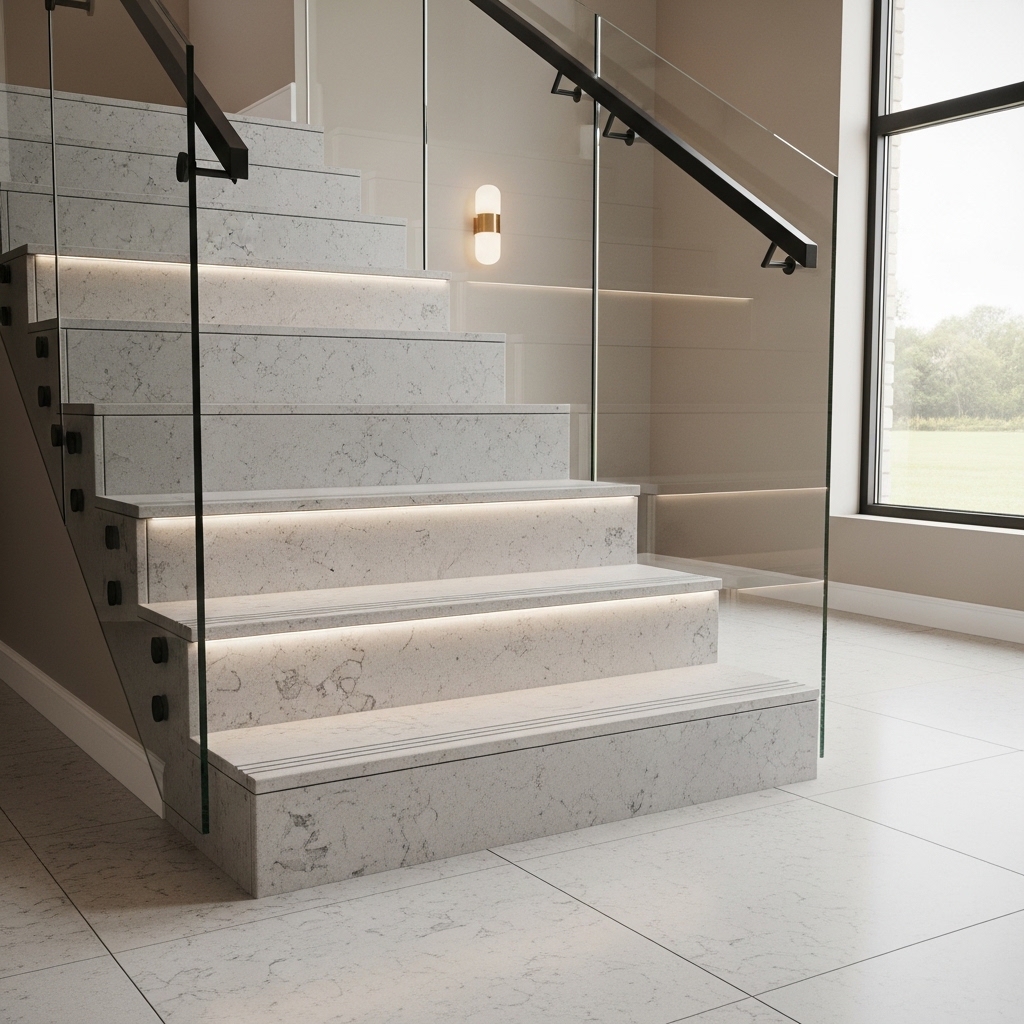
Standard kitchen countertop measurements can guide stair planning when the same slab material or design language is carried from the kitchen into the staircase for continuity in open-plan layouts.
Many kitchens use common benchmarks such as countertop height around 900 mm and depth around 600 mm (typical examples), and these reference lines help align seams and pattern direction near the stair entry zone.
For example, if the island uses a clean waterfall edge, the stair landing can mirror that idea by using a single dominant landing panel and pushing seams to the perimeter edges.
Even when kitchens use thinner vertical cladding panels, stair treads usually need robust thickness (often 20 mm) because steps face constant impact and abrasion.
Coordinating finish level and edge profile between the kitchen surface and the stair tread nose helps the transition feel intentional and consistently detailed.
The standard size of kitchen countertop in UAE residences typically features a depth of 600–650 mm, island widths of 900–1200 mm, and a working height around 900–950 mm including the stone. These proportions are optimized for daily use and appliance integration. To achieve seamless looks on wider layouts, planners often consider the size of jumbo quartz slabs during material selection.
Standard Size of Kitchen Countertop Planning with Self Leveling Prep
Standard size of kitchen countertop planning with self leveling prep generally starts with depths of 600–650 mm, island widths of 900–1200 mm, and working heights close to 900–950 mm. These standards ensure ergonomic comfort and efficient slab usage. Before installation, applying self leveling compounds is essential to create a perfectly flat base, especially when installing large-format slabs that demand precise alignment.
Standard Size of Kitchen Countertop Alignment with Raised Floors
Granite tiles size standards are widely used in projects that incorporate a raised floor due to their modular compatibility. Common tile sizes such as 600 × 600 mm and 800 × 800 mm align well with access floor grids, allowing easy removal for underfloor services without disrupting the overall design.