
Stone Slab Size Guide
Stone slab size (natural stone slabs for countertops) is generally described in ranges because each quarry and bundle can differ, but many common countertop slabs fall around 108–120 in long × 60–72 in wide (274.32–304.80 cm × 152.40–182.88 cm). Larger slabs can be around 126 in × 78 in (320.04 cm × 198.12 cm) when available, and smaller half-slabs are often about 96 in × 48 in (243.84 cm × 121.92 cm) for compact projects or vanities. Standard stone slab thickness is typically 2 cm (0.79 in / 20 mm) or 3 cm (1.18 in / 30 mm), with 1.5 cm (0.59 in / 15 mm) sometimes used for backsplashes, wall cladding, and lighter installations.

Regular Size
108–120 in × 60–72 in, thickness 0.79 in (2 cm) or 1.18 in (3 cm).
Jumbo Size
126 in × 78 in, thickness 0.79 in (2 cm) or 1.18 in (3 cm).
Super Size
138 in × 78 in, thickness 0.79 in (2 cm) or 1.18 in (3 cm).
Super Jumbo
138 in × 78 in, thickness 0.79 in (2 cm) or 1.18 in (3 cm).
Mini Slab
96 in × 48 in, thickness 0.79 in (2 cm) or 1.18 in (3 cm).
Natural-Stone Sheet Measurements Guide
When embarking on a natural-stone project, understanding sheet measurements is crucial for achieving the desired outcome.
First, consider the project dimensions; for instance, a kitchen countertop typically requires slabs measuring 108” x 56”, while a bathroom vanity may need smaller dimensions around 72” x 36”.
Next, the desired aesthetic plays a significant role; whether opting for a sleek, modern look with large, continuous slabs or a more traditional appearance with smaller tiles, the measurements will vary accordingly.
Budget constraints are also a key factor; natural stone can range from $50 to $200 per square foot, so selecting the right size can help optimize costs.
Additionally, the fabricator’s expertise should not be overlooked; some may specialize in intricate designs that require precise measurements, while others may excel in larger, simpler installations.
Lastly, specific design requirements, such as cutouts for sinks or intricate edge profiles, will necessitate careful planning of sheet measurements to ensure a seamless fit and finish. By considering these elements, one can effectively navigate the complexities of natural-stone sheet measurements for a successful project outcome.
Natural-Stone Slab Measurements: Jumbo Advantages
Natural-stone sheet measurements offer several advantages that enhance both the selection process and the installation of stone surfaces.
One significant benefit is the ability to utilize larger slabs, often referred to as jumbo slabs, which can measure up to 126 inches by 76 inches. This size reduces the number of seams required in a project, resulting in a more seamless and aesthetically pleasing finish.
Additionally, larger slabs can minimize waste, as they allow for more efficient use of the material, potentially saving costs on both the stone itself and the labor involved in cutting and fitting smaller pieces.
The precise measurements provided by a natural-stone slab measurements guide ensure that fabricators can accurately plan and execute their designs, leading to a better fit and finish.
Furthermore, understanding the thickness of the slabs, which typically ranges from 2 cm to 3 cm, helps in determining the appropriate support structures needed for countertops and other installations, ensuring durability and longevity.
Overall, the advantages of natural-stone sheet measurements and the use of jumbo slabs contribute to a more efficient, cost-effective, and visually appealing outcome in stone projects.
Stone Slab Material: General Wastage Range
Stone slab material is widely used in construction and design due to its durability and aesthetic appeal. However, the general wastage range during the processing and installation of stone slabs can vary significantly, typically falling between 5% to 15%. This wastage can be attributed to several factors, including cutting, shaping, and transportation.
During the cutting process, approximately 10% of the material may be lost due to saw blade width and imperfections in the stone. Additionally, handling and transportation can lead to further losses, especially if the slabs are not adequately protected.
To minimize wastage, it is crucial to plan the layout of the slabs carefully, ensuring that cuts are optimized and that the most significant pieces are utilized effectively. Employing skilled labor for installation can also reduce the risk of damage.
Ultimately, understanding the general wastage range and implementing strategies to mitigate it can lead to more efficient use of stone slab materials, resulting in cost savings and a more sustainable approach to construction.
Stone Slab Materials: Largest Format Available
Stone slab materials have gained immense popularity in recent years, particularly due to their aesthetic appeal and versatility in various applications. Among the various types of stone slabs available, the largest formats are particularly noteworthy. These expansive slabs can measure up to 10 feet by 5 feet or even larger, allowing for seamless installations that create a striking visual impact.
One of the most significant advantages of using large-format stone slabs is the reduction of grout lines, which not only enhances the overall appearance but also simplifies maintenance. With fewer seams, there is less opportunity for dirt and grime to accumulate, making cleaning a breeze. Additionally, the uniformity of large slabs can create a more cohesive look, whether used in countertops, flooring, or wall cladding.
Materials such as granite, marble, quartzite, and even engineered stones are available in these large formats. For instance, a granite slab measuring 10 feet by 5 feet can weigh upwards of 1,000 pounds, necessitating careful handling and installation. The durability of these materials ensures that they can withstand the rigors of daily use while maintaining their beauty over time.
Moreover, the trend towards open-concept living spaces has fueled the demand for larger stone slabs, as homeowners seek to create fluid transitions between different areas of their homes. The ability to use a single slab for an entire kitchen island or a continuous backsplash can significantly enhance the design aesthetic.
In terms of cost, while large-format stone slabs may come with a higher price tag due to their size and the complexity of installation, the long-term benefits often outweigh the initial investment. Homeowners and designers alike recognize that the visual impact and durability of these materials can elevate a space, making them a worthwhile consideration for any renovation or new construction project.
In conclusion, the availability of large-format stone slabs has revolutionized the way we approach interior design and architecture. Their impressive dimensions, coupled with the natural beauty of stone, provide endless possibilities for creating stunning environments that are both functional and visually appealing. As technology continues to advance, we can expect to see even larger formats and innovative designs that push the boundaries of what is possible with stone materials.
Stone Slab Materials: Thickness for High-Traffic Floors
Stone slab materials are increasingly popular for high-traffic floors due to their durability and aesthetic appeal. When selecting stone slabs for such applications, thickness is a crucial factor to consider. Typically, stone slabs range from 1.25 inches (3 cm) to 2 inches (5 cm) in thickness. For high-traffic areas, a thickness of at least 1.5 inches (4 cm) is recommended to ensure the material can withstand the constant wear and tear.
The thickness of the stone slab directly influences its strength and longevity. Thicker slabs are less prone to cracking and chipping, which is essential in environments such as commercial spaces, airports, and shopping malls where foot traffic is heavy. For instance, a 2-inch thick granite slab can support a significant amount of weight and is less likely to show signs of wear over time compared to a thinner option.
Moreover, the installation process for thicker slabs may require additional considerations, such as the need for a more robust subfloor to support the weight. It is also important to ensure that the installation is performed by professionals who understand the nuances of working with heavy stone materials.
In addition to thickness, the type of stone also plays a role in performance. For example, granite and quartzite are known for their hardness and resistance to scratching, making them ideal for high-traffic areas. On the other hand, softer stones like marble may not be suitable unless they are treated with sealants to enhance their durability.
Ultimately, when choosing stone slab materials for high-traffic floors, it is essential to balance aesthetics with functionality. Selecting the right thickness, along with the appropriate type of stone, will ensure that the flooring not only looks beautiful but also stands the test of time in demanding environments.
Stone slab measurement guide for walls & decorative surfaces
A stone slab measurement guide for walls emphasizes choosing panel sizes that balance visual impact with safe handling, while coordinating seams with architectural lines for a refined finish.
Many stone slabs are cut into large panels to reduce joints, but the final panel sizes are often determined by site access, lifting limits, and the substrate’s ability to support the system.
Thickness selection is a key part of measurement planning, as wall-friendly thickness helps manage load while still delivering the premium slab aesthetic on vertical surfaces.
For example, a wall can be planned with fewer large panels in the focal zone and smaller returns at edges, placing seams at corners or within shadow gaps to keep them discreet.
Accurate measurement also includes joint allowances, edge finishing details, and precise cut-outs so the installation fits cleanly and remains visually consistent across the elevation.
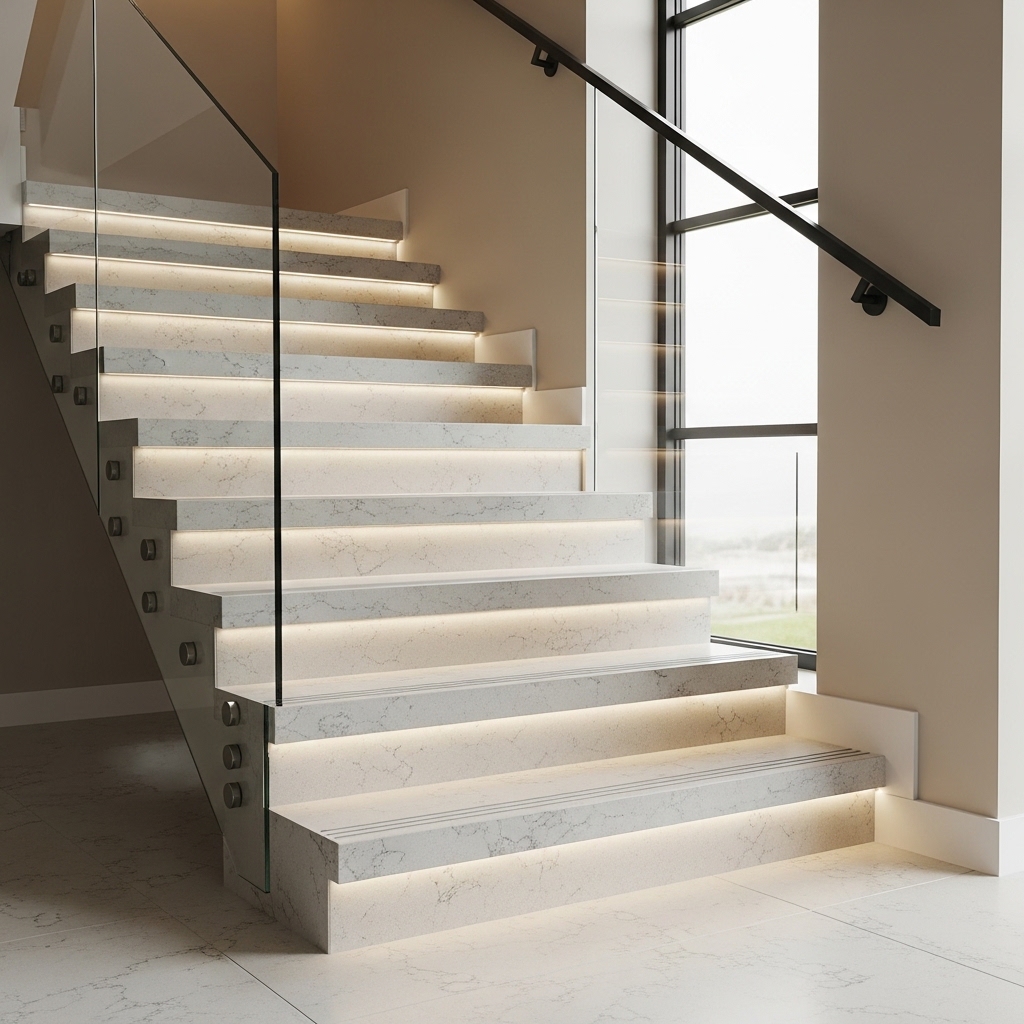
Stone slab measurement guide for stairs
A stone slab measurement guide for stairs covers the universal planning steps that apply across stone types: measure stair geometry, choose slab format, map cuts, and control seams and edge detailing.
Start with tread depth, riser height, flight width, and landing sizes, then plan which surfaces must appear continuous—typically the landing and the main tread faces.
For example, selecting a larger slab format can keep the landing seam-free, while repeated tread cuts are nested around it to improve yield and maintain consistent pattern direction.
Treads are commonly specified at durable thickness (often 20–30 mm depending on stone and design), and edges are finished with eased or chamfered profiles to protect the step nose.
The guide also includes tolerances and consistent joint gaps so the staircase installs straight and looks refined from every viewing angle.
Stone slab size in the UAE refers to the overall dimensions of natural or engineered stone before fabrication, most commonly ranging from 2800–3200 mm in length and 1400–1800 mm in width. Knowing these limits early helps control seam placement and waste. For engineered surfaces, this planning often includes checking the quartz countertop size that best fits the layout.
Stone Slab Size Guide for Seamless Marble Countertops
A stone slab size guide for seamless marble countertops usually recommends slabs around 2800–3200 mm in length and 1400–1800 mm in width to reduce joint lines on long surfaces. Larger slabs help create uninterrupted worktops and islands with consistent veining. Selecting the right slab size is essential for achieving premium-quality marble countertops with a clean, continuous finish.
Stone Slab Size Guide for Raised Floor Fit-Outs
A stone slab size guide helps designers plan efficient fit-outs over a raised floor. Slabs averaging around 3000 × 1500 mm are commonly used, as they can be cut into panels or surfaces that match raised floor grids. Following a size guide reduces waste and improves installation accuracy.