
What is the Standard Quartz Slab Size?
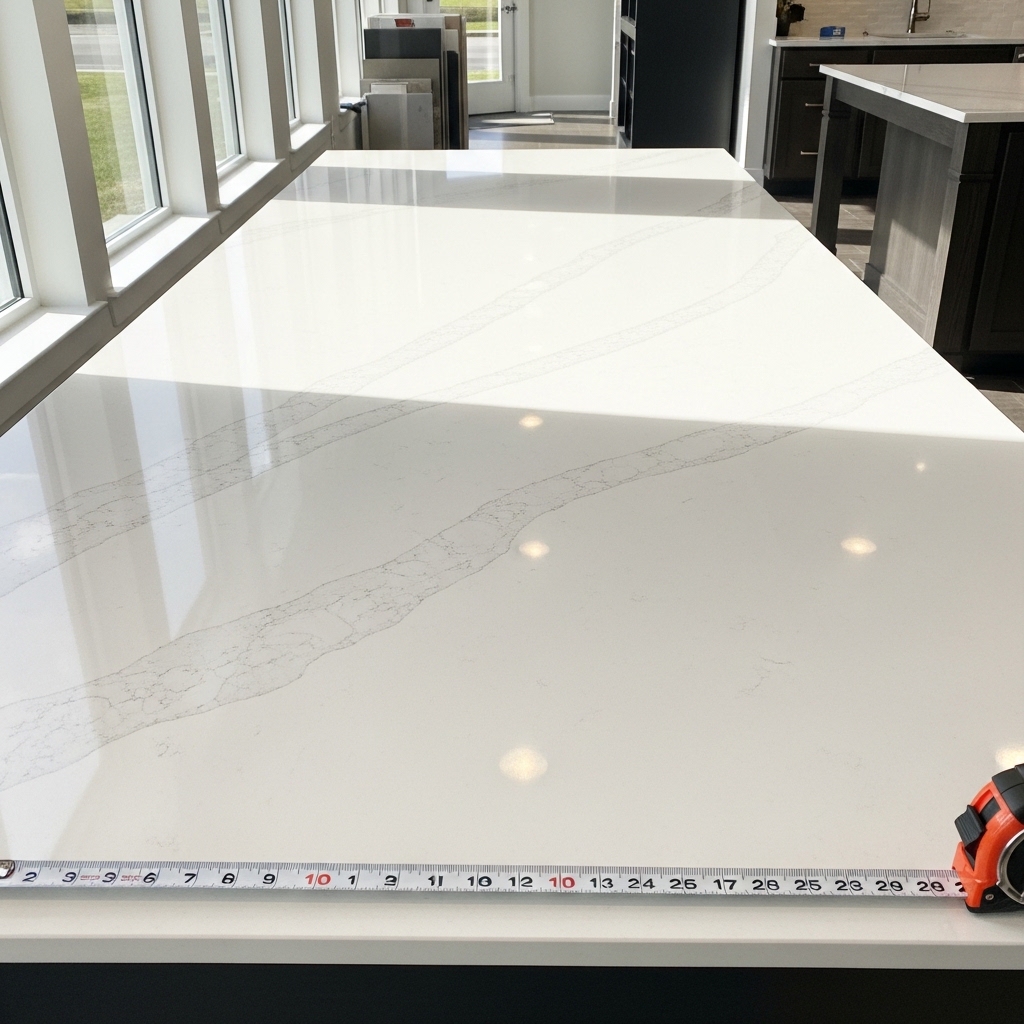
The standard quartz slab size is most commonly the widely stocked “standard” format of 56 in × 120 in (142.24 cm × 304.80 cm), which many fabricators treat as the baseline slab for planning cuts and seams in typical kitchens and vanities. For larger layouts, suppliers often move to jumbo sizes, but the 56 in × 120 in slab remains the standard reference size across many brands. Standard quartz slab thickness is usually 2 cm (0.79 in / 20 mm) or 3 cm (1.18 in / 30 mm, often sold as “1¼ in” nominal), with some product lines also available in thinner 12 mm (0.47 in / 1.2 cm) options for specific applications.
Regular Size
56 in × 120 in, thickness 0.79 in (2 cm) or 1.18 in (3 cm).
Jumbo Size
63 in × 126 in, thickness 0.79 in (2 cm) or 1.18 in (3 cm).
Super Size
78 in × 138 in, thickness 0.79 in (2 cm) or 1.18 in (3 cm).
Super Jumbo
137.80 in × 78.74 in, thickness 0.79 in (2 cm) or 1.18 in (3 cm).
Mini Slab
48 in × 96 in, thickness 0.79 in (2 cm) or 1.18 in (3 cm).
Picking the Standard Quartz Format
When selecting the standard quartz format for a project, it is essential to consider various factors that influence the final outcome.
Project dimensions play a crucial role; for instance, larger surfaces such as kitchen countertops may require slabs that are at least 120 inches long to minimize seams, while smaller applications like bathroom vanities can utilize 60-inch slabs.
The desired aesthetic is another significant factor; quartz comes in a wide range of colors and patterns, so if a sleek, modern look is preferred, a polished finish with a solid color may be ideal, whereas a more rustic design might benefit from a textured or veined pattern.
Budget constraints must also be taken into account, as quartz prices can range from $50 to $150 per square foot, depending on the quality and brand.
Additionally, the fabricator’s expertise is vital; choosing a fabricator experienced in handling large slabs can ensure better installation and fewer issues with cracking or chipping.
Finally, specific design requirements, such as the need for integrated sinks or custom edges, should be discussed with the fabricator to ensure that the chosen quartz format can accommodate these features without compromising the overall design.
Standard Quartz Format: Why Upgrade to Jumbo
The Standard Quartz Format offers numerous advantages for those seeking a reliable and efficient solution for their timekeeping needs.
One of the primary benefits is its accuracy; standard quartz movements typically maintain an accuracy of ±15 seconds per month, making them far superior to mechanical watches.
Additionally, the Standard Quartz Format is generally more affordable, with prices ranging from $20 to $200, depending on the brand and features.
For those considering an upgrade, the Jumbo Quartz Format presents an enticing option.
Jumbo watches often feature larger cases, which not only enhance visibility but also allow for more intricate designs and additional functionalities, such as chronographs or multiple time zones.
The larger size can also improve battery life, with some Jumbo models lasting up to 5 years on a single battery, compared to the 2-3 years typical of standard models.
Furthermore, the Jumbo format appeals to fashion-conscious consumers, as it often aligns with current trends favoring bold, oversized accessories.
Ultimately, whether one opts for the Standard Quartz Format or upgrades to Jumbo, both choices provide exceptional reliability and style, catering to a wide range of preferences and budgets.
Standard Quartz Material: Waste Margin Guide
Standard Quartz Material is increasingly popular in the construction and design industries due to its durability and aesthetic appeal. When working with this material, understanding the waste margin is crucial for effective project management and cost control. Typically, a waste margin of 10% to 15% is recommended for standard quartz installations. This margin accounts for potential errors during cutting, unforeseen damages, and variations in the material. For instance, if a project requires 100 square feet of quartz, it is advisable to order between 110 to 115 square feet to ensure that there is enough material to complete the job without delays. Additionally, factors such as the complexity of the design, the size of the slabs, and the skill level of the installers can influence the waste margin. It is essential to communicate with suppliers and installers to determine the most accurate waste margin for specific projects, as this can lead to significant cost savings and a smoother installation process. Proper planning and consideration of these factors can enhance the overall efficiency and success of quartz material applications in various settings.
Standard Quartz Material: Largest Format Explained
Standard quartz material has gained significant popularity in the realm of interior design and architecture, particularly due to its versatility and aesthetic appeal. One of the most notable advancements in this material is the introduction of large format quartz slabs. These slabs can measure up to 126 inches in length and 63 inches in width, allowing for expansive surfaces that minimize seams and create a seamless look in various applications.
The largest format quartz slabs are not only visually striking but also practical. They are engineered to be durable and resistant to scratches, stains, and heat, making them ideal for high-traffic areas. This durability is particularly beneficial in kitchens and bathrooms, where surfaces are frequently exposed to moisture and potential damage.
Moreover, the large format allows for greater design flexibility. Designers and homeowners can achieve a more cohesive look by using fewer seams, which can often disrupt the flow of a space. This is especially important in open-concept designs where continuity is key. The ability to create expansive countertops, backsplashes, and even wall cladding with minimal interruption enhances the overall aesthetic of a room.
In terms of maintenance, large format quartz slabs are relatively easy to care for. They require simple cleaning with mild soap and water, making them a practical choice for busy households. Additionally, the non-porous nature of quartz means that it does not harbor bacteria or mold, contributing to a healthier living environment.
As the demand for large format quartz continues to rise, manufacturers are innovating to produce a wider variety of colors and patterns. This allows for greater customization and personalization in design projects. From sleek, modern looks to more traditional styles, the options are virtually limitless, catering to diverse tastes and preferences.
In conclusion, the evolution of standard quartz material into large format slabs represents a significant trend in the industry. With their combination of durability, aesthetic appeal, and ease of maintenance, these slabs are poised to remain a popular choice for both residential and commercial applications. As designers and homeowners continue to seek out innovative solutions for their spaces, large format quartz will undoubtedly play a pivotal role in shaping the future of interior design.
Standard Quartz Material: Thickness for Busy Floors
Standard quartz material is increasingly favored for busy floors due to its durability and aesthetic appeal. Thickness plays a crucial role in determining the performance and longevity of quartz surfaces in high-traffic areas. Typically, quartz slabs come in various thicknesses, with the most common being 1 cm (0.39 inches), 2 cm (0.79 inches), and 3 cm (1.18 inches). For busy floors, a thickness of 2 cm is often recommended, as it strikes a balance between strength and weight, making it suitable for both residential and commercial applications.
The 2 cm thickness provides enhanced resistance to impacts and heavy loads, which is essential in environments such as retail stores, restaurants, and airports where foot traffic is constant. Additionally, thicker slabs can withstand the wear and tear associated with heavy equipment and furniture, reducing the likelihood of chipping or cracking over time.
Moreover, the aesthetic versatility of quartz allows it to be engineered in various colors and patterns, making it an attractive choice for designers looking to create visually appealing spaces. The non-porous nature of quartz also means that it is resistant to staining and easy to clean, further enhancing its suitability for busy floors.
In summary, when selecting standard quartz material for high-traffic areas, opting for a thickness of 2 cm is advisable. This thickness not only ensures durability and longevity but also maintains the visual appeal that quartz is known for, making it an ideal choice for busy environments.
Standard quartz slab measurement guide for walls & decorative surfaces
A standard quartz slab measurement guide for wall use typically begins with selecting a widely available slab format and then planning cuts to minimize seams in the most visible areas.
Common standard formats include 3000 × 1400 mm and 3200 × 1600 mm, which offer enough coverage for feature walls, fireplace cladding, and tall backsplashes with fewer joints.
For vertical installations, thickness is often specified in 6–12 mm to manage weight, while 20 mm can be chosen when edges, reveals, or matching countertop profiles are important.
As a quick example, a 3200 × 1600 mm slab (~5.12 m²) can reduce seam count on a wall elevation compared to smaller panels, helping veining patterns look more continuous.
Layout mapping usually includes consistent joint spacing, seam placement on architectural breaks, and sequencing panels for pattern continuity across the wall.
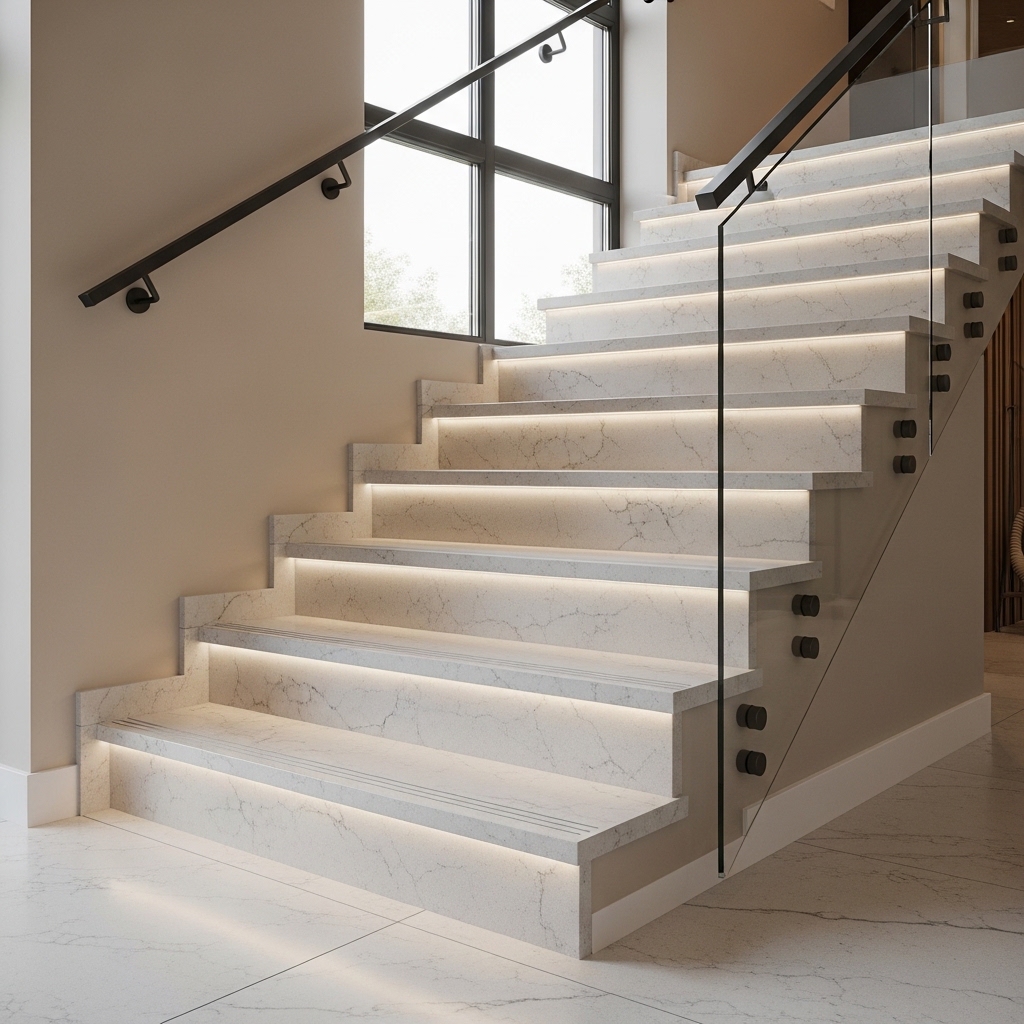
Standard quartz slab measurement guide for stairs
A standard quartz slab measurement guide for stairs focuses on using widely available slab formats and a repeatable cut plan to keep the flight uniform and easy to fabricate.
Common standard slab examples include 3000 × 1400 mm and 3200 × 1600 mm, which can yield multiple tread pieces and risers while maintaining consistent shade from one batch.
For example, a 3000 × 1400 mm slab (~4.2 m²) can often be nested for several treads, while a larger 3200 × 1600 mm slab (~5.12 m²) may improve yield for landings or wider flights.
Stair treads are commonly specified around 20 mm thickness, and the step nose is typically eased or chamfered to reduce chipping risk over time.
A clean result depends on uniform joint gaps, consistent cut orientation, and seam placement away from the center of landings where joints are most noticeable.
When customers ask what is the standard quartz slab size in the UAE, suppliers typically point to dimensions around 3040 × 1440 mm as the most widely stocked option, with 20 mm thickness as standard. This size supports common counter depths and simplifies fabrication planning for most homes. Understanding this baseline also helps when reviewing different quartz slabs size options across brands and collections.
What Is the Standard Quartz Slab Size for Door Marble Threshold Work
When asking what is the standard quartz slab size for door marble threshold work, most suppliers reference slabs measuring approximately 3040 × 1440 mm with a standard thickness of 20 mm. These slabs provide ample material to fabricate countertops and matching transition pieces from the same batch. Producing a consistent door marble threshold from quartz slab offcuts ensures color uniformity and smooth level changes between rooms.
What Is the Standard Quartz Slab Size for Raised Floor Design
When asking what is the standard quartz slab size for effective raised floor design, the most common answer is approximately 3040 × 1440 mm. This size balances ease of handling with sufficient coverage for most interior applications. It also integrates well with access floor grids, supporting precise height coordination and seamless finishes.